
blancdechine.org
Scan to access the online edition
WH-GR-2026-001 · Public Release
中国白
A Cross-Civilizational Study of Dehua White Porcelain
德化白瓷跨文明研究报告
This report represents no commercial interest, contains no product promotion or investment advice. All data sources are cited.
© 2026 World Headlines Inc. All Rights Reserved.
Dehua Blanc de Chine is the only porcelain tradition in human history that treats “whiteness” itself as the ultimate aesthetic end. From the stamped stoneware at Liaotian Jianshan kiln site in Sanban Township (Shang–Zhou period) to the 76-billion-yuan industrial cluster of 2025, the lineage spans thirty-seven centuries, unbroken. Its material foundation — a unique clay body with Fe₂O₃ below 0.5% and K₂O reaching 6.5–7.3% — produces a warm translucency that no other porcelain-producing region can chemically replicate.
Between the late sixteenth century and the mid-eighteenth century, more than three million pieces of Dehua porcelain entered Europe via Portuguese merchant vessels, the Dutch East India Company, and the Manila galleons, directly catalysing the founding of European porcelain factories at Meissen, Saint-Cloud, Chelsea, and elsewhere. The DNA of the European ceramics industry traces to Dehua.
This report, jointly produced by the New York headquarters and China operations team of World Headlines, employs an eight-language parallel retrieval and cross-verification methodology (Chinese, English, French, German, Dutch, Japanese, Portuguese, Spanish) across twelve analytical dimensions. Data cutoff: April 2026. The report represents no commercial interest, contains no product promotion or investment advice.
This document aims to be the most dimensionally comprehensive, linguistically broad, and primary-source-dense public research report on Dehua Blanc de Chine available worldwide as of 2026.
德化白瓷是人类陶瓷史上唯一以“白”本身作为终极审美目标的瓷器体系。从商周时期三班镇辽田尖山窑址的印纹陶算起,这条线索绵延三千七百年,至今未断。它的物质根基——氧化铁含量低于0.5%、氧化钾高达6.5—7.3%的独特瓷土——赋予成品一种其他产区在化学层面无法复制的温润透光性。十六世纪末至十八世纪中叶,经由葡萄牙商船、荷兰东印度公司和马尼拉大帆船,超过三百万件德化瓷器进入欧洲,直接触发了梅森、圣克卢、切尔西等欧洲瓷厂的诞生——欧洲瓷器工业的DNA源头,在德化。
本报告由World Headlines纽约总部与中国运营团队联合完成,采用八语种平行检索与交叉验证方法(中、英、法、德、荷兰、日、葡萄牙、西班牙),以十二个维度覆盖历史演进、何朝宗全球图谱、沉船考古、欧洲仿制证据链、材料科学、拍卖市场、跨文化语义学、产业经济、国际奢瓷对标、当代艺术、政策制度和情景推演。数据截止2026年4月。报告不代表任何商业实体利益,不包含产品推广或投资建议。
Keywords
Blanc de Chine · Dehua white porcelain · He Chaozong · Maritime Silk Road · UNESCO World Heritage · ceramics industry cluster · Meissen · cross-cultural transmission · materials science · auction market · brand strategy · 中国白
From Shang-Zhou to 2025: thirty-seven centuries of white
| Report No. | WH-GR-2026-001-DIM01 |
| Part of | WH-GR-2026-001 |
| Version | 1.0 (Initial Public Release) |
| Published | April 2026 |
| Data Cutoff | April 2026 |
| Lead Researcher | Jack Lin |
| Publisher | World Headlines Inc., Manhattan, New York |
| Review Status | Internal research review; not externally peer-reviewed |
| License | CC BY-NC 4.0 International |
| Persistent ID | 10.5281/zenodo.19519691 |
Stamped stoneware excavated at the Liaotian Jianshan kiln site in Sanban Township, confirmed by radiocarbon dating and typological comparison, pushes the upper limit of Dehua ceramic production back from the conventionally cited Tang-Song period to approximately 3,700 years ago. Between these grey-brown shards and the ivory-white porcelain that would later captivate Europe lies over two millennia of technical evolution—yet the production site never moved. The path from clay deposit to kiln mouth has run through the same valley for thirty-seven centuries.
What does this temporal depth signify? Jingdezhen’s ceramic tradition, counted from the Eastern Han, spans roughly two thousand years. Meissen has operated since 1710—316 years. Dehua’s 3,700 years are nearly twelve times that of Meissen.
This chronological span does not by itself constitute a quality argument, but as an archaeological fact it is unfalsifiable.
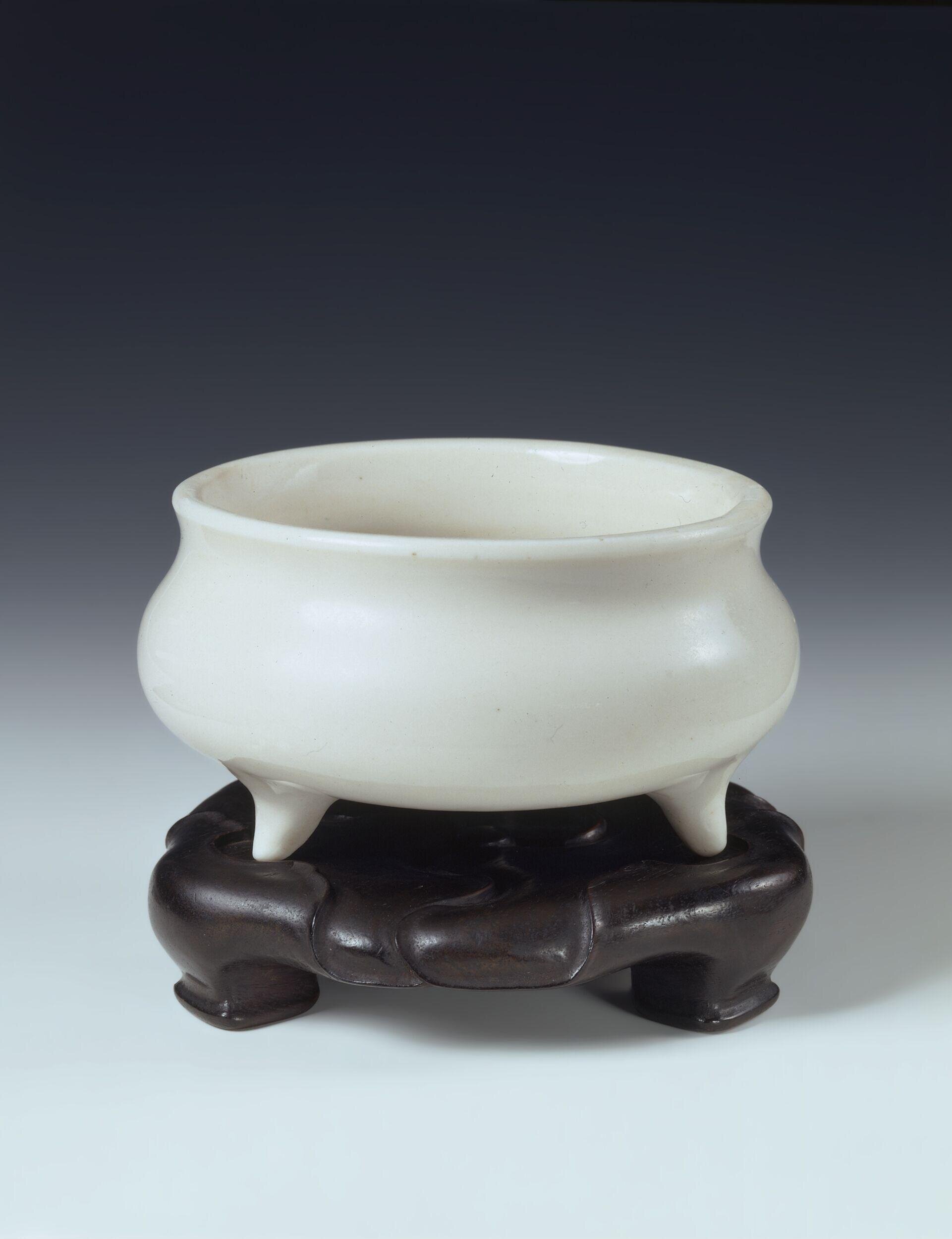
The archaeological excavation of the Wanpinglun kiln site has provided the clearest stratigraphic evidence for the early development of the Dehua kilns. Its 4.7-metre cultural deposit yielded thirteen bronze coins—Northern Song issues including Taiping Tongbao, Zhidao Yuanbao, Xianping Yuanbao, and Jingde Yuanbao—distributed across successive layers, forming a chronological ruler calibrated to individual reign titles.
Coin-based dating is a standard method in Chinese archaeology, but the Wanpinglun assemblage is distinctive in that thirteen coins were recovered from different strata, producing not a single-point date but a continuous time-series. This allows ceramic stylistic evolution to be tracked layer by layer across a substantial span of occupation.
Information extracted from the Wanpinglun stratigraphy, combined with typological comparisons from other sites, confirms over three hundred kiln sites within Dehua County during the Song-Yuan period. Three hundred kilns concentrated within a single county.
The excavation of the Qudougong kiln site fundamentally revised scholarly understanding of Yuan-dynasty Dehua production.
One dragon kiln (jilongyo), surviving to a length of 57.1 metres. 6,793 excavated objects. These two figures speak for themselves: this was no artisanal workshop but a production facility of considerable capacity. The critical evidence is the discovery of saggars inscribed with ‘Phags-pa Mongolian script—saggars are the ceramic containers used to protect wares during firing. The ‘Phags-pa script was promulgated as the official script of the Yuan court under Kublai Khan and fell out of use when the Yuan fell, thereby locking the kiln’s active period to the Yuan dynasty (1271–1368).
The scale of a 57.1-metre kiln reflects the pull of market demand. Yuan-dynasty Quanzhou (known as Zayton) was one of the world’s largest ports—Marco Polo called it the greatest port in the world; Ibn Battuta described it in comparable terms. Dehua lies approximately 100 kilometres from Quanzhou. A 27.5-kilometre overland road built in 974 (the 7th year of Song Kaibao) connected the kiln district to the port. The establishment of the Quanzhou Maritime Trade Office in 1087 (the 2nd year of Yuanyou) institutionalised overseas trade administration, giving Dehua porcelain a formal channel into international markets.
The whiteness of Dehua porcelain is a direct consequence of clay chemistry.
X-ray fluorescence (XRF) data published by Li Weidong in Ceramics International (37: 651–658, 2011) provide the precise chemical fingerprint of Ming-dynasty Dehua porcelain bodies:
| Component | Dehua Ming-Dynasty Body |
|---|---|
| SiO₂ | 71.8—74.2% |
| Al₂O₃ | 15—18% |
| K₂O | 6.5—7.3% |
| Fe₂O₃ | <0.5% |
Fe₂O₃ below 0.5%—iron is the decisive variable in porcelain colouration. Jingdezhen clays contain significantly higher iron; they must be fired in a reducing atmosphere to suppress iron colouration, and the slightest kiln irregularity produces yellowing or greying. Dehua’s low-iron clay permits firing in an oxidising atmosphere. Nigel Wood’s analysis in Chinese Glazes (2007) is definitive: it is precisely this oxidising atmosphere that gives Dehua its characteristic warm ivory tone, distinct from Jingdezhen’s cooler white or bluish-white.
K₂O reaching 6.5–7.3%—the high potassium content promotes glass-phase formation, yielding exceptional translucency. Hold a Ming-dynasty Dehua cup against a light source and the light passing through the wall takes on a warm orange-red hue—the optical signature of the high-potassium glass phase.
(For the full materials-science analysis, see Chemical Fingerprint of Dehua White Porcelain. This section establishes only the causal starting point.)
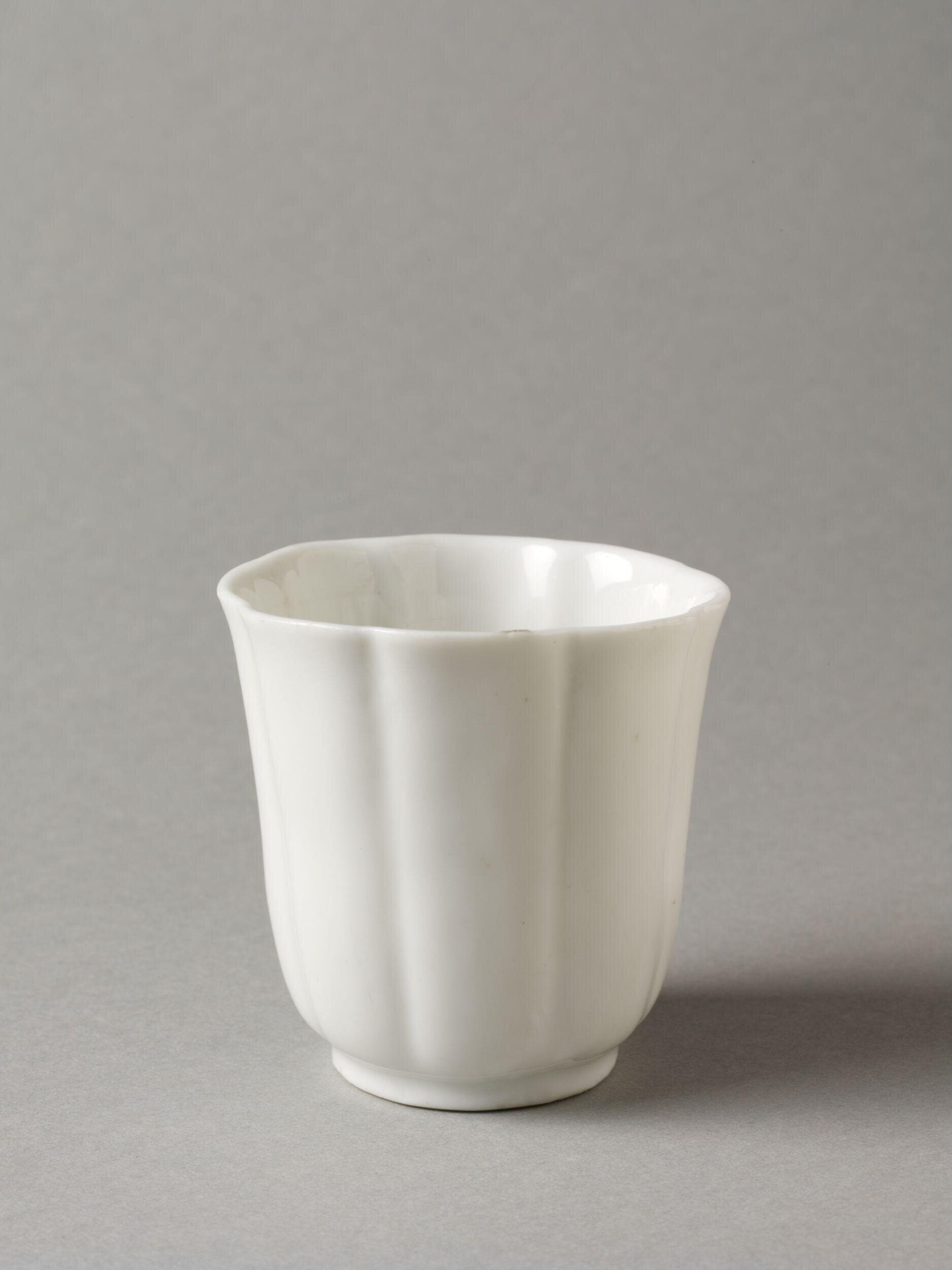
The China Intangible Cultural Heritage Network classifies Dehua porcelain into four developmental phases—a framework corroborated by the chemical data:
Phase I: Qingbai Period (Song–Yuan)—relatively higher iron content in the clay; reduction firing produces a bluish-white (qingbai) tone. Wares excavated at Wanpinglun and Qudougong belong to this phase.
Phase II: Ivory-White Zenith (Mid-to-Late Ming)—Fe₂O₃ falls to its nadir, K₂O rises to its apex, and oxidation-firing technique matures. He Chaozong was active during this period. The Chinese colour-spectrum names “lard white” (zhuyoubai) and “ivory white” (xiangyabai) designate the zenith products of this phase.
Phase III: Scallion-Root White Period (Qing)—Fe₂O₃ rises again; kiln architecture shifts from dragon kilns to stepped kilns (jiejiyao). The colour palette turns cooler and more greenish, with reduced translucency. The term “scallion-root white” (conggenbai) precisely captures this visual shift.
Phase IV: Modern Industrial Period (Republic to Present)—scientific formulation, electric and gas kilns replacing wood-fired kilns; whiteness is controllable but aesthetics have diversified.
Li Weidong’s XRF data trace the intersecting trajectories of declining Fe₂O₃ and rising K₂O from Song through Ming. The two curves meet at their optimal interval during the mid-to-late Ming—the ivory-white zenith was not accidental but the inevitable outcome of chemical evolution. After the Qing transition, Fe₂O₃ rose again, and the zenith ended irreversibly.
The Bamin Tongzhi (Comprehensive Gazetteer of Fujian), compiled during the Hongzhi reign of the Ming dynasty: “White porcelain vessels come from Dehua County.”
Seven characters. This is the earliest surviving local gazetteer entry to explicitly associate Dehua with white porcelain.
Song Yingxing’s Tiangong Kaiwu (The Exploitation of the Works of Nature, 1637) records that the Dehua kilns “fire only exquisite porcelain figures and curios”—note the phrasing: not bowls or utilitarian ware, but “exquisite figures and curios.” This aligns precisely with the historical reputation of the Dehua kilns for sculptural porcelain during the He Chaozong era.
Volume 5, Part 12 of Joseph Needham’s Science and Civilisation in China (authored by Rose Kerr and Nigel Wood, published 2004, 918 pages) remains the most authoritative English-language scholarship on Chinese ceramic technology. It provides an exhaustive analysis of the Dehua kiln system, chemical composition, and firing processes, and its scholarly authority in the field is unrivalled.
In the first year of Longqing (1567), the Ming court opened the port of Yuegang in Zhangzhou, lifting the maritime trade ban.
This policy reversal transformed the export landscape for Dehua porcelain. Before 1567, Dehua’s overseas trade operated in the grey zone between smuggling and tributary commerce. Once the sea ban was lifted, legitimate trade channels opened and production capacity was unleashed.
The archives of the Dutch East India Company (VOC) provide quantitative evidence. Between 1604 and 1657, the VOC shipped over three million pieces of Chinese porcelain to Europe, a substantial proportion of which was Dehua ware. In 1616, VOC employee Kr. Kohn specifically mentioned Dehua white porcelain in a letter. In 1644, Dutch annual orders reached 355,800 pieces.
Three trade routes carried Dehua white porcelain to the world:
The Portuguese Route (the earliest)—via Malacca, Goa, and Lisbon, introducing blanc de chine to the Iberian Peninsula and European courts. The Atalaia shipwreck (1647; see the Shipwreck Archaeological Database) provides physical evidence for this route.
The Dutch East India Company Route (the largest in volume)—via Batavia (modern Jakarta). Through its organisational commercial infrastructure, the VOC scaled the Dehua trade to the three-million-piece level.
The Manila Galleon Route (trans-Pacific)—from Quanzhou/Zhangzhou to Manila, then across the Pacific to Acapulco, Mexico. This route brought Dehua white porcelain into the Americas. The San Cristo de Burgos wreck (1693; see the Shipwreck Archaeological Database) sank on the North American segment of this route.
The English East India Company also participated in the Dehua trade. British records refer to Dehua Guanyin figures as “Sancta Marias”—mistaking Buddhist bodhisattvas for the Virgin Mary. This misidentification is itself a footnote to the cross-cultural semantics of white porcelain.
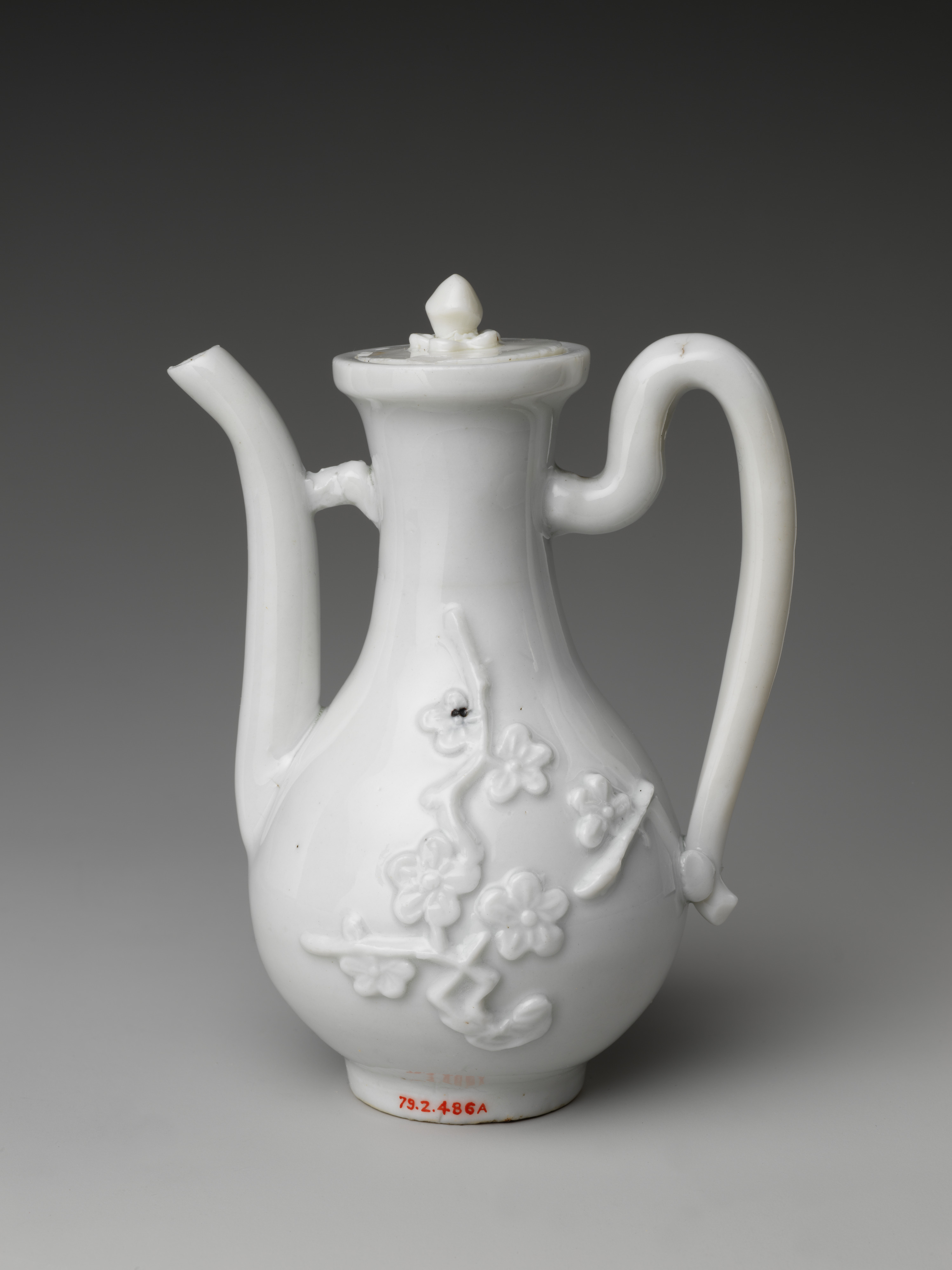
In 1862, the French art historian Albert Jacquemart used the term “blanc de Chine” in his writings to designate Dehua white porcelain. This is the earliest documented usage that can be traced.
Merriam-Webster records the first English usage in 1888.
“Blanc de Chine” literally means “white of China” in French. The trajectory of its adoption is a micro-history of cultural transmission: coined by a Frenchman, adopted by the English-speaking world, the French term became the international standard—while China itself only began systematically deploying this international name for cultural export purposes in relatively recent years.
In 2025, a doctoral thesis on Dehua white porcelain was defended at the Sorbonne—163 years after Jacquemart’s coinage, “blanc de Chine” remains the standard term in French-language scholarship.
On 25 July 2021, “Quanzhou: Emporium of the World in Song-Yuan China” was inscribed on the UNESCO World Heritage List. The Dehua kiln sites (Weilin–Neiban and Qudougong) were included among the 22 heritage components.
The significance of World Heritage status lies not in the honorific label but in the internationally recognised narrative framework it provides: the Dehua kilns were integral to the Song-Yuan global maritime trade system, and their products reached every major market in the known world. The policy implications and tourism multiplier effects of this framework are analysed in Policy and Institutional Frameworks.
According to the Dehua County Government’s profile published in March 2026, the output value of Dehua ceramics reached ¥76 billion RMB in 2025.
From Shang-Zhou stamped stoneware to a ¥76-billion industrial cluster, thirty-seven centuries compressed into a single dimension. The core thread is not complex: the same clay, the same valley, a kiln fire that has burned for thirty-seven centuries without interruption. Scale, technology, markets, and institutions have undergone fundamental transformations, but the core raw material—Dehua clay with Fe₂O₃ below 0.5%—has remained the material foundation of the region’s competitive advantage throughout.
Keywords
Blanc de Chine · Dehua Porcelain · Dehua White Porcelain · Chinese White Porcelain · Dehua Ware · He Chaozong · Ivory White · Lard White · Scallion-Root White · Qingbai Porcelain · Liaotian Jianshan Kiln · Wanpinglun Kiln · Qudougong Kiln · Dehua Kiln Archaeology · Maritime Silk Road · Export Porcelain · Trade Porcelain · Dutch East India Company · VOC · Longqing Sea Ban · Manila Galleon · Quanzhou UNESCO · Jingdezhen · Porcelain Capital · ¥76 Billion · Ceramics Industry · Ceramic Archaeology · Porcelain Dating
Global distribution, auction records and key scholars of He Chaozong's oeuvre
| Report No. | WH-GR-2026-001-DIM02 |
| Part of | WH-GR-2026-001 |
| Version | 1.0 (Initial Public Release) |
| Published | April 2026 |
| Data Cutoff | April 2026 |
| Lead Researcher | Jack Lin |
| Publisher | World Headlines Inc., Manhattan, New York |
| Review Status | Internal research review; not externally peer-reviewed |
| License | CC BY-NC 4.0 International |
| Persistent ID | 10.5281/zenodo.19519691 |
The birth and death dates of He Chaozong remain unresolved.
For an artist described by the 1763 Quanzhou Gazetteer as one whose works are “treasured by the whole world” (天下共宝之), this silence is itself revealing. Dehua's porcelain masters occupied an extraordinarily low position in China's traditional literati recording system. The assessment “treasured by the whole world” is the highest possible praise, yet the craftsman's social rank in the traditional hierarchy of written culture placed him near the bottom — works cherished, makers unrecorded. This contradiction runs through the entire history of Chinese craftsmanship.
Multiple scholarly positions exist regarding He Chaozong's dating: some place him in the Jiajing-to-Wanli reign (c. 1522–1600), others in the Chenghua-to-Jiajing period (c. 1465–1560), and still others argue for a Song-dynasty attribution (per the survey of competing views in Blumenfield 2002). Suzanne G. Valenstein, in A Handbook of Chinese Ceramics (Metropolitan Museum of Art, revised edition 1989, ISBN 0-87099-514-6), favoured a late-Ming dating. The positions stand in parallel, none supported by decisive evidence.
Donnelly discussed the question at length in his 1969 monograph Blanc de Chine. Blumenfield's 2002 assessment was more blunt — he used the word “shocking” to describe the paucity of biographical documentation for He Chaozong.
Blumenfield's choice of “shocking” is not without justification: an artist whose works are distributed across more than ten of the world's leading museums lacks, to this day, a single primary source that permits cross-verification of his life dates.
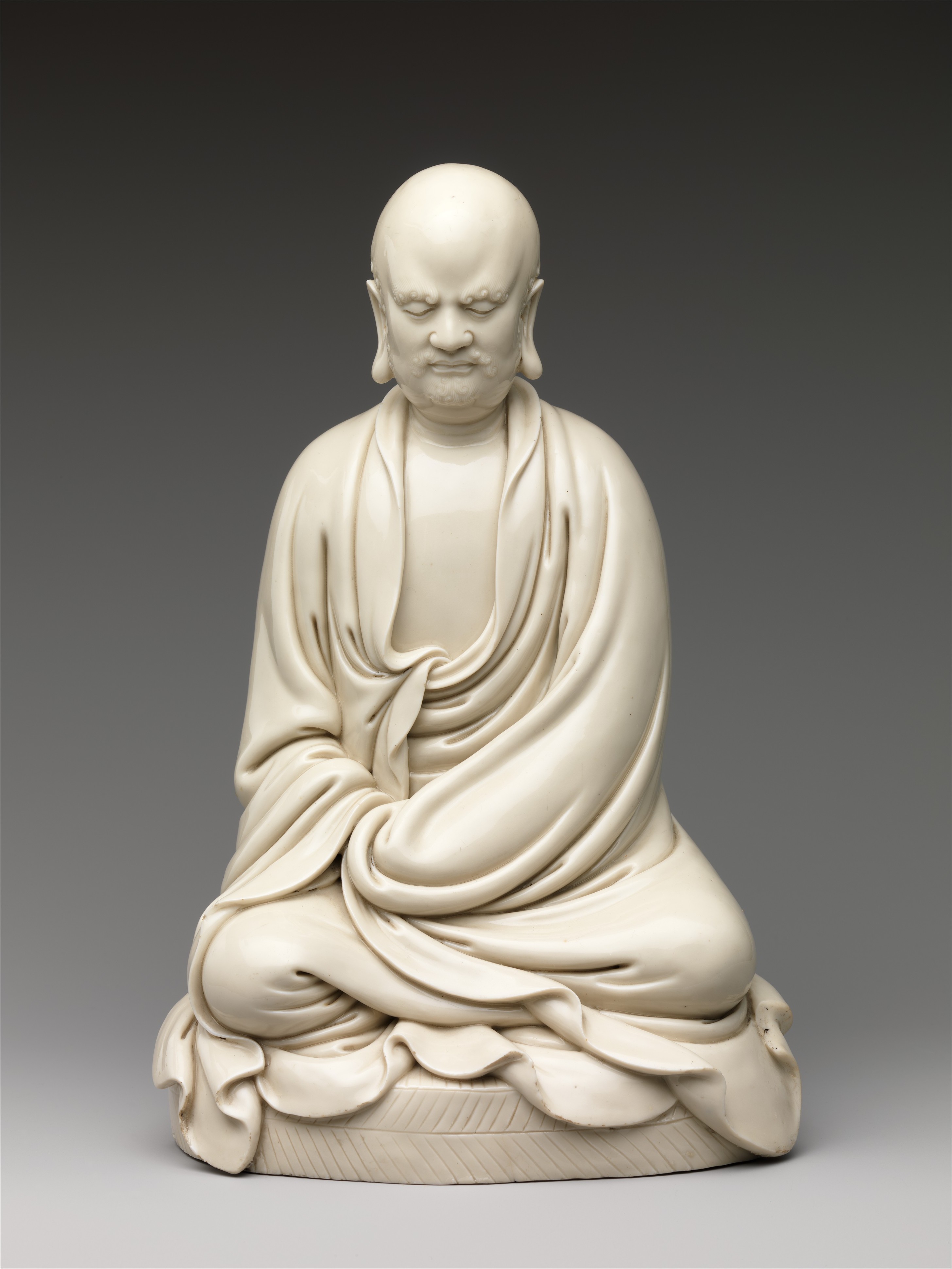
His family can be traced back to He Kunyuan, through He Shanfu, to He Chaozong as the ninth generation. This was a family that worked in porcelain sculpture for generations. The depth of He Chaozong's mastery is explained by hereditary transmission — he stood on the accumulated expertise of eight preceding generations.
He Chaozong's technical core is traditionally summarised in eight characters: niē, sù, diāo, kè, guā, jiē, tiē, xiū (pinching, moulding, carving, incising, scraping, joining, appliqué, finishing). His treatment of drapery folds synthesised two opposing aesthetites from the Chinese tradition — cáo yī chū shuǐ (“Cao's robes emerging from water,” the wet-clinging effect attributed to the Northern Qi painter Cao Zhongda) and wú dài dāng fēng (“Wu's sashes caught in the wind,” the billowing drapery style of the Tang-dynasty painter Wu Daozi). These two modes were regarded as polar opposites in the painting tradition; He Chaozong unified them in three-dimensional porcelain sculpture.
His seal marks fall into two categories: gourd-shaped seals and square seals. The distribution patterns and period attributions of these two types remain a focal point of connoisseurship debate.
The lineage of notable Dehua porcelain sculptors: in the Ming dynasty, He Chaozong, Lin Xizong, Lin Chaojing, Zhang Shoushan, and Chen Wei; in the Qing, He Chaochun, Xu Liangxi, and others. He Chaozong's achievement stands at the apex. His works have been called masterpieces of Eastern art and are held in museums worldwide. Traditional Chinese religious statuary continued to be a major export category, with new generations of sculptors emerging continually.
Works by He Chaozong and important Dehua Blanc de Chine pieces are dispersed across museums worldwide. The following is an itemised list of verified key holdings:
| Institution | City | Key Accessions | Provenance |
|---|---|---|---|
| Palace Museum | Beijing | 4 pieces attributed to He Chaozong | Former Qing imperial collection |
| Victoria and Albert Museum | London | C.546-1910; FE.52:1,2-2012; FE.52-2018 | George Salting bequest (1910) |
| Rijksmuseum | Amsterdam | AK-MAK-594 | T.H. Westendorp collection |
| Musée Guimet | Paris | G 535 | Ernest Grandidier collection |
| Nelson-Atkins Museum | Kansas City | 33-588 | Laurence Sickman, purchased in Beijing, 1933 |
| British Museum | London | Prefix 1980,0728 | P.J. Donnelly, donated in full, 1980 |
| Art Institute of Chicago | Chicago | 1925.1482 | Acquired 1925 |
| Metropolitan Museum of Art | New York | 63.176; 79.2.479; 1974.356.319 | — |
| Staatliche Kunstsammlungen Dresden | Dresden | PO 8638; PE 2373; PE 2188 | Augustus the Strong (1,000+ Dehua pieces) |
| Asian Civilisations Museum | Singapore | 160 pieces | Frank Hickley collection |
| Quanzhou Maritime Museum | Quanzhou | — | Regional excavations and transmitted works |
| Blenheim Palace | Oxfordshire | — | Vanderbilt marriage connection |
| San Marco Basilica | Venice | — | Early trade route (Lin Meicun 2017 argument) |
| Institution | City | Notes |
|---|---|---|
| Place of Origin | ||
| Dehua / Quanzhou | Fujian, China | Birthplace of Blanc de Chine |
| Europe (13 locations) | ||
| V&A · BM · Blenheim | London | Three major London collections |
| Percival David Foundation | London | Now part of British Museum |
| Ashmolean Museum | Oxford | |
| Rijksmuseum | Amsterdam | |
| Groninger Museum | Groningen | |
| Musée Guimet | Paris | |
| Dresdner Porzellansammlung | Dresden | 1,000+ pieces of Dehua porcelain |
| Tesoro di San Marco | Venice | |
| Nationalmuseet | Copenhagen | |
| Hallwyl Museum + 3 others | Stockholm | Four Stockholm institutions |
| Nasjonalmuseet | Oslo | |
| Collection Baur | Geneva | |
| State Russian Museum | Moscow | |
| Asia-Pacific (5 locations) | ||
| Palace Museum | Beijing | |
| Quanzhou Maritime Museum | Quanzhou | |
| Asian Civilisations Museum | Singapore | 160 pieces (Hickley Collection) |
| Tokyo National Museum + 1 other | Tokyo | Two Tokyo institutions |
| AGNSW | Sydney | |
| North America (6 locations) | ||
| Metropolitan Museum of Art | New York | |
| Nelson-Atkins Museum | Kansas City | |
| Art Institute of Chicago | Chicago | |
| MFA Boston | Boston | |
| Getty Museum | Los Angeles | |
| Royal Ontario Museum | Toronto | |
The Palace Museum holds four pieces of Dehua porcelain attributed to He Chaozong. These represent the transmission lineage of the former Qing imperial collection — works that have been preserved through the Qing court's collection system to the present day.
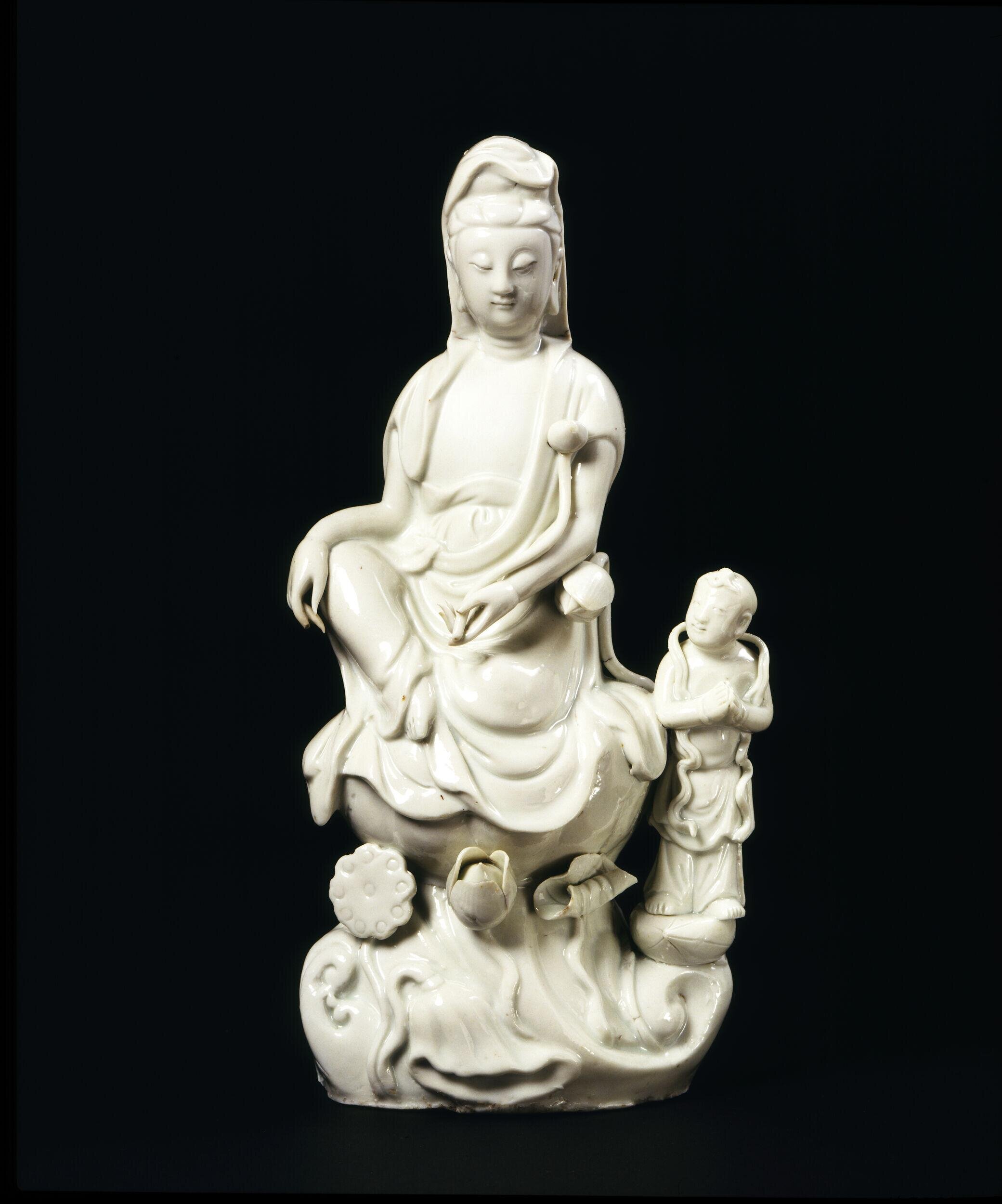
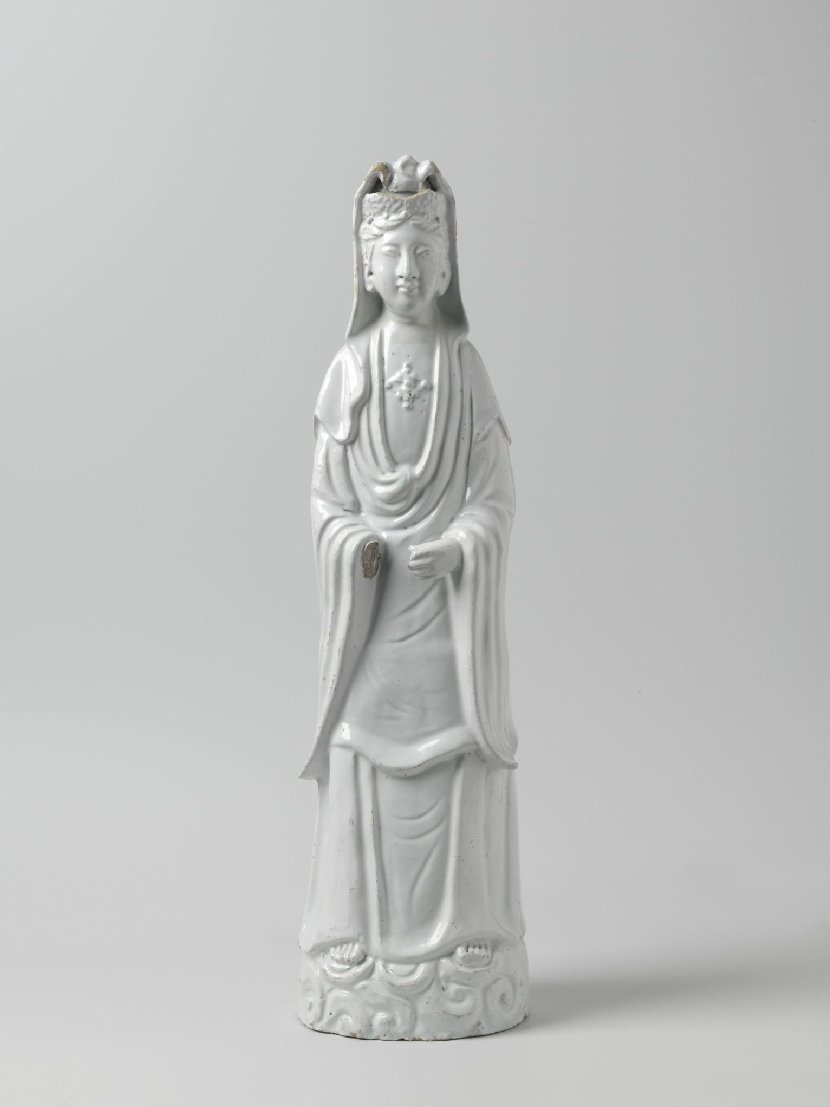
C.546-1910 — Guanyin, seated. Provenance: George Salting bequest (1910). Salting was one of the most important Asian art collectors in Victorian London; his bequest forms one of the cornerstones of the V&A's Asian ceramics collection.
The V&A's Dehua porcelain holdings span four centuries, from Ming-dynasty classics to contemporary works. Two contemporary acquisitions are particularly noteworthy:
FE.52:1,2-2012 — Peter Ting, Buddha Hands. Acquired 2012. (See Contemporary Ceramic Art from Dehua.)
FE.52-2018 — Su Xianzhong, Paper series. Acquired 2018. (See Contemporary Ceramic Art from Dehua.)
An earlier holding, C.49-1953, was identified in 2019 by Su Xianzhong himself as the work of his great-grandfather Su Xuejin (1869–1919). An object accessioned in 1953, recognised sixty-six years later by the maker's descendant in the museum — this detail speaks to the continuity of the Dehua sculptural tradition more eloquently than any scholarly argument.
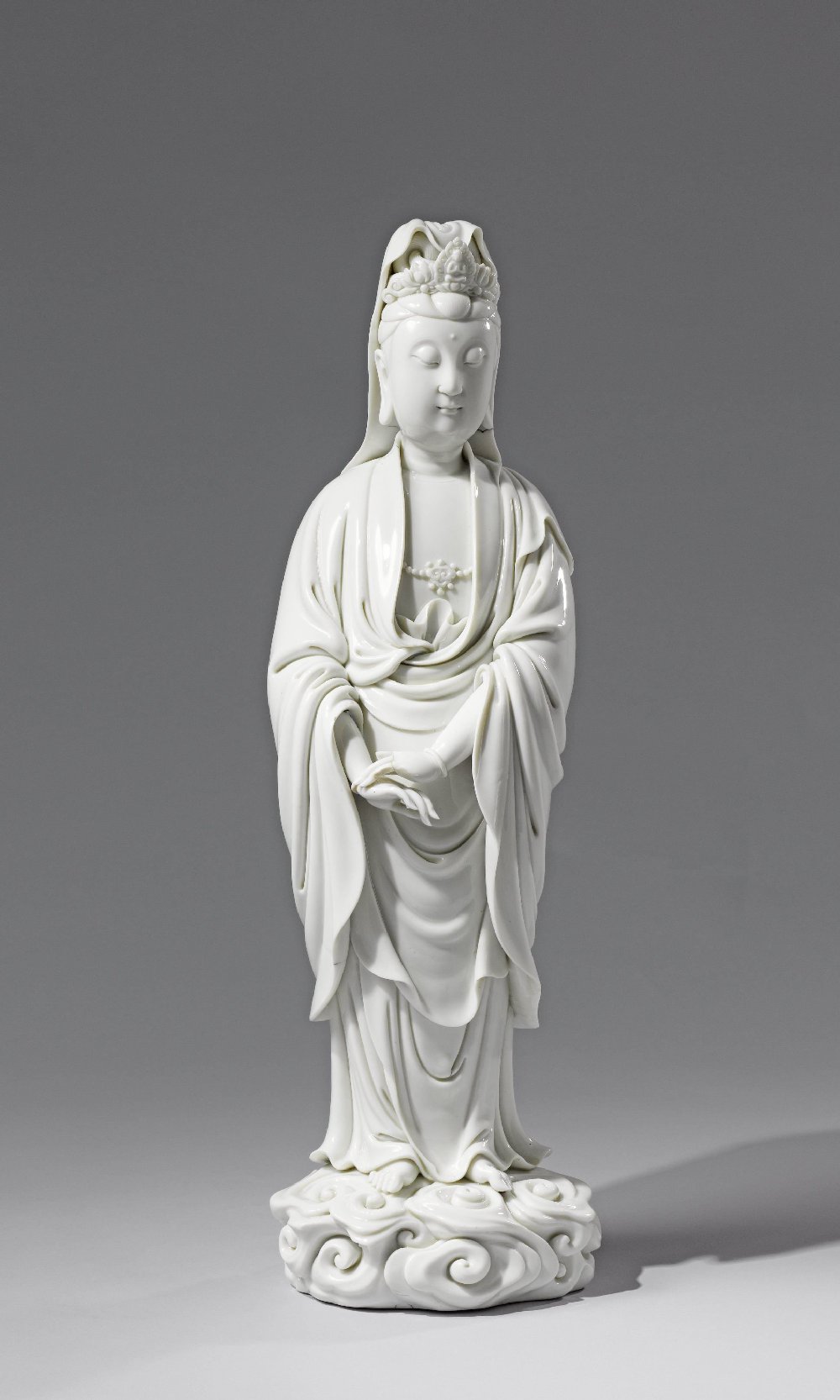
AK-MAK-594 — Guanyin. Former collection of T.H. Westendorp. Westendorp was one of the most significant Asian art collectors in the Netherlands at the turn of the nineteenth century.
G 535 — Dehua porcelain. Ernest Grandidier collection. Grandidier was nineteenth-century France's most systematic collector of Chinese ceramics; his holdings of several thousand pieces form the core of the Musée Guimet's Chinese ceramic collection.
33-588 — Guanyin. Purchased by Laurence Sickman in Beijing in 1933. Sickman later became the first curator of Asian art at the Nelson-Atkins Museum and one of the foremost American scholars of Chinese art in the first half of the twentieth century.
The Donnelly collection constitutes the most important component of the British Museum's Dehua porcelain holdings. P.J. Donnelly donated his entire collection to the British Museum in 1980, accessioned under the prefix 1980,0728. Donnelly was not merely a collector but a scholar — his 1969 publication Blanc de Chine: The Porcelain of Tehua in Fukien (507 pages, 160 plates) remains the single most important English-language reference on the subject.
1925.1482 — Dehua porcelain. Accessioned in 1925, making it one of the earliest Dehua porcelain acquisitions in the American museum system.
As the specialist museum for the region where Dehua is located, the Quanzhou Maritime Museum holds extensive Dehua porcelain, with particular strength in excavated and transmitted works related to overseas trade.
The porcelain collection of Augustus the Strong (Augustus II) stands as one of the most extraordinary acts of personal collecting in history. Some 29,000 pieces of East Asian ceramics in total, including more than 1,000 pieces of Dehua porcelain — the largest single collection of Dehua ware in Europe. Augustus's Porzellankrankheit (“porcelain sickness”) directly drove the founding of the Meissen porcelain factory (see European Imitation Evidence Chain).
Three pieces of particular research value — PO 8638, PE 2373, PE 2188 — serve as core comparative material for studying Dehua originals alongside Meissen copies (see European Imitation Evidence Chain).
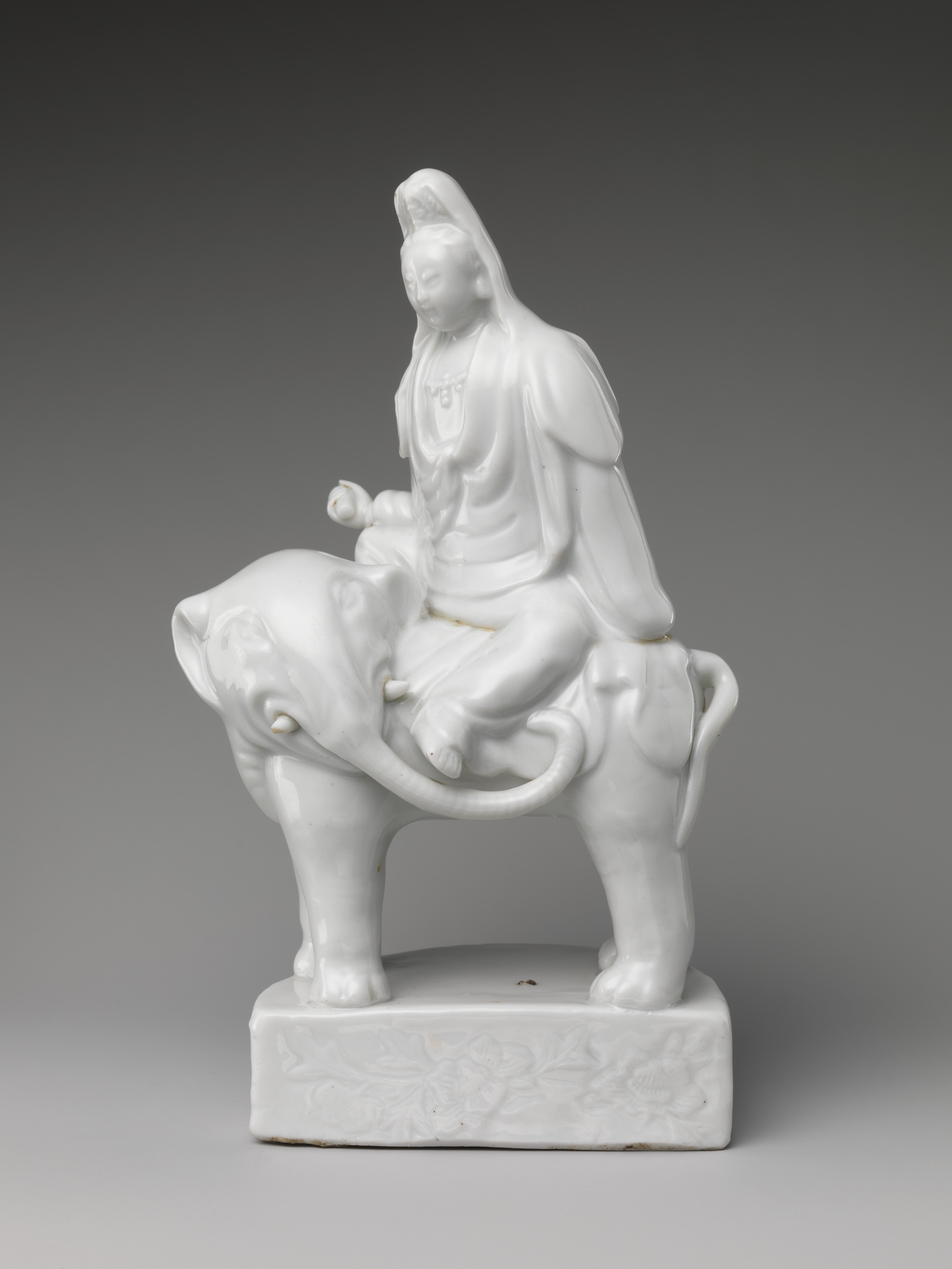
The Met holds multiple Dehua porcelain pieces, among which 1974.356.319 (H 37.5 cm) is analysed in detail in European Imitation Evidence Chain in the context of Meissen copying.
Cleveland holds important Dehua porcelain, representing a core collection in this field for the American Midwest.
The Dehua porcelain at Blenheim Palace carries a transatlantic provenance. In the late nineteenth century, the 9th Duke of Marlborough married Consuelo Vanderbilt, granddaughter of the American railroad magnate Cornelius Vanderbilt. The Vanderbilt dowry and subsequent funds helped sustain Blenheim Palace's operations. The collecting history of some Dehua porcelain at the Palace is closely tied to the wealth flows of this Anglo-American marriage alliance.
Frank Hickley's collection of 160 Dehua porcelain pieces forms the core of the ACM's holdings in this field. Rose Kerr and John Ayers published a dedicated study of this collection in 2002, establishing the foundational scholarly text for Dehua porcelain research in Southeast Asia.
A 2017 paper by Lin Meicun in the European Journal of Archaeology discussed a small jar held at Venice's San Marco Basilica, arguing that it may be one of the earliest Dehua porcelain pieces to reach Europe via early trade routes. The dating and route attribution remain contested, but the object's existence itself suggests that Dehua porcelain may have entered Europe considerably earlier than the large-scale trade of the Age of Exploration.
The Ashmolean's holdings span from the Song dynasty to the Republican period, including early treasures such as qingbai-glazed incised dishes and Persian-style vases (popularly known as “Marco Polo vases”). The museum's Dehua collection carries considerable weight in international collecting circles.
The Percival David Foundation collection includes censers, vases, water droppers, boxes, bowls, dishes, brush washers, and Guanyin and other religious figures — encompassing multiple works bearing He Chaozong seals as well as pieces by other master sculptors.
The Staatliche Kunstsammlungen Dresden holds the largest collection of transmitted Dehua porcelain outside China. Some 400 sets (1,255 individual pieces) survive, the majority white-glazed, comprising Buddhist figures, secular figures, bowls, dishes, vases, spoons, boxes, and cups. The collection was built on the foundation of Augustus the Strong's acquisitions. The 1721 royal porcelain inventory (Kangxi 60th year) inscribed each piece with a letter, a number, and a symbol on the base. In 1727, 81 pieces were added (6 foreign lots containing 469 Dehua pieces); in the same year, another 57 pieces were added (32 lots containing 71 “Blanc de Chine” pieces); in 1723, 133 lots were added (70 lots containing 588 “Blanc de Chine” pieces).
The Copenhagen City Museum (Københavns Bymuseum) and the Design Museum Denmark both hold Dehua porcelain, with the earliest catalogue entries dating to the 1690s. The Rosenborg Castle's earliest inventory of 1718 records five Guanyin figures and three standing lady figures wearing long robes and tall head ornaments.
Four institutions hold Dehua porcelain: the Museum of Far Eastern Antiquities, Drottningholm Palace (the Chinese Pavilion, a royal residence outside Stockholm where objects have been housed since 1769), the Kempe Collection (one of the world's largest private collections), and the Hallwyl Museum.
Auction results for He Chaozong works and significant Dehua Blanc de Chine, ranked by hammer price in descending order:
| # | Lot Description | Auction House / Date | Lot | Price Realised | Notes |
|---|---|---|---|---|---|
| 1 | White-glazed Guanyin Crossing the Sea, "He Chaozong yin" seal, H 51.5 cm | Christie's Hong Kong, 27 Nov 2017 | 8120 | HK$19.3M (≈$2.47M) | International auction house record |
| 2 | "He Chaozong yin" seal Bodhidharma standing figure | Kami Auction (Osaka), Autumn 2022 | — | ≈RMB 12.07M (≈$1.7M) | Japanese market record |
| 3 | He Chaozong-attributed work | Shizhuzhai, 2023 | — | RMB 15M | Mainland China high |
| 4 | White-glazed Bodhidharma, "He Chaozong" seal, Ming 16th c., H 40.8 cm | Christie's Hong Kong, 26 Nov 2014 | 3120 | HK$14.44M | |
| 5 | He Chaozong Bodhidharma seated, "He Chaozong" seal script | China Guardian Shengjia, Spring 2023 | — | RMB 12.075M | |
| 6 | White porcelain Guanyin, 20th c., H 39.3 cm | Christie's London, 12 May 2015 | 155 | £818.5K (≈$1.27M) | Non-He Chaozong; 20th-c. high |
| 7 | White-glazed Guanyin seated, "He Chaozong" seal, Qing 18th c., H 36.2 cm | Sotheby's, 17 Mar 2015 | 259 | $970K | |
| 8 | He Chaozong-attributed Guanyin | Christie's Hong Kong, 2015 | 2912 | HK$8.92M | |
| 9 | White porcelain Bodhidharma seated, "He Chaozong yin" seal, 17th/18th c., H 34.6 cm | Lempertz (Cologne), 15 Dec 2014 | 56 | €856K | Continental Europe high |
| 10 | White-glazed Guanyin standing, "He Chaozong yin" seal, 17th c., H 51.5 cm | Sotheby's Hong Kong, 6 Apr 2016 | 3606 | HK$7.28M | |
| 11 | Dehua Blanc de Chine Guanyin | Sotheby's New York, 2025 | 136 | $635K | Most recent as of data cutoff |
| 12 | White porcelain Guanyin, "He Chaozong yin" seal, 17th c., H 37 cm | Bonhams (London), 17 May 2012 | 297 | £529.25K | |
| 13 | White-glazed Guanyin standing, "He Chaozong" seal, late Ming, H 31 cm | Christie's Hong Kong, 30 Nov 2016 | 3324 | HK$4.26M | |
| 14 | He Chaozong Guanyin Crossing the Sea, H 46.7 cm | Nagel (Stuttgart), 5 Nov 2010 | 1023 | €425.6K | |
| 15 | Pair of Wenshu & Puxian seated figures, "Dehua" "Xu Yunlin zhi" seal, H 46 cm | Sotheby's Hong Kong, 8 Apr 2013 | 3196 | HK$3.4M | By Xu Yunlin; not He Chaozong |
| 16 | Dehua Blanc de Chine | Hindman (Chicago), 2020 | — | $357K | Opening bid $600; 595× premium |
| 17 | White-glazed Bodhidharma seated, "Chen shi xin yin" seal, early 17th c., H 27 cm | Christie's, 20 Mar 2014 | 1628 | $317K | Chen shi mark; not He Chaozong |
The 595-fold gap between opening bid and hammer price in the Hindman case (entry 16) reflects market information asymmetry being corrected instantaneously by competitive bidding — when two or more bidders with deep knowledge of Dehua porcelain are present, price discovery completes within minutes.
The seventeen entries above span nine auction houses (Christie's, Sotheby's, Kami Auction, China Guardian Shengjia, Shizhuzhai, Lempertz, Bonhams, Nagel, Hindman) across seven cities (Hong Kong, London, New York, Osaka, Cologne, Stuttgart, Chicago). He Chaozong-attributed works occupy the top five positions, but entry 6 (Christie's London 2015) and entry 15 (Sotheby's Hong Kong 2013, Xu Yunlin mark) demonstrate robust demand for works by other named masters. Entry 17 (Chen-shi-xin-yin seal Bodhidharma, $317K) further confirms that the auction value of Dehua porcelain does not depend solely on the He Chaozong “brand” — other sculptors in the Dehua lineage also command recognition in the international market.
Sources: Christie's, Sotheby's, Bonhams, Lempertz, Nagel, Hindman official sale results; CANS Arts Dehua porcelain sculpture ranking (1 Jan 2007 – 31 Aug 2023). Data cutoff April 2025.
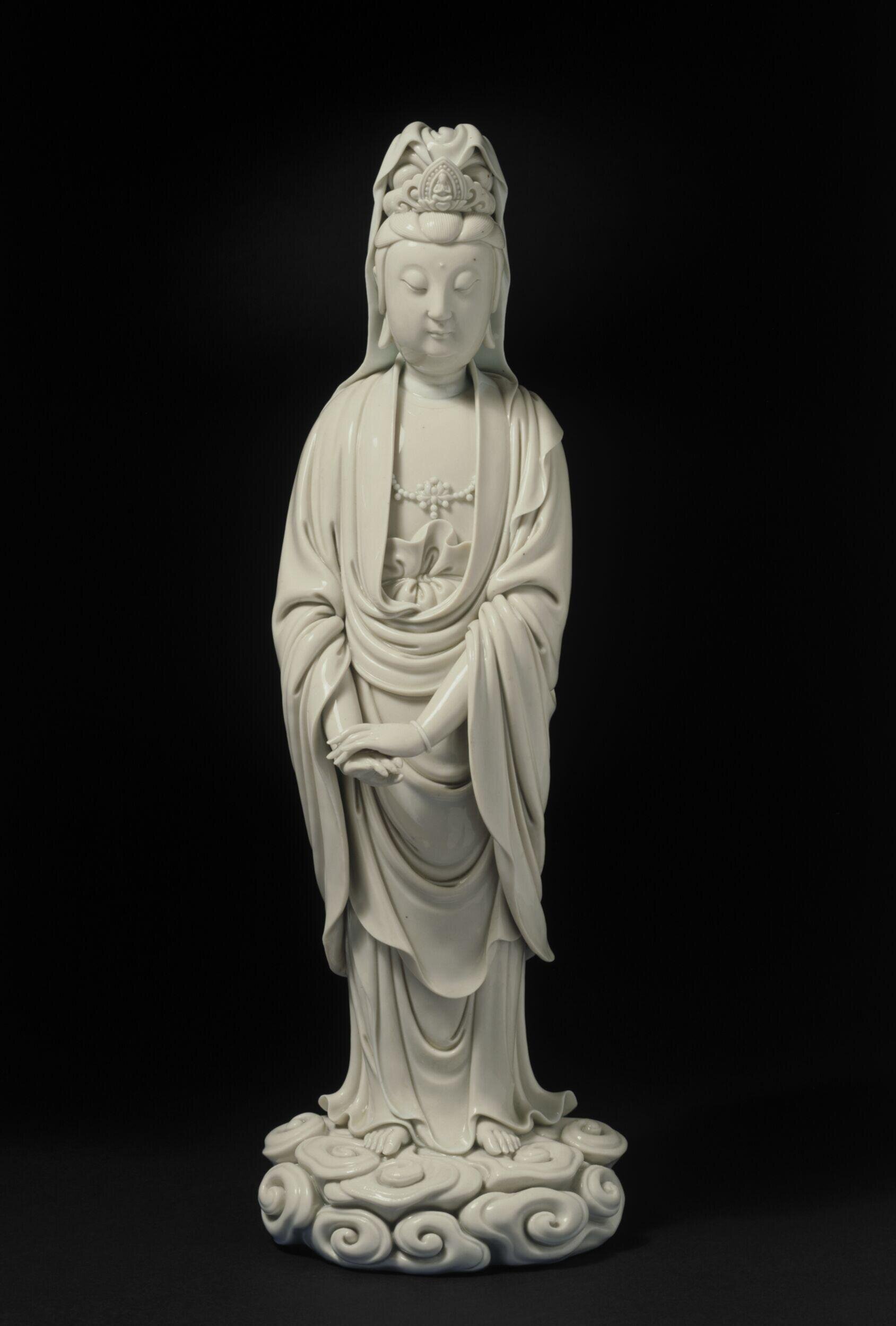
P.J. Donnelly's contribution to the study of Blanc de Chine cannot be circumvented.
Published in 1969, Blanc de Chine: The Porcelain of Têhua in Fukien (Faber & Faber, London, ISBN 0-571-08078-2) comprises 407 pages of text plus 160 plates. It defined the terminology, established the classification framework, and surveyed global collections. Every subsequent English-language study of Dehua porcelain begins from Donnelly's footnotes. In 1980, he donated his personal collection to the British Museum in its entirety — scholar and collection ultimately coming to rest under the same roof.
The position of the London dealers Marchant in the Dehua porcelain market warrants specific attention.
Founded in 1925, three generations of family management. Relocated to Mayfair in spring 2025. Five dedicated Dehua porcelain exhibitions — 1985, 1994, 2006, 2014, 2024 — spanning nearly four decades. The 2014 exhibition included works from the Captain Meuldijk collection; the exhibition catalogue was priced at £80/$130.
Marchant's operating model combines an extremely narrow category focus with an extremely long client-relationship cycle. In the high-end antiques market, the connoisseurship credibility accumulated over forty years of concentration on a single category itself constitutes a source of pricing authority. No domestic dealer with equivalent focus and international visibility has yet emerged for Dehua porcelain.
Keywords
He Chaozong · Blanc de Chine · Dehua white porcelain · Guanyin · Bodhidharma · Donnelly · Marchant · V&A · British Museum · Metropolitan Museum · Rijksmuseum · Dresden · Ivory white · Seal mark · Auction record · Christie's · Sotheby's · Museum holdings · 何朝宗 · 中国白 · 德化白瓷
View Full Data — Global Collection Index · Auction Records
Eleven Shipwrecks and the Underwater Trade Evidence Chain of Dehua Blanc de Chine
| Report No. | WH-GR-2026-001-DIM03 |
| Part of | WH-GR-2026-001 |
| Version | 1.0 (Initial Public Release) |
| Published | April 2026 |
| Data Cutoff | April 2026 |
| Lead Researcher | Jack Lin |
| Publisher | World Headlines Inc., Manhattan, New York |
| Review Status | Internal research review; not externally peer-reviewed |
| License | CC BY-NC 4.0 International |
| Persistent ID | 10.5281/zenodo.19519691 |
The moment a ship sinks, every item of cargo aboard is locked into a precise point in time — unlike objects that survive on land, which can be resold, altered, or have their provenance fabricated by subsequent owners. Shipwreck archaeology provides trade evidence of forensic-grade reliability: when, from where, to where, and what was carried.
The eleven shipwrecks below constitute the underwater evidence chain for the overseas trade of Blanc de Chine, spanning from 1183 to 1822 and covering the South China Sea, Indian Ocean, Atlantic Ocean, and Pacific Ocean. They lie along three major trade routes: the Portuguese route (via Malacca and Goa to Lisbon), the Dutch East India Company (VOC) route (via Batavia to Amsterdam), and the Manila Galleon route (via the Philippines across the Pacific to the Americas).
An observation by Robert McPherson — a London antiquarian and specialist in shipwreck porcelain — deserves citation: “Most shipwrecks do not contain white porcelain.” This means that the Dehua blanc de Chine recovered from each of the eleven wrecks below constitutes an archaeological event worthy of special attention.
| Route | Origin | Destination | Key Intermediaries |
|---|---|---|---|
| Portuguese Route | Quanzhou | Lisbon | Malacca → Goa → Cape of Good Hope |
| VOC Dutch Route | Quanzhou | Amsterdam | Batavia → Cape of Good Hope |
| Manila Galleon | Quanzhou | Acapulco | Manila → Pacific Ocean |
| # | Name | Date | Dynasty | Waters | Recovered Objects | Significance |
|---|---|---|---|---|---|---|
| 1 | Nanhai No. 1 | 约1183 | Southern Song | South China Sea (Yangjiang, Guangdong) | 180,000+ pieces (Dehua ≈ 26% ≈ 47,000) | Largest underwater excavation in China; proves Dehua was a major export producer via Quanzhou port by Southern Song |
| 2 | Huaguangjiao No. 1 | 1162年后 | Southern Song | Paracel Islands | 1,000+ powder boxes | Reflects everyday demand in Southeast Asian markets |
| 3 | Java Sea Wreck | 约1340–1352 | Yuan dynasty | Java Sea | 3.5 tonnes recovered (2024 discovery) | Incremental evidence of Yuan-era Dehua export volumes |
| 4 | Hatcher Cargo | 约1643 | Late Ming | South China Sea | 579 pieces (incl. 439 bowls + Guanyin figures) | Milestone: Dehua blanc de Chine enters the international auction market |
| 5 | Atalaia | 1647 | Late Ming | Portuguese route (Atlantic) | 8 sherds | Earliest physical evidence of Dehua porcelain on a Portuguese route |
| 6 | Vung Tau Cargo | 约1690 | Qing Kangxi | South China Sea (Vung Tau, Vietnam) | ≈ 30 Guanyin figures | Proves bulk European trade demand for Dehua sculptural porcelain |
| 7 | Santo Cristo de Burgos | 1693 | Qing Kangxi | Pacific Ocean (Nehalem, Oregon) | Dehua porcelain (quantity unknown) | Earliest Dehua porcelain found archaeologically in North America |
| 8 | Ca Mau | 约1725 | Qing Yongzheng | South China Sea (Cà Mau, Vietnam) | Includes Dehua products | Early Qing underwater anchor point on the South China Sea trade route |
| 9 | Geldermalsen | 1752 | Qing Qianlong | South China Sea | VOC cargo | Turning point: European porcelain factories overtake Asian imports |
| 10 | Diana Cargo | 1817 | Qing Jiaqing | Strait of Malacca | Includes Dehua porcelain | Late-phase picture of Dehua exports in the early 19th century |
| 11 | Tek Sing | 1822 | Qing Daoguang | South China Sea | ≈ 350,000 pieces (predominantly blue-and-white) | Signal of declining Dehua blanc de Chine share in bulk exports |
Sinking date: c. 1183 (Southern Song dynasty)
Total recovered artefacts: 180,000+ pieces
Dehua kiln proportion: c. 26%
Nanhai One is the largest underwater archaeological excavation in Chinese history. Of the 180,000+ recovered artefacts, Dehua kiln products account for approximately 26% — roughly 47,000 pieces. The cargo composition proves that by the Southern Song period, Dehua was already one of the primary production centres supplying export porcelain through the port of Quanzhou.
In 2024, a provenance study published in Antiquity (Cambridge University Press) used chemical composition analysis to identify the origins of ceramics recovered from Nanhai One, further confirming the proportion and distribution of Dehua kiln products. This research applied chemical fingerprint analysis directly to underwater archaeological material, establishing cross-validation between shipwreck data and materials science.
Sinking date: after 1162 (Southern Song dynasty)
Dehua-related artefacts: 1,000+ powder boxes
Huaguangjiao No. 1 sank in the waters of the Paracel Islands. The 1,000-plus powder boxes are typical Dehua products — powder boxes were among the most common vessel types in Song-dynasty export ceramics, reflecting everyday demand in Southeast Asian markets. Compact and stackable for efficient shipping, they were among the most economically viable export items of the Southern Song period. Together with Nanhai One, Huaguangjiao No. 1 confirms that by the twelfth century, Dehua porcelain was already a routine bulk commodity in the Quanzhou–Southeast Asia maritime trade.
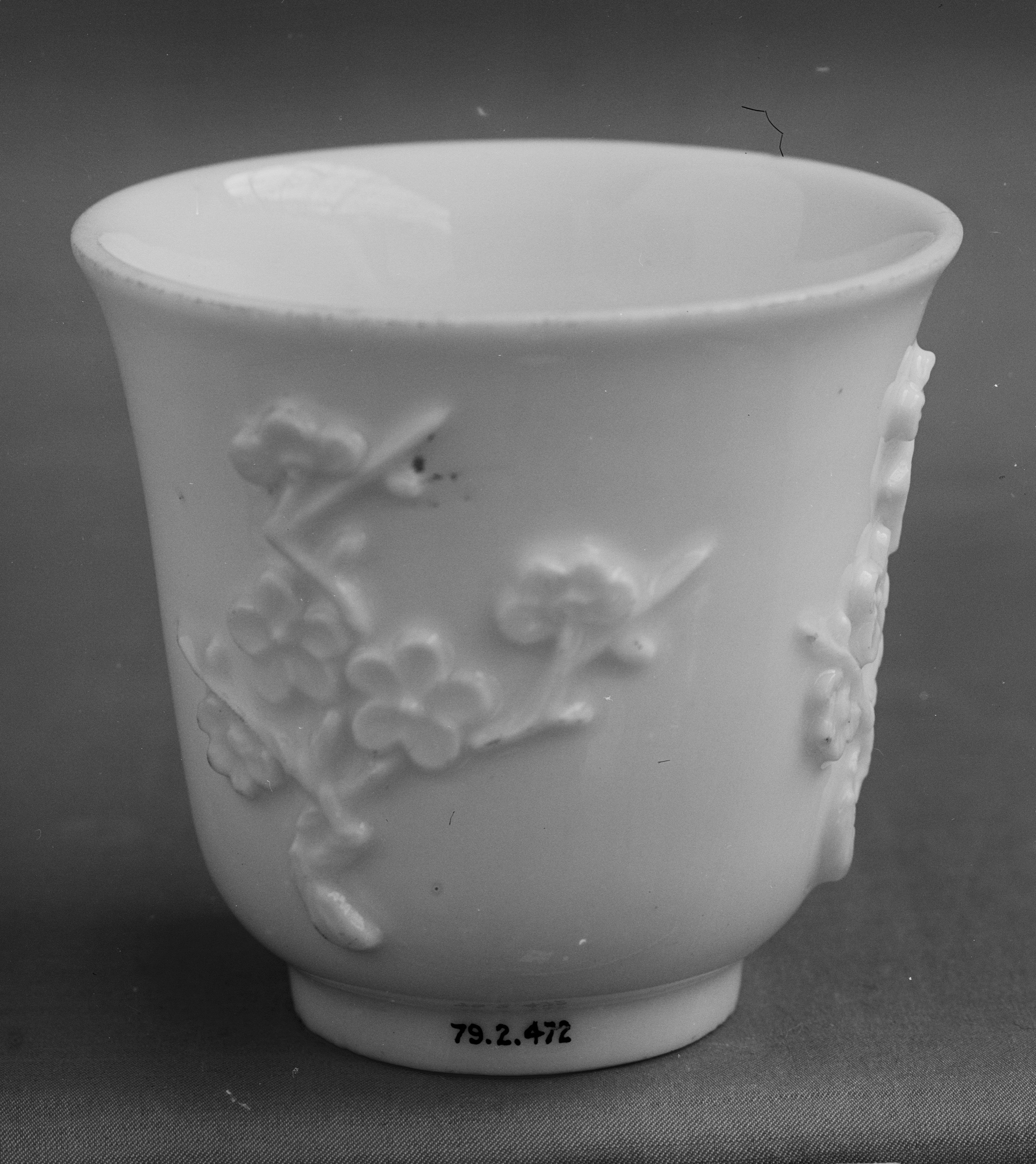
Sinking date: c. 1643 (late Ming dynasty)
Dehua white porcelain recovered: 579 pieces, including 439 bowls and several Guanyin figures
Auction: Christie’s Amsterdam, c. $2 million
This cargo, salvaged by British captain Michael Hatcher in the 1980s, was a watershed moment for Dehua blanc de Chine in the international auction market. The 579 white porcelain pieces included Guanyin figures — the presence of religious sculptures in a shipwreck demonstrates that European demand for Dehua porcelain extended well beyond utilitarian wares, with sculptural pieces already constituting regular trade goods by the mid-seventeenth century. The combination of 439 bowls and several Guanyin figures precisely reflects the structure of an export manifest: bulk utilitarian wares at the base, high-value sculptures at the apex.
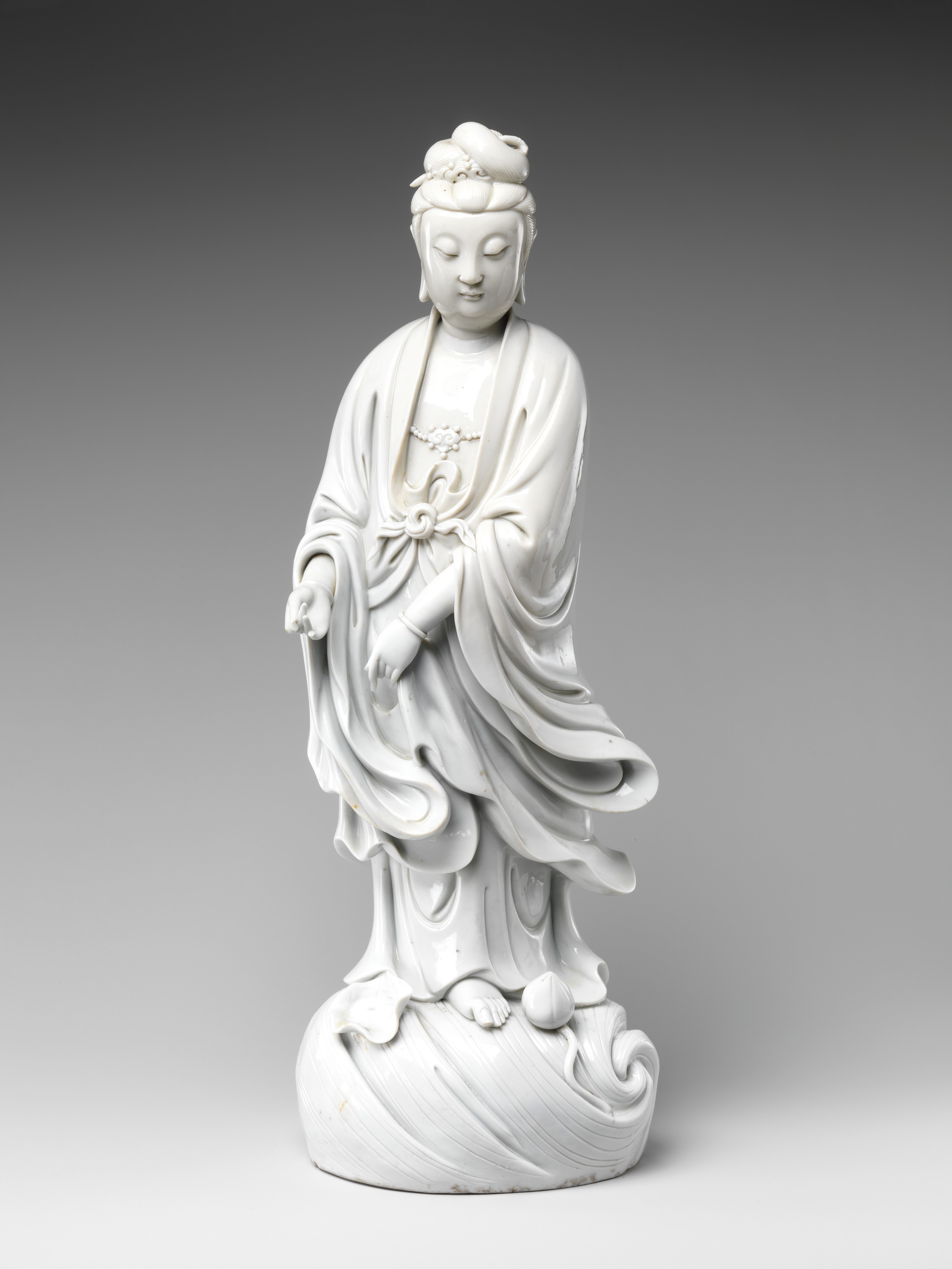
Sinking date: c. 1690 (Qing Kangxi era)
Dehua white porcelain recovered: c. 30 Guanyin figures
Auction: Christie’s, $7.3 million
The concentrated recovery of approximately 30 Guanyin figures indicates that by c. 1690, European market demand for Dehua sculptural porcelain had reached bulk-trade scale rather than incidental inclusion. The Vung Tau Cargo’s Christie’s auction total of $7.3 million far surpassed the Hatcher Cargo’s $2 million, reflecting the escalating 1990s market enthusiasm for shipwreck porcelain. This price-escalation trend connects directly to the seven-tier price model constructed in the auction market intelligence analysis.
Sinking date: 1647
Dehua white porcelain recovered: 8 sherds
Route: Portuguese (Lisbon–Asia)
Significance: Earliest physical evidence of Dehua blanc de Chine on the Portuguese trade route
The 8 white porcelain sherds constitute the earliest confirmed physical evidence that the Portuguese trade route carried Dehua blanc de Chine. The Atalaia was a Portuguese merchantman whose route connected Asia to the Iberian Peninsula. These sherds confirm that Dehua porcelain reached Europe via the Portuguese westward sea route. This archaeological discovery drew on Portuguese-language documentation — a direct application of the eight-language research framework employed in this report.
Sinking date: 1693
Sinking location: Nehalem, Oregon
Route: Manila Galleon (Philippines–Acapulco)
Significance: Earliest Dehua porcelain found in North American archaeology
This Manila galleon departed the Philippines and crossed the Pacific, sinking off the coast of North America. The Dehua blanc de Chine recovered from the wreck is the earliest Dehua porcelain in the North American archaeological record — confirming the trans-Pacific trade route as an authentic channel for the global dissemination of Dehua wares.
This case demonstrates that by the late seventeenth century, the Manila Galleon trade had extended the circulation of Dehua blanc de Chine to the Pacific coast of North America. Spanish-language archives (AGI, Archivo General de Indias) provide primary documentary support for this vessel’s route and cargo — an application of the report’s eight-language research framework in the Spanish-language domain.
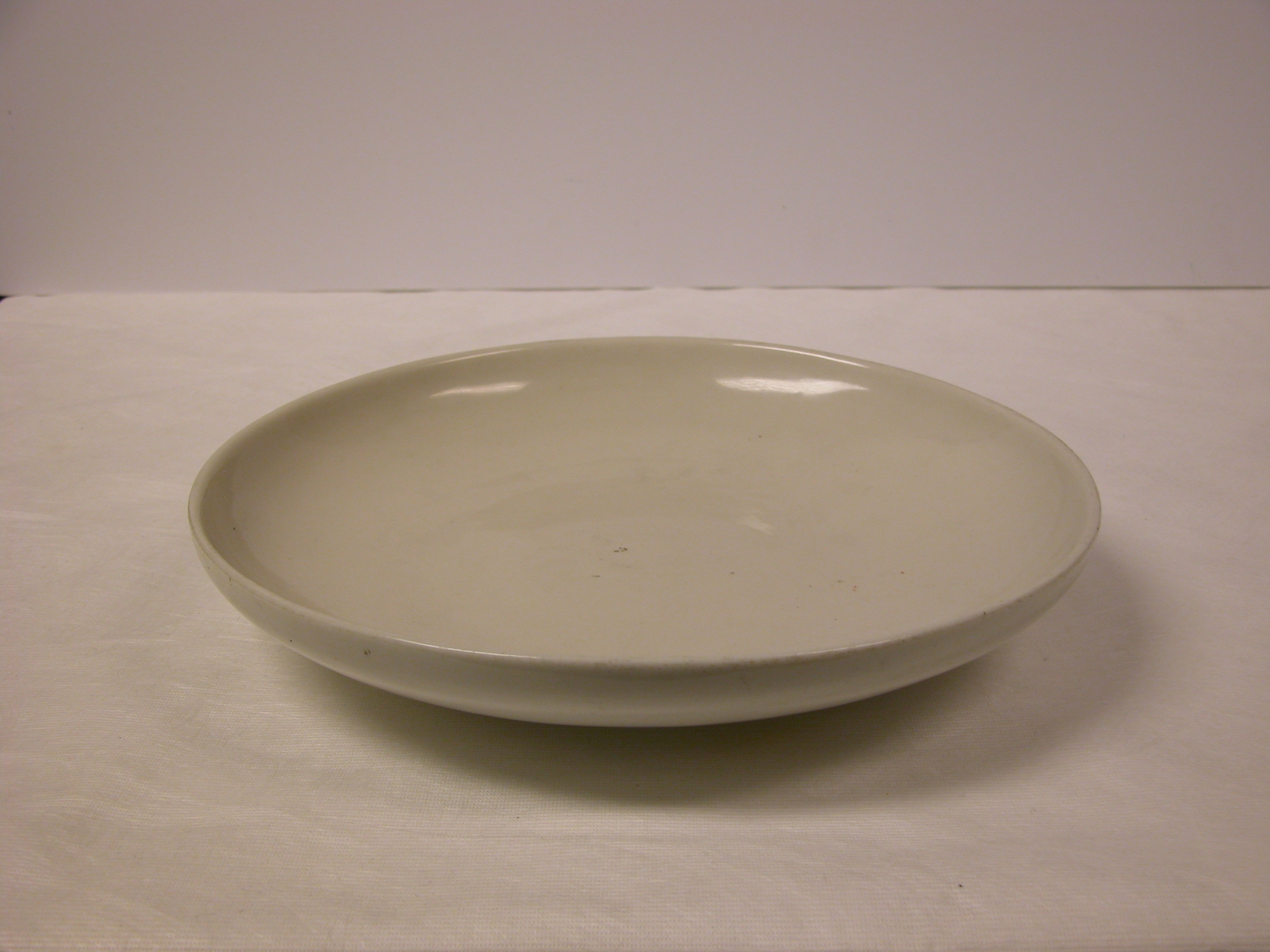
Sinking date: 1822
Total recovered objects: c. 350,000 pieces
Significance: Signal of industrial transition
The Tek Sing is the latest-dated wreck in this database. Its 350,000 recovered ceramics were predominantly blue-and-white utilitarian wares. This cargo composition itself constitutes a signal: by 1822, the share of Dehua blanc de Chine in bulk export trade had declined significantly, displaced by blue-and-white and other categories. This aligns with the declining quality trajectory of the Qing-dynasty “spring onion white” glaze described in the historical evolution — as the product lost the aesthetic pinnacle of the Ming ivory-white glaze, market preferences naturally shifted. Concurrently, the European porcelain factories described in the European imitation evidence chain had completed their transition from imitation to independent innovation, further compressing the market space for Chinese export porcelain.
In 2019, the Aquatic Cultural Group donated a collection of Tek Sing artefacts to the National Museum of China.
Sinking date: c. 1725 (Qing Yongzheng era)
Sinking location: Ca Mau province, Vietnam
The Ca Mau wreck cargo included Dehua products, serving as another underwater anchor point on the early Qing South China Sea trade route. Ca Mau lies at the southernmost tip of the Mekong Delta — this location indicates that the South China Sea trade lanes remained active during the Yongzheng era.
Sinking date: 1817
Related auction: Christie’s
Dehua porcelain recovered from the Diana Cargo, together with the Tek Sing, delineates the late-phase landscape of Dehua ceramic exports in the early nineteenth century. Separated by only five years (1817–1822), a comparison of the two vessels’ cargo compositions reflects the rapid category shifts in Chinese export ceramics during this period.
Sinking date: c. 1340–1352 (Yuan dynasty)
Major discovery: 3.5 tonnes of artefacts recovered in 2024
The 2024 discovery provides significant new evidence for the overseas trade of Dehua porcelain during the Yuan dynasty. The scale of 3.5 tonnes of recovered material indicates that Yuan-dynasty Dehua kiln output for export was already substantial — corroborating the production capacity reflected by the 57.1-metre “chicken coop” kiln (jilongyo) at the Qudougong kiln site described in the historical evolution. Chronologically, the Java Sea Wreck fills a 260-year archaeological gap between the Southern Song (Nanhai One, c. 1183) and the late Ming (Hatcher Cargo, c. 1643).
Sinking date: 1752
Operator: VOC (Dutch East India Company)
Significance: A pivotal node in the European imitation evidence chain’s “great reversal”
The sinking of the Geldermalsen (a VOC vessel) and its subsequent salvage auction hold turning-point significance within the narrative of the European imitation evidence chain — 1752 marks precisely the era when European porcelain factories were achieving competitive scale and Chinese export porcelain began facing displacement. Dutch-language archives (VOC commercial records) provide detailed documentation of this vessel’s cargo and route.
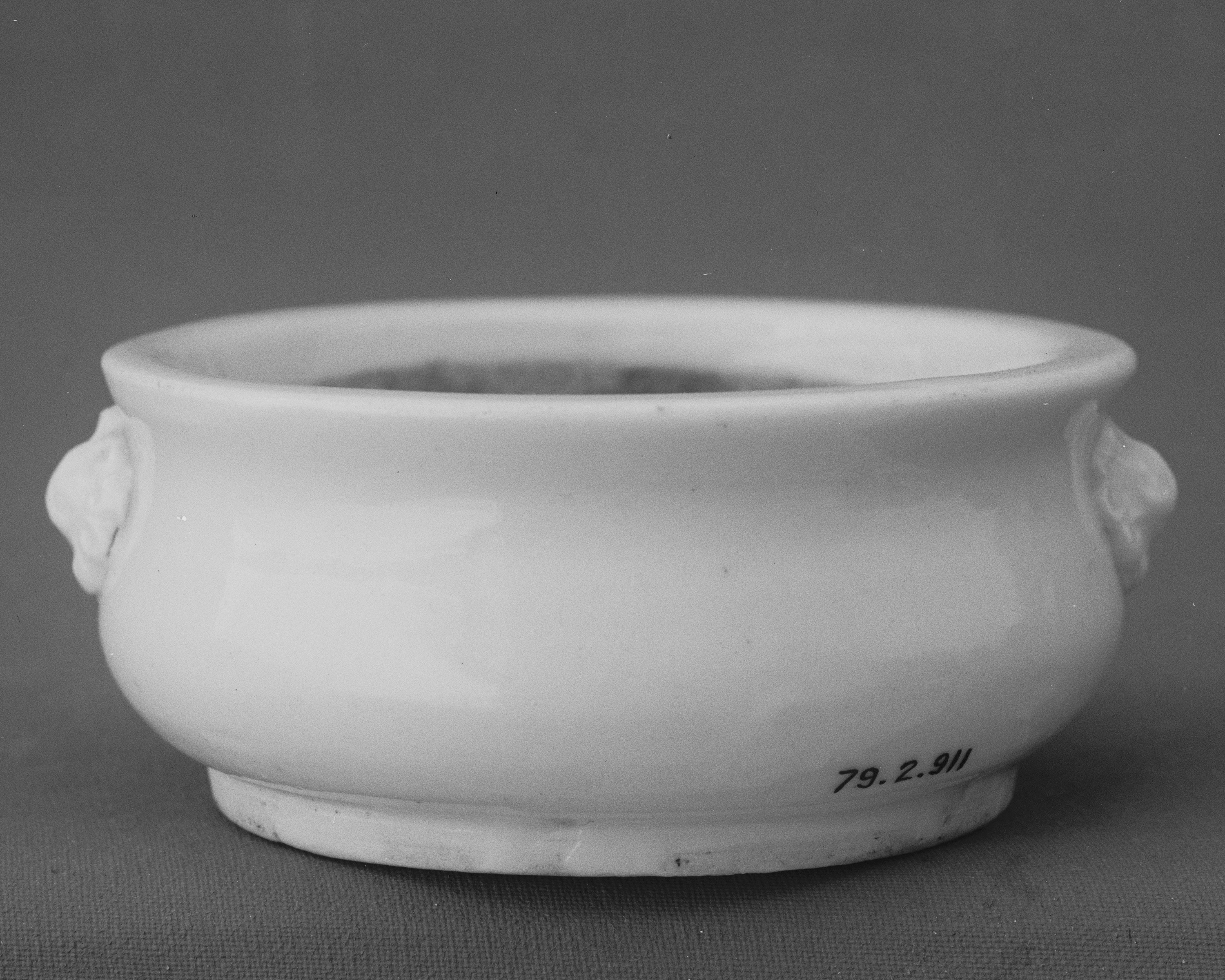
The eleven shipwrecks span 639 years (1183–1822) and cover four oceans: the South China Sea, the Indian Ocean, the Atlantic, and the Pacific. Arranged chronologically, the narrative arc of this evidence chain emerges with clarity:
The timeline above traces a complete narrative arc: in the Southern Song, Dehua porcelain was already a bulk export commodity from the port of Quanzhou (Nanhai One, Huaguangjiao No. 1) → Yuan-dynasty volumes expanded further (Java Sea Wreck) → by the late Ming, blanc de Chine had become a star product in the European market (Hatcher Cargo) → early Qing demand peaked, with Guanyin figures exported in bulk (Vung Tau Cargo) → mid-eighteenth-century competitive dynamics shifted (Geldermalsen / Ca Mau) → by the nineteenth century, the share of blanc de Chine in bulk export trade had declined (Diana Cargo, Tek Sing).
The defining characteristic of this underwater evidence is that every recovered piece carries a precise sinking date and route attribution, constituting independently verifiable trade records.
The eleven shipwrecks are distributed along three major trade routes, with geographic coverage extending from the South China Sea to the Atlantic and Pacific:
| Route | Wrecks | Ships | Time Span |
|---|---|---|---|
| South China Sea Regional | 6 | Nanhai One, Huaguangjiao No. 1, Java Sea Wreck, Hatcher, Ca Mau, Tek Sing | 1162–1822 (660 years) |
| VOC / Dutch East India Co. | 3 | Vung Tau Cargo, Geldermalsen, Diana Cargo | 1690–1817 (127 years) |
| Portuguese Route | 1 | Atalaia | 1647 |
| Manila Galleon | 1 | Santo Cristo de Burgos | 1693 |
The South China Sea regional route has the highest shipwreck density (6 wrecks) and the longest time span (660 years), reflecting the enduring centrality of the South China Sea as the core waterway for Dehua porcelain exports. The three VOC-route wrecks precisely mark the critical interval from the peak of Dutch East India Company trade (1690) to its inflection point (1752). The Portuguese and Manila Galleon routes each have only one wreck record, but their archaeological significance lies not in quantity but in route confirmation — respectively proving the existence of the Atlantic westward channel and the Pacific eastward channel.
The coverage of four oceans constitutes a geographic completeness argument: the South China Sea (8 wrecks), the Indian Ocean (a necessary transit segment with no wreck record), the Atlantic (1: Atalaia), and the Pacific (1: Santo Cristo de Burgos). Although the Indian Ocean has no direct shipwreck record, both the Portuguese and VOC routes traversed Indian Ocean waters — wrecks from these routes in other seas indirectly confirm transit through the Indian Ocean segment.
| # | Shipwreck | Sinking Date | Dynasty | Dehua-Related Artefacts | Key Significance |
|---|---|---|---|---|---|
| 1 | Nanhai No. 1 南海一号 | 约1183 | Southern Song | 180,000+ pieces (Dehua ≈ 26% ≈ 47,000) | Largest underwater excavation in China; proves Dehua was a major export producer via Quanzhou port by Southern Song |
| 2 | Huaguangjiao No. 1 华光礁一号 | 1162年后 | Southern Song | 1,000+ powder boxes | Reflects everyday demand in Southeast Asian markets |
| 3 | Java Sea Wreck 德马西克沉船 | 约1340–1352 | Yuan dynasty | 3.5 tonnes recovered (2024 discovery) | Incremental evidence of Yuan-era Dehua export volumes |
| 4 | Hatcher Cargo 哈彻沉船 | 约1643 | Late Ming | 579 pieces (incl. 439 bowls + Guanyin figures) | Milestone: Dehua blanc de Chine enters the international auction market |
| 5 | Atalaia 阿塔拉亚号 | 1647 | Late Ming | 8 sherds | Earliest physical evidence of Dehua porcelain on a Portuguese route |
| 6 | Vung Tau Cargo 头顿沉船 | 约1690 | Qing Kangxi | ≈ 30 Guanyin figures | Proves bulk European trade demand for Dehua sculptural porcelain |
| 7 | Santo Cristo de Burgos 布尔戈斯圣基督号 | 1693 | Qing Kangxi | Dehua porcelain (quantity unknown) | Earliest Dehua porcelain found archaeologically in North America |
| 8 | Ca Mau 金瓯沉船 | 约1725 | Qing Yongzheng | Includes Dehua products | Early Qing underwater anchor point on the South China Sea trade route |
| 9 | Geldermalsen 盖尔德马尔森号 | 1752 | Qing Qianlong | VOC cargo | Turning point: European porcelain factories overtake Asian imports |
| 10 | Diana Cargo 黛安娜号 | 1817 | Qing Jiaqing | Includes Dehua porcelain | Late-phase picture of Dehua exports in the early 19th century |
| 11 | Tek Sing 泰兴号 | 1822 | Qing Daoguang | ≈ 350,000 pieces (predominantly blue-and-white) | Signal of declining Dehua blanc de Chine share in bulk exports |
Shipwreck archaeology captures randomly preserved cross-sections of trade — only ships that sank leave records. The complementary source is commercial archives: the English East India Company (EIC) cargo manifests document trade data from voyages that were completed successfully. The records below, compiled from Rose Kerr’s systematic study of EIC archives, reflect the scale and category structure of Dehua blanc de Chine shipped from the port of Xiamen to England between 1699 and 1707.
| Ship | Date | Cargo Summary | Notes |
|---|---|---|---|
| Nassau | Returned to England 1699 | 175 Virgin Mary figures, 70 lady-and-child figures, 71 smaller lady figures, 37 large white lions, 1,247 small white lions, 255 white jars and handled cups, 497 white handled cups, 1,470 white chocolate cups | Resold in London, 1699 |
| Dorrill | Returned to England before April 1702 | 4,200 white chocolate cups, 52 Virgin Mary figures, 42 lady-and-child figures | Sold April 1702 |
| Dashwood | Arrived at Xiamen winter 1701 | Virgin Mary figures, pulpit priest figures, lady-and-child figures, figure-on-beast and various birds, beasts and white handled cups; also figures never before imported to England: 41 Dutch family groups, 14 Dutch horsemen, 110 Dutch figures | Auctioned in London, 1703 |
| Union | Arrived at Xiamen 1703 | 22 kiln-loads of white porcelain figures (including 2 Dutch family groups, 2 Dutch figures, 2 Virgin Mary figures, 65 pulpit priest figures, 3 plain figures without priest) | Sold in a series of auctions, March 1705 |
| Fleet | Returned to England before September 1705 | 2,240 lions, 118 double josses, 310 birds, 35 elephants | Sold September 1705 |
| Regard | Returned to England before September 1705 | 4 standing Virgin Mary figures | Sold September 1705 |
| Tavestock | April 1706 | 4 standing Virgin Mary figures, 6 small white lady figures, 6 white chocolate cups, etc. | — |
| Somers | Returned to England before June 1707 | 2 horseman figures, 2 roosters, 2 lady-and-child figures, 3 small lady-and-child figures, 3 standing Virgin Mary figures, 8 white toy figures, 9 cold-painted lions, 10 cold-painted figures | Auctioned June 1707 |
| Toddington | Returned to England before June 1707 | 2 large cold-painted figures, 1 cold-painted lady-and-child figure, 2 smaller cold-painted lady-and-child figures | Auctioned June 1707 |
Sources: Rose Kerr, “Dehua Blanc de Chine Trade to Europe and the New World, Late 17th to Early 18th Century” (Part I), Fujian Wenbo, 2012, No. 4; Wan Jun, “Production and Trade of Dehua Blanc de Chine in a Global Perspective,” Journal of the Palace Museum, 2021, Vol. 22, Appendix II.
The table above reveals several key trade characteristics. First, religious sculptures (Virgin Mary figures, pulpit priest figures) were bulk trade goods — the Nassau alone carried 175 Virgin Mary figures, demonstrating that these were not curiosities shipped on occasion but regular export items with a stable European clientele. Second, the sheer quantity of animal figures is remarkable — the Fleet carried 2,240 lions, 310 birds, and 35 elephants — a scale proving that Dehua’s porcelain sculpture output far exceeded the “masterpieces by celebrated artisans” scope typically emphasised in academic discourse. Third, the Dashwood’s manifest listed 41 “Dutch family groups” and 14 “Dutch horsemen” — direct evidence of bespoke production, with Dehua potters working from models or drawings supplied by European merchants to create European-subject sculptures. Fourth, the Somers and Toddington manifests include “cold-painted” (enamelled after firing) items, indicating that some Dehua blanc de Chine underwent secondary decoration upon arrival in Europe — consistent with the overpainting phenomena discussed in the European imitation evidence chain.
Shipwrecks are trade snapshots intercepted en route; terrestrial sites are reception records at the destination. The following archaeological discoveries confirm that the global circulation of Dehua blanc de Chine extends beyond museum collections of heirloom objects — Dehua porcelain has been excavated from sites and ruins across Southeast Asia, South Asia, East Africa, and the Americas.
| Region | Site | Excavated Material | Date / Notes |
|---|---|---|---|
| Macau | Ruins of St. Paul’s and adjacent college | Dehua blanc de Chine sherds | Portuguese route transshipment node |
| Goa, India | Church of St. Augustine ruins (built 1602) | Dehua sherds: straight-necked vases, lids, betel-nut boxes, magnolia-form cups, bird and large figure fragments | Second half of 16th century, Portuguese trading post |
| Bijapur, India | Urban ruins of the Bijapur Deccan kingdom | Dehua porcelain sherds | Before 1686 (conquest by Aurangzeb) |
| Kenya | Coastal sites and tombs | Chinese ceramics including Longquan celadon, Jingdezhen blue-and-white, Dehua blanc de Chine | 9th to mid-19th century |
| Nigeria | Waters near Cape Nigaras | Dehua blanc de Chine sherds | 1686, near the wreck site of the Nossa Senhora dos Milagros |
| Cape Town, South Africa | Waters near the Cape | Dehua blanc de Chine cups, boxes, Buddhist figures, candlesticks, etc. | From the VOC vessel Oosterland |
| Mexico | Oaxaca (Monte Albán and multiple sites) | Animal figures, prunus-blossom cups, octagonal cups | Post-1521 Spanish colonial period |
| Mexico | Mexico City, Templo Mayor, municipal plaza, etc. | Animal figures, prunus cups, plain cups; Oaxaca monasteries: 65 small dishes, 377 prunus or plain bowls and cups | Manila Galleon route terminus |
| Alabama, USA | Old Mobile site | 86 Dehua blanc de Chine peony-motif cup sherds, 44 other white porcelain sherds | 1693, redistributed via Manila Galleon route |
| Oregon, USA | Nehalem Bay beach | Dehua blanc de Chine sherds | From the Santo Cristo de Burgos (1693) |
| Alkmaar, Netherlands | Alkmaar ruins | Several Dehua porcelain pieces (including a puzzle cup / gongdaobei) | VOC trade end-consumer site |
Sources: Wan Jun, “Production and Trade of Dehua Blanc de Chine in a Global Perspective,” Journal of the Palace Museum, 2021, Vol. 22; Rose Kerr, “Dehua Blanc de Chine Trade to Europe and the New World, Late 17th to Early 18th Century” (Parts I & II), Fujian Wenbo, 2012/2014.
Terrestrial site evidence and shipwreck evidence are mutually complementary: shipwrecks mark trade routes and en-route cargo composition, while terrestrial sites mark final consumption and use contexts. The blanc de Chine sherds at the Goa church ruins demonstrate that Dehua porcelain entered the religious spaces of Portuguese colonies; the 377 bowls and cups excavated from Oaxaca monasteries in Mexico show that Dehua utilitarian wares reached daily life in Spanish America via the Manila Galleon route; the 86 peony-cup sherds at the Old Mobile site confirm that Dehua blanc de Chine penetrated French colonial territory through North American redistribution networks. These sites span four continents, corroborating the three-route geographic analysis presented in §3.4.
Keywords
shipwreck archaeology · Dehua porcelain · Blanc de Chine · Maritime Silk Road · Nanhai One · Huaguangjiao No. 1 · Hatcher Cargo · Vung Tau Cargo · Tek Sing · Geldermalsen · VOC · Dutch East India Company · Manila Galleon · EIC · East India Company · underwater archaeology · export porcelain · porcelain trade · Christie’s · Rose Kerr · Wan Jun
View Full Data — Shipwreck Database
From the Eastern Han to 1708, China held a monopoly on true porcelain for approximately 1,500 years. At least eight European production centres used Blanc de Chine as their direct model, taking sixty years to close the technological gap.
| Report No. | WH-GR-2026-001-DIM04 |
| Part of | WH-GR-2026-001 |
| Version | 1.0 (Initial Public Release) |
| Published | April 2026 |
| Data Cutoff | April 2026 |
| Lead Researcher | Jack Lin |
| Publisher | World Headlines Inc., Manhattan, New York |
| Review Status | Internal research review; not externally peer-reviewed |
| License | CC BY-NC 4.0 International |
| Persistent ID | 10.5281/zenodo.19519691 |
The invention of porcelain is one of China’s most significant contributions to world material civilisation. Encyclopædia Britannica (“Porcelain” entry) dates the emergence of mature porcelain to the Eastern Han dynasty (25–220 CE), when kilns in the Shangyu area of Zhejiang first produced true porcelain with dense bodies and vitrified glazes. Robert Finlay’s framework in The Pilgrim Art: Cultures of Porcelain in World History (University of California Press, 2010) is built on this premise: porcelain as “a Chinese monopoly” that Europe did not break until the early eighteenth century. By the Tang dynasty (618–907), Chinese porcelain had already entered international trade networks via the Maritime Silk Road — the shipwreck archaeological database documents the underwater evidence of these trade routes.
Europe’s first written record of porcelain came in 1295, when Marco Polo returned to Venice from China. In Il Milione he used the word “porcellana” to describe Chinese porcelain — a term derived from the Italian name for a smooth-shelled cowrie (porcellino), whose lustre resembled that of porcelain. Subsequently, the English word “china” became a direct synonym for porcelain — a material named after a country, an extraordinarily rare phenomenon in English lexical history.
From Marco Polo to Europe’s first attempt at manufacturing porcelain, nearly three hundred years passed. In 1575, Francesco I de’ Medici of Florence announced the successful creation of “porcelana dell’India” (Indian porcelain), witnessed by the Venetian ambassador Andrea Gussoni. Gussoni’s report noted that Francesco had spent ten years in development with technical guidance from a Levantine. But Medici porcelain was essentially soft-paste porcelain, fundamentally different from Chinese hard-paste in both chemical composition and firing temperature. Fewer than 70 Medici porcelain pieces survive — a production figure that itself attests to the technology’s instability.
From the Medici failure to Europe’s first true hard-paste porcelain, another 133 years elapsed.
In European courts of the late seventeenth and early eighteenth centuries, Chinese porcelain held a status equivalent to gold. The German term “Weißes Gold” (white gold) was no rhetorical exaggeration — porcelain genuinely functioned as a strategic resource. Finlay (2010, pp. 3–7) systematically demonstrates porcelain’s civilisational significance as a global trade commodity: Spanish galleons carried Chinese porcelain to Peru and Mexico, Persian cobalt ore was shipped to China for blue-and-white production, and the entire system constituted one of the core logistical networks of fourteenth-to-eighteenth-century globalisation.
This obsession left architectural evidence. In 1670, Louis XIV built the Trianon de Porcelaine at Versailles — a pleasure pavilion inspired by Chinese porcelain, its exterior clad in blue-and-white ceramic tiles to please his mistress Madame de Montespan. The Trianon was demolished in 1687 due to structural deficiencies and replaced by the Grand Trianon in marble, but its very existence documents the French court’s extreme pursuit of Chinese porcelain aesthetics.
The Porzellan-Kabinett at Charlottenburg Palace in Berlin (c. 1695–1705) survives intact, its walls entirely covered with Chinese and Japanese porcelain. Room 23 of Copenhagen’s Rosenborg Castle displays the Danish royal collection of East Asian ceramics. Sweden’s Drottningholm Palace likewise has dedicated porcelain display spaces. From northern to southern Europe, from the Atlantic coast to the Eastern European interior, virtually every significant European palace of the seventeenth and eighteenth centuries contained a “porcelain room” or “porcelain cabinet” — their existence constitutes spatial evidence of Chinese porcelain’s centrality in European material culture.
Augustus II “der Starke” (1670–1733), Elector of Saxony and King of Poland, was the most obsessive porcelain collector in European history. His total East Asian ceramics holdings exceeded 29,000 pieces (Ströber, in Kerr & Ayers 2002), and he converted Dresden’s Dutch Palace (later renamed the Japanisches Palais) into a dedicated porcelain exhibition hall. The Staatliche Kunstsammlungen Dresden’s ten-year Dresden Porcelain Project (2014–2024) systematically catalogued approximately 8,000 surviving Augustus-era East Asian ceramics (SKD 2024).
Contemporaries described Augustus as suffering from “Porzellankrankheit” (porcelain sickness). One piece of clinical evidence for this diagnosis was the “Dragoon Vases” exchange: Augustus traded 600 Saxon dragoon soldiers to Prussian King Friedrich Wilhelm I for 151 large Chinese blue-and-white porcelain vases (subsequently known as the “Dragoon Vases”), originally housed at Oranienburg and Charlottenburg Palaces in Berlin. Trading military manpower for porcelain — this was not anecdote but a state-level transaction recorded in diplomatic archives.
Augustus’s porcelain ambitions extended beyond collecting. He needed to crack the manufacturing secret — in German, to find the “Arcanum” (the mystery).
Around 1701, a young apothecary’s apprentice named Johann Friedrich Böttger (1682–1719) claimed to possess the art of alchemy — a “Goldmachertinktur” for transmuting base metals into gold. When word reached Berlin, the Prussian king demanded his arrest. Böttger fled to Saxony, but Augustus likewise detained him — not for gold-making, but to command him to research porcelain formulas. Böttger was imprisoned in laboratories in Dresden and the Albrechtsburg fortress, working under armed guard.
The physicist and mathematician Ehrenfried Walther von Tschirnhaus (1651–1708) was the critical collaborator. Tschirnhaus possessed genuine mineralogical knowledge and systematic experimental methods; his research on high-temperature mineral firing provided the scientific foundation for Böttger’s work. In 1708, kaolin samples from Schneeberg and alabaster as flux proved to be a viable raw-material combination. Tschirnhaus died suddenly on 11 October 1708, temporarily halting research. The following spring, Böttger announced the discovery of the hard-paste porcelain formula.
Regarding the respective contributions of Tschirnhaus and Böttger, scholarly debate continues. Queiroz & Agathopoulos (2006, arXiv:physics/0601111, published in Trabalhos de Arqueologia) argue in “The Discovery of European Porcelain Technology” that Tschirnhaus’s contribution has been systematically undervalued. Regardless of credit attribution, one point is undisputed: the entire research programme was driven by Augustus’s obsession with Chinese porcelain, and the models came from Dehua.
In 1710, the Meissen porcelain factory was formally established. Gleeson’s (1998) title for this history — The Arcanum — itself encapsulates the nature of the enterprise: a king imprisoned an alchemist, and it took nearly a decade to crack a technological secret that Chinese artisans had held for fifteen hundred years.
After the establishment of the Meissen factory, Augustus’s next directive was unambiguous: imitate Chinese porcelain. On 28 November 1709, he ordered several Dehua blanc de Chine Guanyin figures transferred from the Japanisches Palais collection to Meissen as models for replication.
The exact number of pieces delivered is subject to documentary discrepancy. The Metropolitan Museum of Art cites Fay-Hallé’s record of 8 pieces; a Staatliche Kunstsammlungen Dresden blog entry records 7. Eva Ströber, in a dedicated chapter of Rose Kerr and John Ayers’s Blanc de Chine: Porcelain from Dehua (Art Media Resources, 2002), discusses “Dehua Porcelain in the Collection of Augustus the Strong in Dresden” and confirms both the Dehua provenance and the imitative purpose of these samples. The Metropolitan Museum’s curatorial text explicitly states: “Among the first objects made at Meissen in red stoneware was the figure of Guanyin, the Chinese goddess of mercy and compassion, derived from a Chinese white-porcelain figure in the Saxon royal collections.”
Seven or eight pieces? The numerical discrepancy is not academically critical. The core fact remains: Meissen’s earliest product lines — including red stoneware (Jaspisporzellan) and subsequent white hard-paste porcelain — were directly modelled on Dehua blanc de Chine Guanyin figures. The first products of Europe’s first hard-paste porcelain factory were copies of wares from Dehua kilns in Fujian.
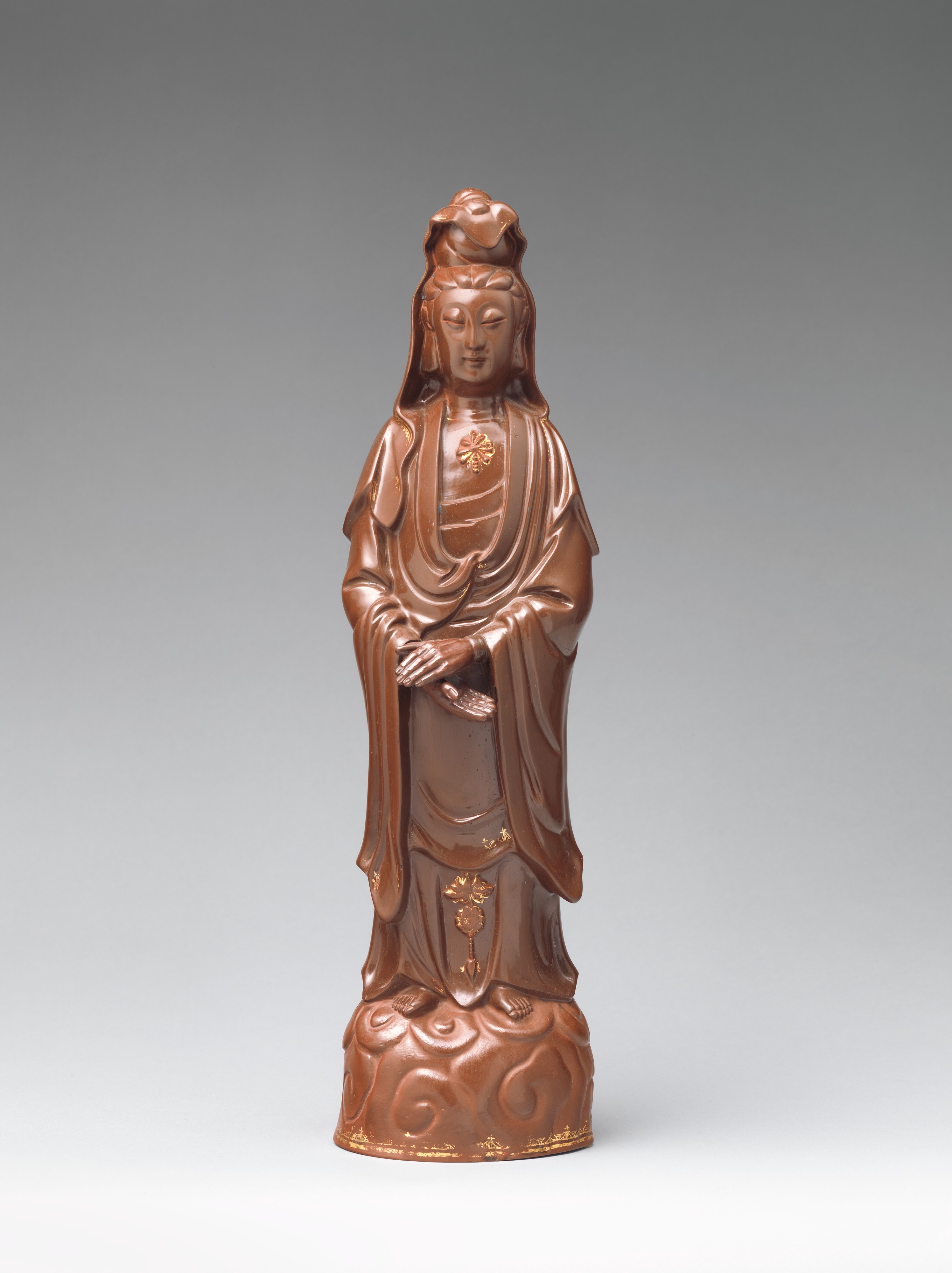
Three pieces in the Staatliche Kunstsammlungen Dresden — PO 8638 (Dehua original), PE 2373 (Meissen copy), and PE 2188 (Meissen copy) — constitute the most important known comparative study material between Dehua originals and Meissen imitations. Their juxtaposed display is an object lesson in materials science and craft transmission.
Shrinkage — Meissen copies are systematically smaller than Dehua originals. The reason is materials physics: Meissen’s porcelain paste formula differs from Dehua’s, producing different firing shrinkage rates. Attempting a 1:1 copy inevitably yields a smaller piece upon removal from the kiln. This visible size discrepancy is the macroscopic expression of two different paste chemistries — the chemical fingerprint analysis examines this material difference in detail.
Hand modelling differences — The Guanyin’s hands in the Dehua original are fluid and naturalistic, with soft yet precise transitions between knuckles and joints. The Meissen copy’s hands are noticeably stiff, with inferior proportional relationships and curvature quality. Hands are the most technically demanding element in porcelain sculpture — they expose the Meissen artisan’s gap relative to the He Chaozong tradition documented in the He Chaozong global corpus.
Firing cracks — Cracks appearing on Meissen copies are extremely rare on Dehua originals. Although Meissen’s hard-paste formula was chemically close to true porcelain (this was Böttger’s breakthrough), its thermal expansion coefficient match with the glaze differs from Dehua’s, producing different body-glaze stress relationships and therefore different crack probabilities.
Metropolitan Museum piece 1974.356.319 (H. 37.5 cm) provides another publicly accessible comparative case. The differences in size, glaze texture, and overall presence between this Meissen copy and its Dehua original are perceptible even to non-specialist viewers in side-by-side display.
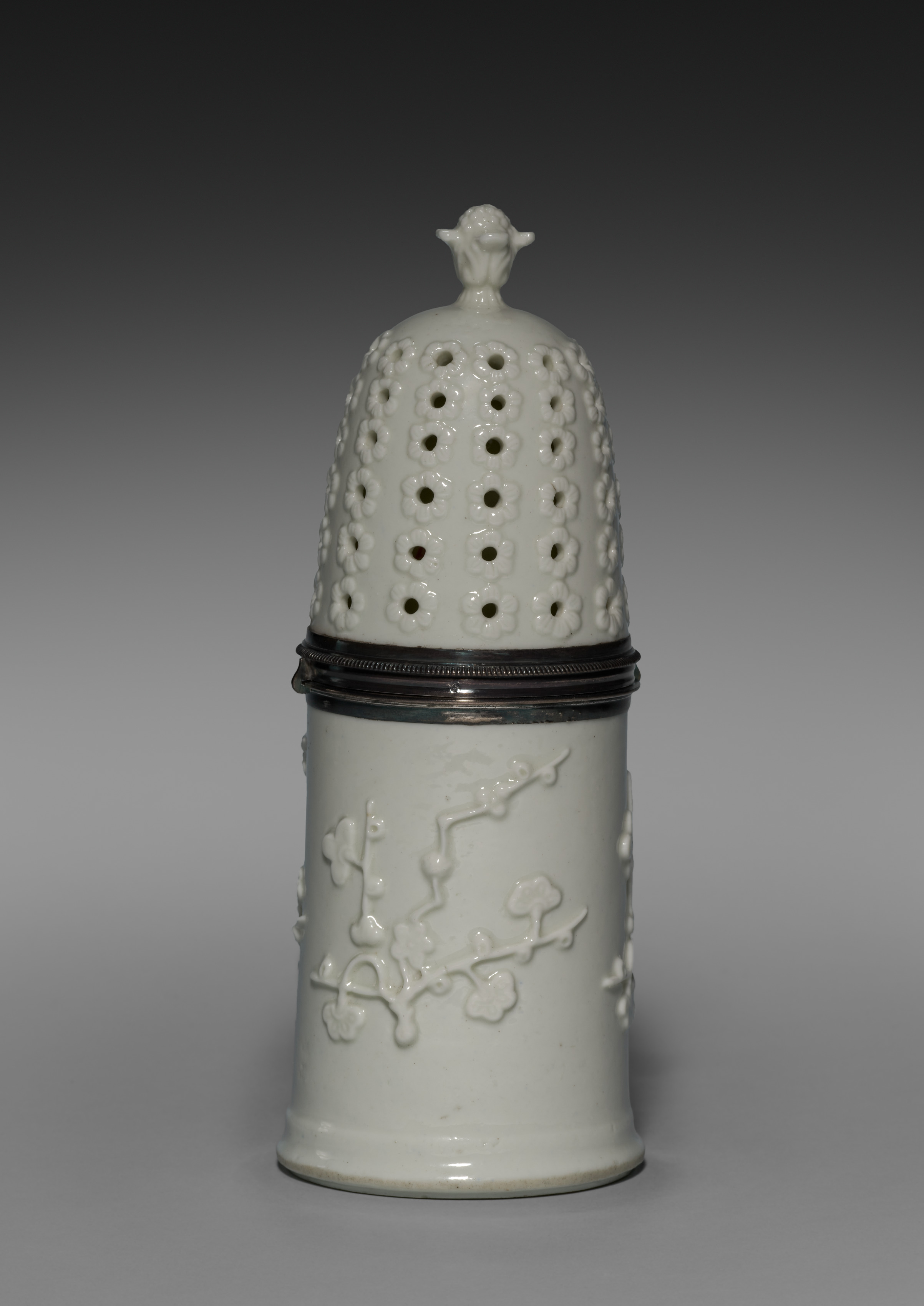
Meissen’s imitation of Dehua blanc de Chine proceeded through three clearly distinguishable phases. This evolutionary sequence, documented by P.J. Donnelly (Blanc de Chine: The Porcelain of Tehua in Fukien, Faber & Faber, 1969, xiv + 407 pp.) and repeatedly cited by subsequent scholars, has become the canonical case study of technological catch-up in ceramic history.
Phase One: Direct Imitation (c. 1710–1720s)
Early Meissen products were near piece-by-piece moulds of Dehua blanc de Chine. PO 8638/PE 2373/PE 2188 document precisely this phase. The artisan’s task was to replicate Chinese originals as accurately as possible — the results, as detailed above: shrinkage, stiff hands, cracks. The 2006 Frick Collection exhibition “Meissen at the Palace” confirmed this phase’s high dependency on Dehua originals.
Phase Two: Höroldt’s Chinoiserie (c. 1720–1730s)
Johann Gregorius Höroldt joined Meissen in 1720, bringing a revolution in painted decoration. He developed 16 enamel colours and began painting “Chinoiserie” motifs on white porcelain bodies — no longer pursuing Dehua’s plain white aesthetic but using white porcelain as a canvas for a new visual language. This was a critical turning point: from “copying China” to “imagining China.”
Phase Three: Kändler’s Original Period (from 1731)
Johann Joachim Kändler became Meissen’s chief modeller (Modellmeister) in 1731, subsequently creating over 1,300 original models. His Swan Service (Schwanenservice, c. 1737–1741, over 2,200 pieces) for Count Heinrich von Brühl marked Meissen’s complete departure from the Chinese paradigm, establishing an independent aesthetic system. From copying Dehua Guanyin to the Swan Service — this evolution took approximately twenty years.
Meissen’s early history includes a scandal repeatedly cited in museum scholarship, whose details are more remarkable than the usual summary suggests. A 2024 paper in Archaeometry (Wiley), “Scandal at the Albrechtsburg,” provides a systematic reconstruction.
Count Karl Heinrich von Hoym (1694–1736, Saxon ambassador to Paris) conspired with porcelain merchant Rodolphe Lemaire (born 1688). Lemaire travelled to Dresden, where von Hoym arranged an audience with Augustus and secured a commission for Meissen to produce imitations of Japanese Kakiemon-style porcelain. Augustus required all copies to bear Meissen’s crossed-swords mark — to showcase Saxon manufacturing prowess.
Von Hoym and Lemaire did the opposite. They persuaded painter Höroldt to apply the crossed swords in overglaze rather than underglaze, making the marks removable with nitric acid or diamond abrasion and replaceable with forged Chinese marks. Lemaire took 2,500 pieces; von Hoym privately retained 1,800. Some pieces entered the Paris market, sold as genuine East Asian wares at corresponding prices. When Augustus returned to Dresden in 1731, the scheme was exposed.
The consequences were severe. Von Hoym was dismissed, convicted of treason, sentenced to life imprisonment, and ultimately took his own life at Königstein Fortress. Lemaire was briefly imprisoned and expelled from Saxony, thereafter disappearing from the historical record.
The core insight of this affair transcends the scandal itself: in the European market of the 1720s–1730s, the brand premium carried by a “made in China” porcelain label was so high that an ambassador and a merchant risked a treason conviction to forge it. Meissen’s crossed-swords mark — which in later centuries became one of Europe’s most valuable porcelain trademarks — at the time actually needed to be removed because it diminished market value. The 2027–2035 scenario projection analyses the reversal of this brand-value hierarchy over three centuries.
The Victoria and Albert Museum holds over 170 pieces of Dehua blanc de Chine, primarily spanning the seventeenth to twentieth centuries — a figure confirmed by Rose Kerr, former principal curator of the V&A’s Far Eastern Department. Kerr is also the lead author of Blanc de Chine: Porcelain from Dehua (2002).
V&A piece C.450&A-1922 — a Meissen prunus-relief chocolate beaker and saucer — is described in the curatorial text as “virtually indistinguishable” from the Dehua original.
For a world-class museum’s professional curatorial team to deploy the phrase “virtually indistinguishable” simultaneously conveys two things: the highest possible assessment of early Meissen imitative precision, and a direct confirmation of Dehua’s status as the model. Yet the same V&A curators in the same context also noted discernible differences — corroborating the shrinkage and cracking phenomena demonstrated by the Dresden Three in §4.5.
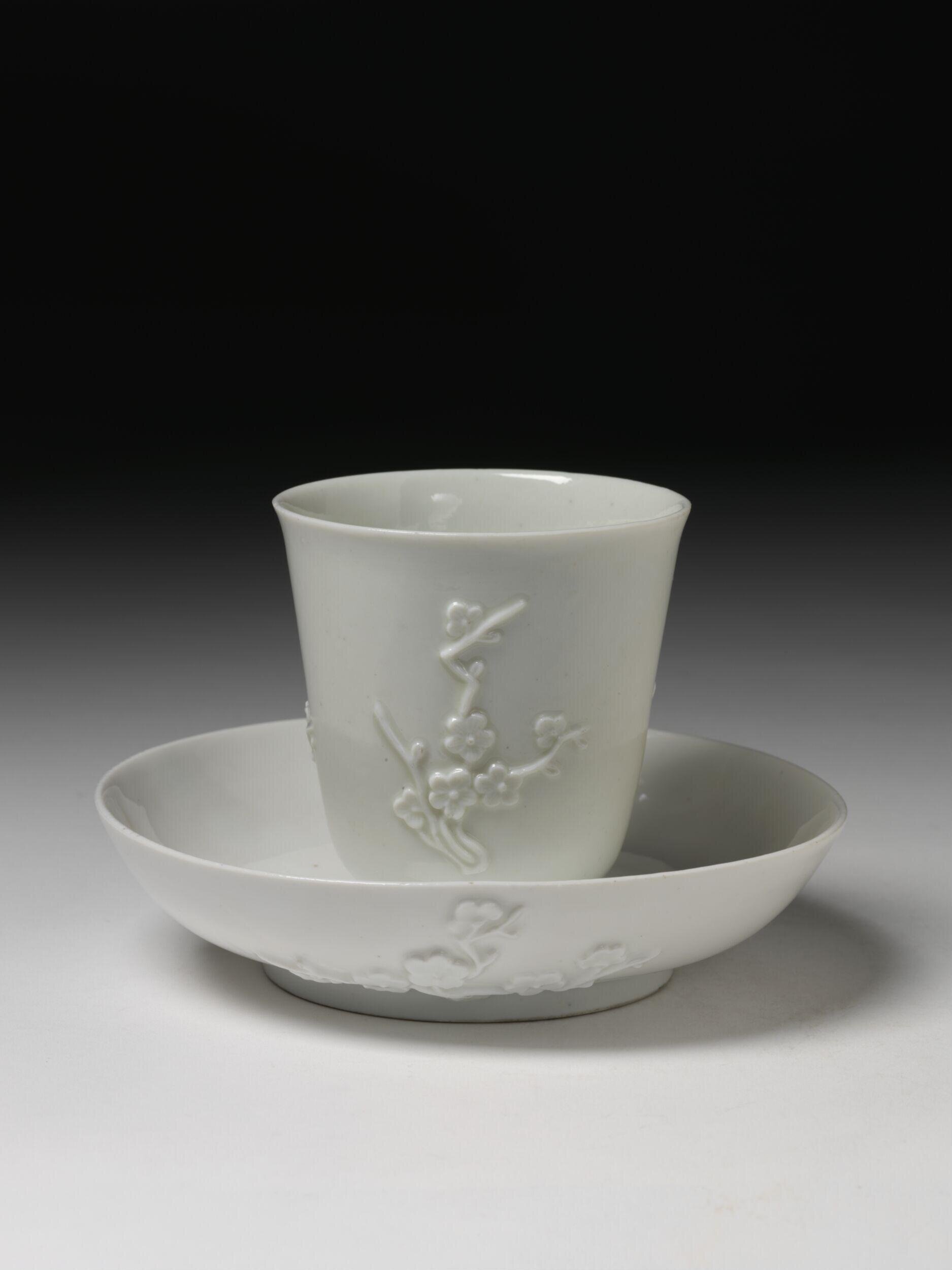
Meissen was not the only student. From the Netherlands to Naples, from Paris to London’s East End, all of Europe was attempting to replicate Dehua blanc de Chine. The confirmed major imitation centres, in chronological order:
Delft’s De Grieksche A factory (“The Greek A,” Adrianus Kocx, products bearing the AK mark) was among the earliest imitators. Delft used tin-glazed earthenware — not porcelain by any definition — but its white appearance sought to approximate the visual effect of Dehua blanc de Chine. Transaction records from Amsterdam dealer Aronson Antiquairs include multiple Delft white-glaze pieces imitating Dehua. Delft’s positioning was to provide the Dutch middle class with a lower-cost visual approximation of Dehua blanc de Chine.
The earliest European factory to successfully produce soft-paste porcelain. Encyclopædia Britannica confirms Dehua blanc de Chine’s direct influence on Saint-Cloud. One of Saint-Cloud’s most successful decorative motifs — the “en artichaut” (thistle) pattern — derives directly from Dehua’s relief prunus-blossom decoration. The Musée des Arts Décoratifs in Paris holds 410 Saint-Cloud pieces — the world’s largest Saint-Cloud collection. Bard Graduate Center’s 1999 exhibition “Discovering the Secrets of Soft-Paste Porcelain at the Saint-Cloud Manufactory” systematically presented this material. Approximately 20 examples feature Dehua cups paired with Saint-Cloud saucers — Chinese cup, French saucer — a hybrid born not of aesthetic choice but of supply-chain reality.
The marriage of Naples King Charles VII (later King Carlos III of Spain) to Maria Amalia of Saxony — granddaughter of Augustus the Strong — brought the porcelain obsession from Dresden to Naples. In 1743, the couple established a porcelain factory at the Palace of Capodimonte. Products included soft-paste cups with prunus relief imitating Dehua — from Dresden to Naples, Dehua blanc de Chine’s influence crossed the Alps. When Charles inherited the Spanish throne in 1759, the entire factory was relocated to Madrid (Real Fábrica del Buen Retiro).
Self-styled “New Canton.” The British Museum holds a Bow inkwell inscribed “MADE AT NEW CANTON 1750.” Bow not only named itself after a Chinese city; the architecture of its first factory was modelled on the East India Company warehouses in Canton. Encyclopædia Britannica confirms that Bow employed approximately 300 workers at its peak, with products including imitations of Dehua blanc de Chine.
Chelsea factory’s “Triangle Period” (1745–1749) products feature prunus-relief decoration. V&A curatorial texts confirm the transmission chain for this decorative element: Dehua blanc de Chine → Saint-Cloud → Chelsea. Chelsea’s prunus relief was not a direct imitation of Dehua but an imitation of Saint-Cloud’s imitation of Dehua — an influence transmitted through two intermediaries. The origin of the transmission chain remains traceable to Dehua kilns in Fujian.
Worcester porcelain works likewise produced Chinese-style soft-paste products in its early years. Worcester used soapstone (steatite) as one of its raw materials — a formula differing from both Dehua and Meissen pastes, but whose products pursued visual approximation of East Asian white porcelain.
Eighteenth-century France sustained a distinctive trade: the marchands-merciers (luxury dealers / decorative-arts merchants). They did not produce things; they transformed them — purchasing Oriental porcelain, fitting ormolu mounts (gilt-bronze fittings), and converting “exotic curiosities” into “French interior elements.” Only marchands-merciers, exempt from guild restrictions, held the legal right to perform this cross-material conversion — bronze-fitting, lacquer-inlaying, base-mounting — itself a legally protected monopoly.
Lazare Duvaux’s Livre-Journal (1748–1758) is the most important primary document for this trade, edited and published in 1873 by art historian Louis Courajod and since established as a canonical source for eighteenth-century decorative arts research. This account book records luxury goods Duvaux sold to French aristocratic clients. A 1750 entry records for the first time a Chinese celadon carp ewer fitted with ormolu mounts — a pair of similar pieces sold at Christie’s in 2023 descends from this tradition. Madame de Pompadour was among Duvaux’s principal clients; in 1752 she purchased “quatre morceaux de porcelaine céladon… le tout garni en bronze doré d’or moulu” (four celadon pieces, all fitted with ormolu mounts).
Duvaux’s records pertaining directly to Dehua blanc de Chine are equally significant. On 4 August 1755, Duvaux sold a pair of Dehua blanc de Chine cockerel figures with ormolu mounts (No. 2207) to Madame de Pompadour — a transaction that precisely locates Dehua blanc de Chine within the decorative system of Louis XV’s court. The Royal Collection likewise contains multiple examples of Dehua blanc de Chine with metal fittings; John Ayers catalogued at least Cat. 163, 164, 170, 171, 172, and 173 in his 2017 inventory.
Metal fittings on Dehua blanc de Chine took two forms: first, fitting traditional Chinese vessels with Western-style mounts — as with a Royal Collection Dehua prunus vase fitted with gilt-bronze lip and foot mounts, the rim and lid edge mounted in silver-gilt, its lid also set with a miniature portrait of George III; second, transforming damaged pieces into new objects through metal fittings — as with a Dehua vase with a broken neck repurposed as an incense burner, its lid pierced with six silver-set holes and crowned with a gilt finial, reassembled into an entirely new functional object.
The peak period for ormolu mounts was 1740–1760. A Dehua Guanyin without bronze mounts was, in a European drawing room, an exotic curiosity from the Orient — foreign, conversational. With Louis XV-style ormolu mounts, the same Guanyin became an organic component of French Rococo interior design. This identity transformation was unidirectional. Dehua potters did not know their work would be fitted with bronze feet in Paris. Buyers did not care about the potters’ intentions. The marchands-merciers’ profit derived precisely from the identity-transformation process itself — the cross-cultural semantics of white porcelain returns to this phenomenon within a framework of cross-cultural reception.
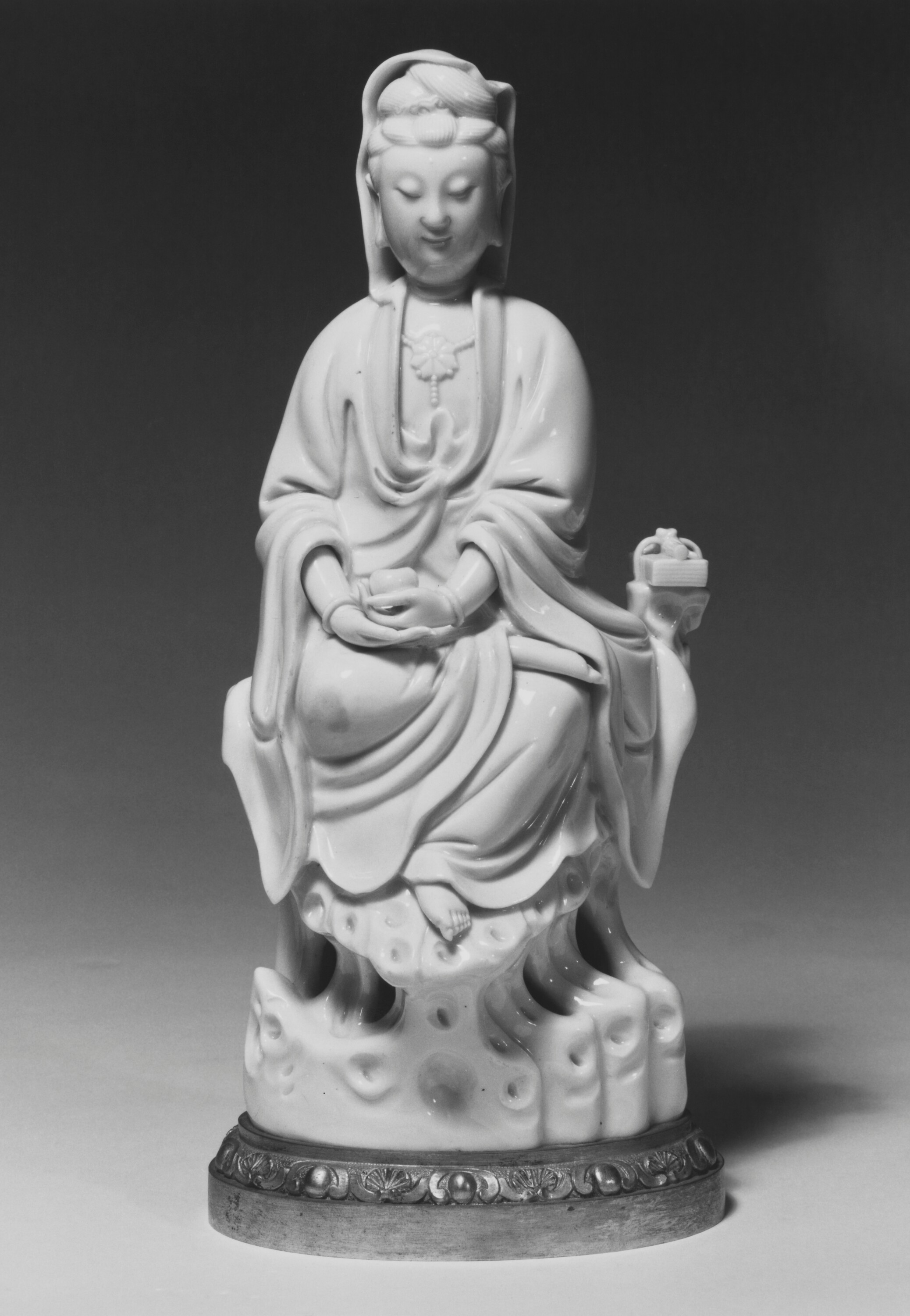
In 1752, the VOC vessel Geldermalsen sank in the South China Sea (shipwreck archaeological database). Its cargo of Chinese porcelain never reached Europe — but by this date, European market dependence on Chinese porcelain had already declined sharply.
By approximately 1752, the production capacity and quality of Meissen, Sèvres, Chelsea, Worcester, and other European factories had matured. Import substitution was complete. In the same period, China began reverse-imitating Meissen — the direction of imitation had inverted. The Walker Art Center collection includes examples juxtaposing Chinese Meissen-imitations with Meissen Dehua-imitations. The two directions of imitation, placed side by side, constitute a complete footnote to eighteenth-century globalised trade.
The time window of this Great Reversal — approximately 1740–1760 — overlaps with the decline of Dehua blanc de Chine’s ivory-white peak (as described in the historical evolution, Qing-era Fe₂O₃ rebound). Supply-side quality decline and demand-side competitive displacement occurred simultaneously. From 1690 to the 1750s: sixty years. In sixty years, Dehua blanc de Chine went from being the model that European factories copied to being the product they replaced — a complete technological catch-up process with detailed archival documentation in ceramic history.
Within the twenty-first-century global museum system, the distribution of Dehua blanc de Chine holdings itself constitutes an evidence inventory. Confirmed major collections include:
The above lists only confirmed dedicated collections. The National Palace Museum (Taipei), Palace Museum (Beijing), Guangzhou Museum, Fujian Museum, and Quanzhou Maritime History Museum also hold substantial Dehua blanc de Chine holdings — but this dimension focuses on the European imitation evidence chain; Chinese museum collections are discussed in other dimensions.
Beyond museum holdings, the inventory lists and wills of seventeenth- and eighteenth-century European royalty and aristocracy provide direct evidence that Dehua blanc de Chine penetrated the upper echelons of European society. The following records are compiled from EIC shipping archives and various noble-family documents.
| Country | Owner | Date | Collection Summary |
|---|---|---|---|
| England | Thomas Howard, Earl of Arundel (1585–1646) | 1641 | Inventory lists 69 white porcelain figures: white man-and-boy, laughing Buddha (Budai), white lion on pedestal, seated lady, standing lady figures |
| England | Lady Diana, Viscountess Cranborne | 1675 | Inventory: lion figures, two figures, one Virgin Mary with ewer, one Cupid |
| England | 5th Earl of Exeter (Burghley House) | 1688/1690 | 1688: two seated white nuns, two standing white nuns, two figures on lions, two white lions, two large white figures, two lidded white teapots. 1690: two figures with child on lap |
| England | Queen Mary II (1662–1694), Hampton Court | c. 1696 | Six large seated Guanyin figures (inventoried from Kensington Palace, 1696–1697) |
| England | Duke of Marlborough, Blenheim Palace | early 18th c. | Cups of various sizes, three Virgin Mary figures, one seated child-giving Guanyin, one cold-painted standing Guanyin, one European-on-monkey seated figure |
| Germany | Augustus the Strong | 1721 | Inventory lists 1,122 pieces: figure sculptures and dolls, various bowls, butter dishes, dessert plates, salt boxes, bottles, jars and spoons, tea sets and accessories (teapots, milk jugs, saucers and coffee cups) — many lots annotated as “Blanc de Chine” |
| France | Philippe II d’Orléans, Régent (1674–1723) | 1724 | Inventory: small ewers, cups, silver-mounted teapots, figures, European family groups, silver-mounted crane candlesticks |
| France | Lazare Duvaux, dealer (c. 1703–1758) | 1748–1758 | Sales ledger documents Dehua transactions; 4 August 1755 sold a pair of ormolu-mounted Dehua cockerel figures (No. 2207) to Madame de Pompadour |
| Netherlands | Jan Blasse, painter (d. before 1637) | before 1637 | Inventory includes lion candlesticks — per documentary sources, among the earliest Dehua blanc de Chine to reach the Netherlands |
| Italy | Anna Maria Luisa de’ Medici (1667–1743), Palazzo Pitti | late 17th c. | Numerous Dehua figures and wine cups: European-on-qilin, European family groups, lion candlesticks in three sizes, and seated child-giving Guanyin |
| Spain | Palacio Real, Madrid | 1759–1788 | Posthumous inventory of King Charles III lists two clocks mounted with Dehua blanc de Chine figures |
| Denmark | Christian IV, Rosenborg Castle | 1718 | Earliest castle inventory lists five Guanyin figures and three standing lady figures in robes with high-booted headdress |
| Sweden | Queen Hedwig Eleonora (1636–1715), consort of Charles X | 1690–1700 | Purchased from the Netherlands: one seated Guanyin-with-child, two standing Buddhas, two cold-painted Virgin Marys, lady figures including one holding an infant |
| America | Jacob De Lange, barber-surgeon | 1685 | New York inventory lists two white teapots and three white male figures — very probably Dehua blanc de Chine |
| America | Margrieta van Varick (1649–1695) | 1695 | New York will and inventory: one white porcelain lion incense-holder, one figure, and two lidded cups or bowls |
Sources: Wan Jun, “Production and Trade of Dehua Blanc de Chine in a Global Perspective,” Journal of the Palace Museum, 2021, Vol. 22, Appendix III; Rose Kerr, “Dehua Blanc de Chine Trade to Europe and the New World” (Parts I & II), Fujian Wenbo, 2012/2014.
The table reveals three important findings. First, the earliest record appears in 1637 (Dutch painter Jan Blasse), predating the conventionally recognised bulk-trade period — indicating that Dehua blanc de Chine entered European private collections earlier than the bulk trade. Second, the 1685 New York record of Jacob De Lange and the 1695 New York record of Margrieta van Varick prove that Dehua blanc de Chine had crossed the Atlantic into daily life in North American colonies by the late seventeenth century. Third, Augustus the Strong’s 1721 inventory of 1,122 pieces and the French Régent’s 1724 multi-category inventory demonstrate not only collection scale but also that Dehua blanc de Chine’s function in European courts had expanded from “exotic curiosity” to utilitarian ware (tea sets, coffee cups) and interior decoration (candlesticks, figures) — entirely consistent with the cross-cultural reception pathways discussed in the cross-cultural semantics of white porcelain.
The European imitation evidence chain for Dehua blanc de Chine, arranged chronologically:
| Date | Event | Location | Nature |
|---|---|---|---|
| c. 200 CE | Eastern Han China — mature porcelain appears | China | Global monopoly |
| 1295 | Marco Polo brings porcelain records to Europe | Italy / China | First record |
| 1575 | Medici soft-paste porcelain (failed) | Italy | First attempt |
| c. 1690 on | Delft imitation (tin-glazed earthenware) | Netherlands | Low-end substitute |
| c. 1693 | Saint-Cloud begins soft-paste production | France | Earliest European soft-paste |
| 1708 | Böttger discovers hard-paste formula | Saxony | Technological breakthrough |
| 1709.11.28 | Augustus orders Dehua samples sent to Meissen | Saxony | Hard-paste imitation begins |
| c. 1710–1720 | Meissen direct imitation phase | Saxony | Piece-by-piece moulding |
| c. 1720–1730 | Höroldt Chinoiserie phase | Saxony | Adaptive innovation |
| 1731 on | Kändler original phase | Saxony | Independent system |
| c. 1740–1760 | Ormolu mount peak period | France | Identity transformation |
| 1743 | Capodimonte factory founded | Naples | Soft-paste imitation |
| c. 1744–1776 | Bow "New Canton" | England | Imitation + self-naming |
| 1745–1749 | Chelsea Triangle period prunus relief | England | Second-hand imitation |
| c. 1750s | Great Reversal — China begins imitating Meissen | China / Europe | Direction reversed |
European factories completed the catch-up in craft and design, but could not replicate the chemical characteristics of Dehua paste — Fe₂O₃ content below 0.5% is a geological endowment, not transferable. The chemical fingerprint analysis examines this material difference in detail. The international luxury porcelain benchmarking returns to Meissen’s evolutionary arc from imitation to original creation within a brand-comparison framework.
The factual claims in this dimension are based on the following categories of sources: (1) Museum curatorial texts and collection databases (Met, V&A, SKD, Rijksmuseum, Getty); (2) Peer-reviewed journal articles (Archaeometry, etc.); (3) Authoritative encyclopaedia entries (Encyclopædia Britannica); (4) Field-standard scholarly monographs (Donnelly 1969, Kerr & Ayers 2002, Finlay 2010). All figures, dates, and quotations are attributed to sources. Where sources disagree (e.g. the number of Dehua samples sent to Meissen on 28 November 1709: 7 vs. 8), this report presents the discrepancy without arbitrary resolution. The term “imitation” is used throughout in accordance with ceramic-history convention, denoting reference and replication of craft and form without pejorative judgment.
Keywords
European porcelain imitation · Meissen · Blanc de Chine · Dehua porcelain · Augustus the Strong · Böttger · hard-paste porcelain · Delft · Saint-Cloud · Chelsea · Bow · Capodimonte · ormolu mounts · Dragoon Vases · Dresden · prunus relief · Chinoiserie · Tschirnhaus · Weißes Gold · Hoym-Lemaire
View Full Data — European Imitation Timeline
Chemical composition of Dehua clay compared across four major white porcelain centres — the geochemical basis of the warm white tone of Blanc de Chine
| Report No. | WH-GR-2026-001-DIM05 |
| Part of | WH-GR-2026-001 |
| Version | 1.0 (Initial Public Release) |
| Published | April 2026 |
| Data Cutoff | April 2026 |
| Lead Researcher | Jack Lin |
| Publisher | World Headlines Inc., Manhattan, New York |
| Review Status | Internal research review; not externally peer-reviewed |
| License | CC BY-NC 4.0 International |
| Persistent ID | 10.5281/zenodo.19519691 |
The chemical data below isolate the core parameters that set Dehua apart from every other white porcelain tradition.
The comparison synthesises three key academic sources:
| Component | Dehua (Ming body) | Jingdezhen (tianbai body) | Ding (Song body) | Meissen (early hard-paste) |
|---|---|---|---|---|
| SiO₂ | 71.8–74.2% | 70–75% | 64–68% | 65–70% |
| Al₂O₃ | 15–18% | 18–23% | 25–30% | 24–28% |
| K₂O | 6.5–7.3% | 3–4.5% | 2.5–4% | 1–2% |
| Fe₂O₃ | <0.5% | 0.8–1.5% | 1–2% | 0.5–1% |
| Na₂O | 0.3–0.8% | 0.5–1.5% | 0.5–1% | 2–4% |
| CaO | 0.5–2% | 1–5% | 2–5% | 1–3% |
Two key parameters distinguish Dehua from every other centre: Fe₂O₃ < 0.5% and K₂O 6.5—7.3%.
Jingdezhen uses a “dual-formula” body — porcelain stone blended with kaolin clay. This has been standard practice since the Yuan dynasty. The dual formula raises the alumina content and refractoriness of the body, making it possible to fire large-scale vessels.
Dehua is different. Dehua uses a single porcelain stone. One rock, ground and levigated (washed repeatedly in water to separate coarse from fine particles), shaped directly into ware. No second raw material is needed.
The physical consequence of the single formula: body and glaze have closely matched thermal expansion coefficients. A Song-dynasty assessment noted that Dehua ware “resembles Ding ware but without crazing” — meaning Dehua was as fine as Ding, yet free of crackle (the network of fine fractures in the glaze surface). Crazing results from a mismatch in the thermal expansion of body and glaze. Dehua has no crazing because the body is the chemical foundation of the glaze itself; the two contract in unison as the kiln cools.
K₂O at 6.5—7.3% — this figure leads all four white porcelain centres by a wide margin. Jingdezhen: 3—4.5%. Ding: 2.5—4%. Meissen: 1—2%. Dehua’s potassium content is three to seven times that of Meissen.
The physical effect of high potassium: it promotes the formation of a glass phase — the non-crystalline fraction of the fired body. The higher the glass-phase proportion, the denser and more translucent the body becomes.
Hold a thin-walled Ming Dehua cup against natural light. Light passes through the wall and emerges as a warm amber-orange tone — the result of scattering and absorption by the high-potassium glass phase. Jingdezhen’s tianbai glaze also shows some translucency, but in a cooler, bluish register, sharply distinct from Dehua’s warmth.
This translucency cannot be reproduced through craftsmanship in a low-potassium formulation, because it is a direct physical expression of chemical composition.
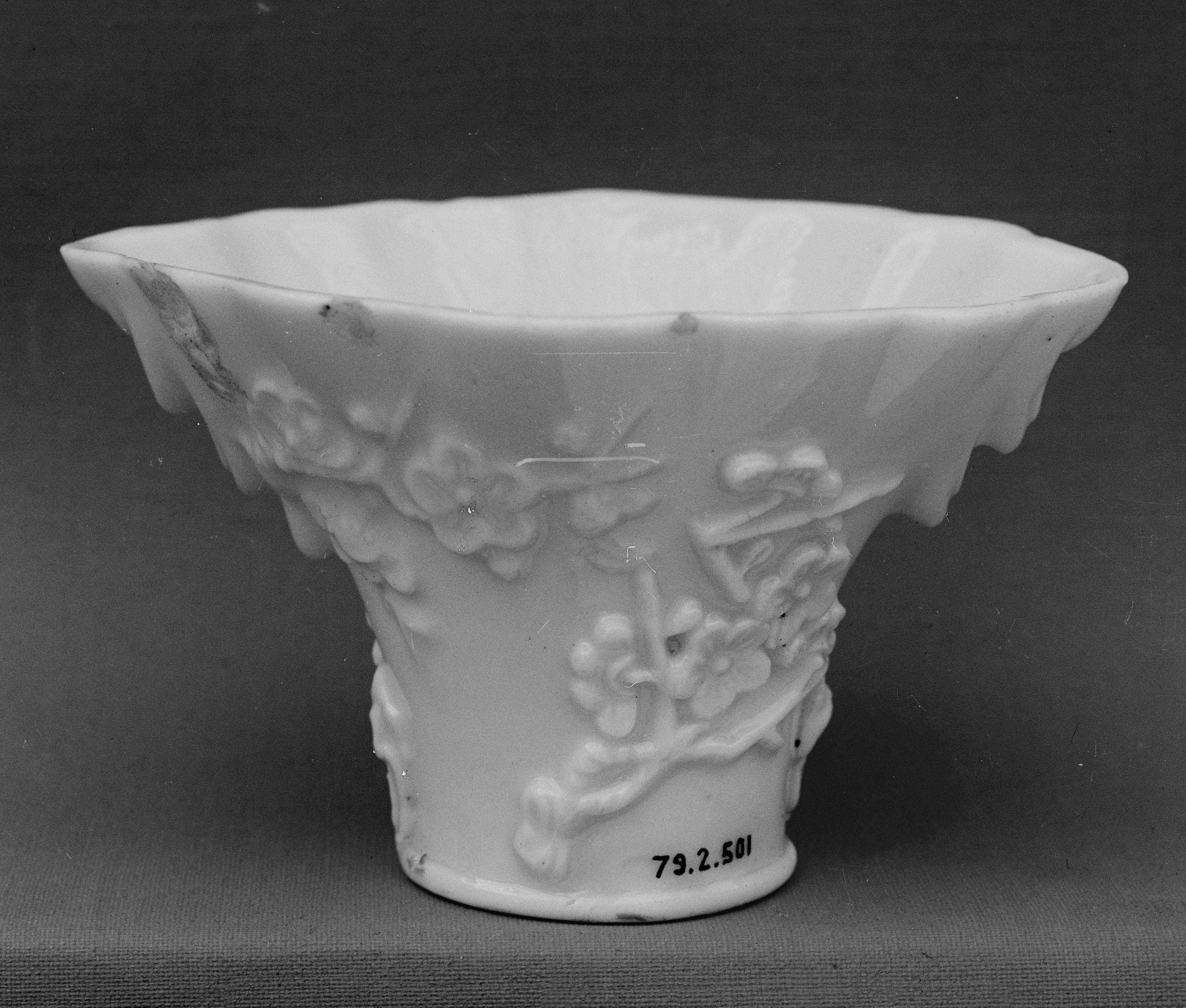
Kiln atmosphere falls into two categories: reducing (low oxygen, high carbon monoxide concentration) and oxidising (ample oxygen).
Jingdezhen must fire in a reducing atmosphere. The reason: its clay has high iron content (0.8—1.5%). In an oxidising atmosphere, iron exists as ferric iron (Fe³⁺), which colours the body yellow or brown — the porcelain turns sallow. A reducing atmosphere converts ferric iron to ferrous iron (Fe²⁺), which shifts the colour toward blue-green — this is the physical principle behind qingbai (bluish-white) ware. But reduction is difficult to control; minor fluctuations in kiln temperature and atmosphere cause colour variation and lower the yield.
At Fe₂O₃ below 0.5%, the iron content is so low that even in an oxidising atmosphere the colouring effect of ferric iron is negligible. Dehua can therefore fire in oxidation — technically simpler, with more uniform temperature and atmosphere across the kiln, and more stable colour.
Nigel Wood’s analysis in Chinese Glazes (2007) provides the authoritative conclusion: it is precisely the oxidising atmosphere that gives Dehua its distinctive warm white tone, visually quite unlike the cool white (bluish-white) produced under Jingdezhen’s reducing conditions.
Jingdezhen relies on a complex reducing process to counteract high iron for whiteness, while Dehua’s low-iron clay fires naturally white under oxidation.
Li Weidong’s XRF data reveal a critical temporal curve:
Song dynasty: Fe₂O₃ relatively high (approaching the 0.5% ceiling), K₂O relatively low. Colour tended toward bluish-white.
Mid-to-late Ming: Fe₂O₃ dropped to its minimum (around 0.3%), K₂O rose to its maximum (approaching 7.3%). The two curves crossed here, reaching the optimal range. The ivory-white peak.
Qing dynasty: Fe₂O₃ rose again (above 0.5%), K₂O declined. Colour shifted cool and slightly blue — “scallion white” (congren bai).
This chemical trajectory maps directly onto the traditional colour vocabulary:
Why was the Ming peak unsustainable? A likely explanation is that the source of clay changed. The Ming-period strata may have occupied the geological zone with the lowest iron and highest potassium. Once that zone was exhausted, Qing-era potters turned to strata with marginally higher iron. Changes in kiln architecture (from dragon kilns to step kilns) also altered the control of firing atmosphere.
The temporal evolution of chemical composition, overlaid with the shift in kiln technology, together produced an irreversible decline in Qing-era white porcelain quality. The conditions for Ming ivory white depended on the chemical signature of a specific geological stratum matched to the kiln technology of the period; once that stratum was depleted, the combination could not be reassembled.
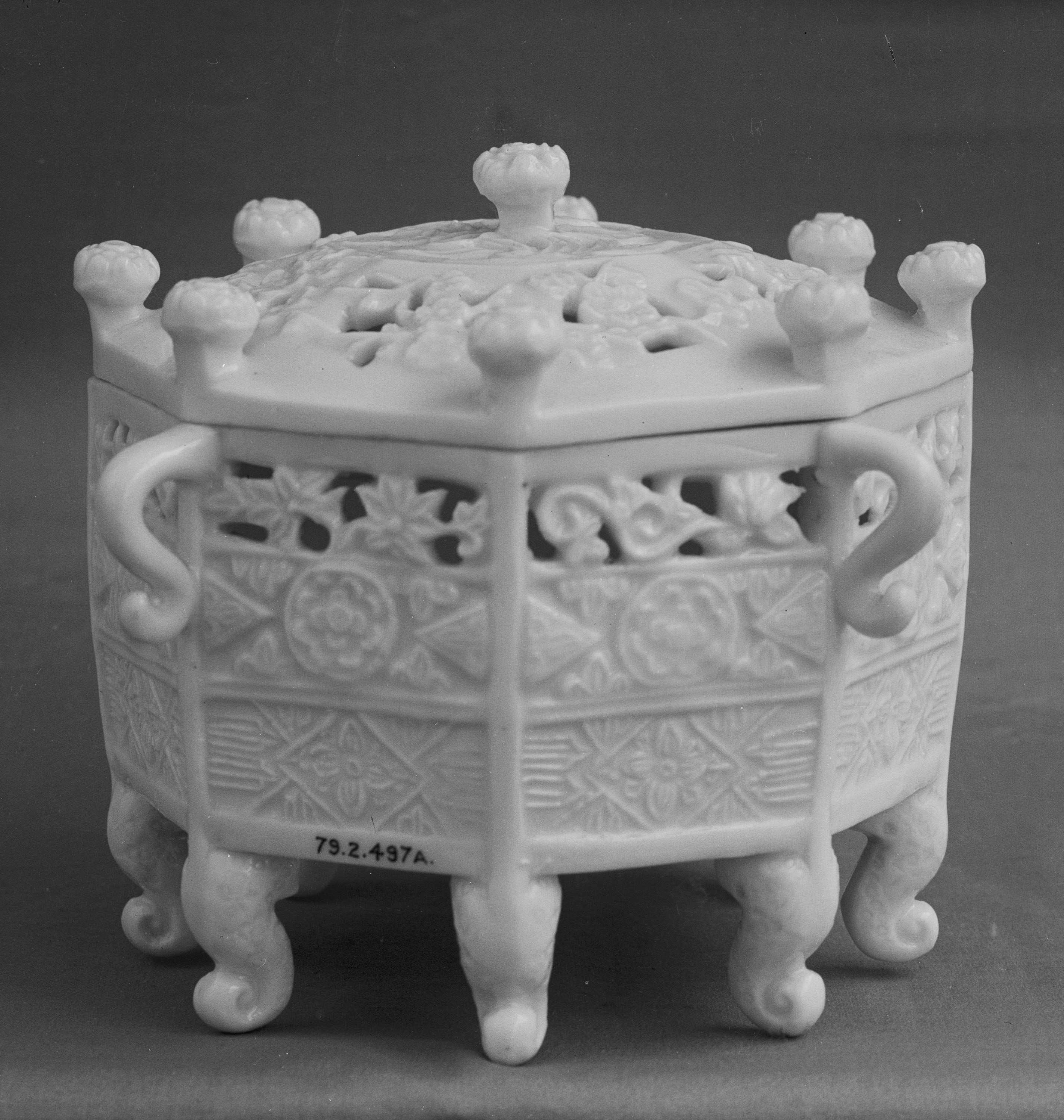
A passage in Nigel Wood’s Chinese Glazes (2007) serves as the concluding evidence for the materials-science dimension:
“Fundamental chemical differences” exist between Dehua and Jingdezhen porcelain, and these differences mean that the texture and tone of Dehua white porcelain “cannot be replicated” — not “difficult to replicate,” but “cannot be replicated.”
This judgement comes from the foremost authority on Chinese ceramic technology in the English-speaking world. Its implication: Dehua’s colour is determined by the geochemistry of its clay, not by process control. Even with complete mastery of firing technique and temperature profile, if the Fe₂O₃ content is 0.8% instead of 0.3%, the Dehua whiteness cannot be obtained. Meissen has been producing hard-paste porcelain since 1710, and its products have long commanded among the highest prices in the global market, yet it has never reproduced Dehua’s warm white tone — precisely because the clay chemistry is irreplaceable.
Proven Dehua clay reserves total 11.37 million tonnes.
For comparison: in 2009, the Ministry of Land and Resources designated Jingdezhen a “resource-depleted city.” After centuries of large-scale extraction, Jingdezhen faces severe resource constraints.
Dehua’s 11.37 million tonnes appear ample, but one critical figure is missing: annual consumption. Reserves divided by annual consumption equals extractable lifespan. Without the consumption figure, the lifespan cannot be calculated, and the point at which resource constraints become a hard limit on industrial growth cannot be assessed.
This is one of three information gaps identified by this report. In the 2027–2035 scenario projections, the quantitative assessment of Scenario C (resource-constraint scenario) is accordingly limited. The order of magnitude of reserves is known, but the extractable lifespan remains indeterminate.
“Electricity replaces firewood” (yi dian dai chai) has been one of the most consequential technological shifts in Dehua’s ceramics industry over the past two decades.
The environmental cost of traditional wood-fired kilns was enormous. Dehua lies in the Daiyun mountain range, historically rich in forest resources, but centuries of continuous logging for kiln fuel placed significant ecological pressure on the area. The adoption of electric and gas kilns severed the causal link between ceramic production and deforestation.
Dehua County’s forest coverage has since recovered to a high level — largely thanks to the ecological space freed by the fuel transition in the kiln industry.
The energy transition has a second dimension: electric and gas kilns offer far greater precision in temperature control than wood-fired kilns, raising the pass rate accordingly. This is one of the foundational conditions for the industry’s efficiency upgrade; detailed figures appear in Dehua ceramics industrial economics.
Keywords
Dehua porcelain chemical composition · ceramic chemical fingerprint · Blanc de Chine · Fe₂O₃ · K₂O · ivory white · lard white · scallion white · baby red · oxidising atmosphere · reducing atmosphere · translucency · glass phase · single-formula body · levigation · Nigel Wood · Chinese Glazes · XRF · four white porcelain centres · Jingdezhen · Ding ware · Meissen · clay reserves · energy transition
View Full Data — Chemical Composition Comparison
Structural analysis of public auction data for Blanc de Chine
| Report No. | WH-GR-2026-001-DIM06 |
| Part of | WH-GR-2026-001 |
| Version | 1.0 (Initial Public Release) |
| Published | April 2026 |
| Data Cutoff | April 2026 |
| Lead Researcher | Jack Lin |
| Publisher | World Headlines Inc., Manhattan, New York |
| Review Status | Internal research review; not externally peer-reviewed |
| License | CC BY-NC 4.0 International |
| Persistent ID | 10.5281/zenodo.19519691 |
The He Chaozong global corpus already lists He Chaozong and major Dehua auction results in descending order. Rather than repeating the table, this section analyses the structural features of the price distribution.
Geographic distribution of top results — the three highest prices were achieved in Tokyo (Uesugi, ¥320M), Hong Kong (Christie’s, HK$19.3M) and Nanjing (Shizhuzhai, RMB 15M). None occurred at a European or American saleroom. The implication: pricing power for the highest tier of Dehua porcelain currently sits in Asia, not London or New York.
Asia–West price gap — Lempertz Cologne at €856K, Bonhams London at £529K, Sotheby’s New York at $635K stand an order of magnitude below Christie’s Hong Kong at HK$19.3M. This means that for a He Chaozong work of comparable rank, the premium achievable at an Asian auction house far exceeds what the same piece would fetch in Europe or the United States. The reason is straightforward: Asian buyers — especially from mainland China, Hong Kong and Taiwan — have a far stronger cultural identification with and collecting preference for He Chaozong.
The Hindman effect — in 2020, a Dehua white porcelain figure at Hindman Auctions in Chicago was estimated at $600 and sold for $357,000. This extreme divergence between estimate and hammer is known in the trade as a “price discovery event” — the market correcting a severe prior undervaluation in real time. Hindman is a regional auction house whose core business is not Chinese ceramics; the initial estimate reflected a knowledge gap outside the specialist field. The moment a buyer who understood the true value of Dehua porcelain entered the room, the price snapped to its proper level.
Events like this continue to occur. They indicate that Dehua porcelain remains systematically undervalued in non-core markets — small and mid-tier auction houses outside Asia.
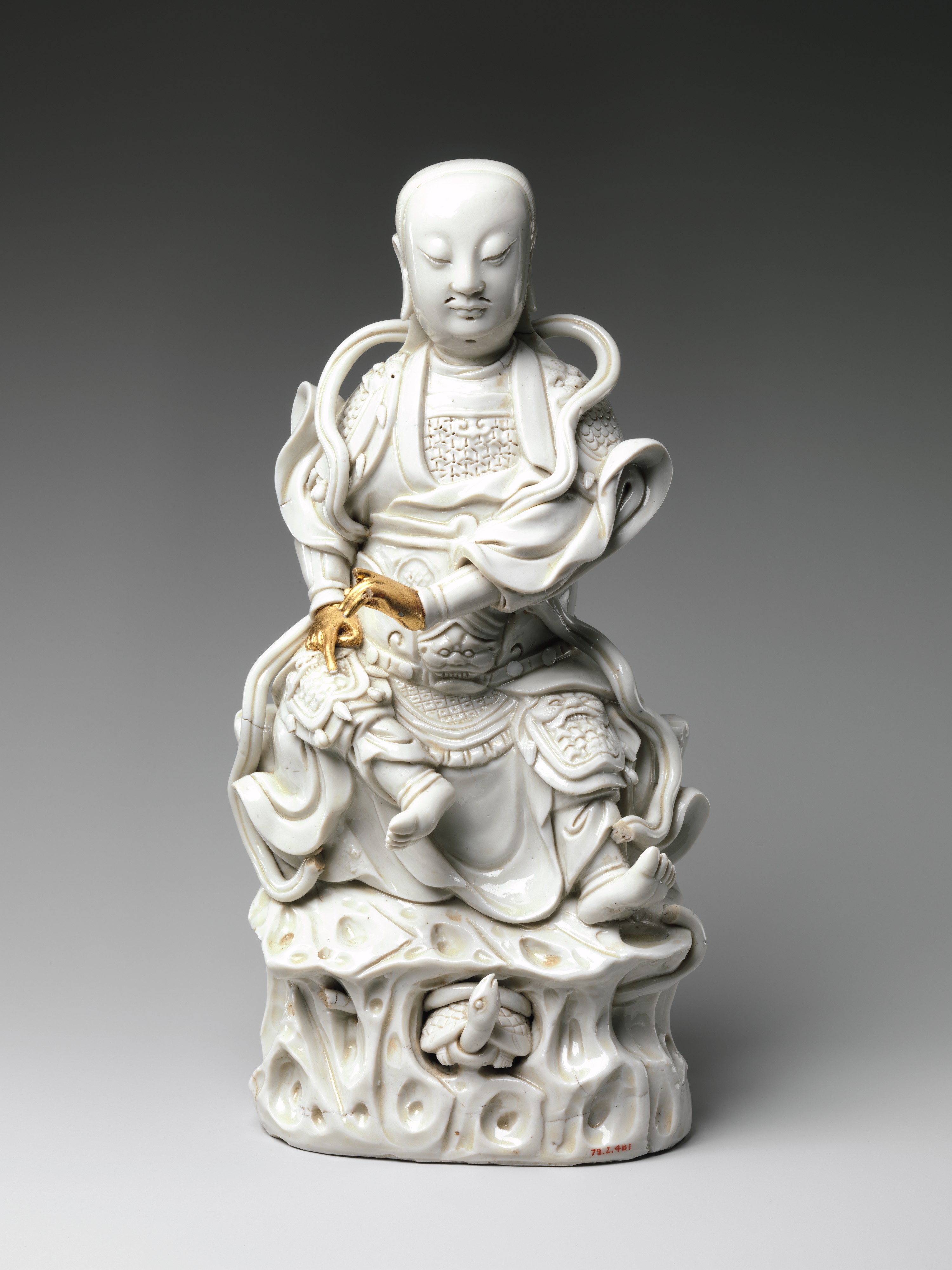
Based on a comprehensive analysis of public auction records through late 2025, the Dehua porcelain market can be segmented into seven price tiers:
| Tier | Category | Price Range (USD) | Market Characteristics |
|---|---|---|---|
| I | He Chaozong masterworks (clear seal, reliable provenance, perfect condition) | $600K–2.5M | Top auction houses, Asian buyers dominant |
| II | He Chaozong mid-range (seal disputed or minor condition issues) | $100K–500K | International auctions, requires scholarly support |
| III | Non-He master works (Zhang Shoushan, Lin Chaojing, Chen Wei, etc.) | $5K–50K | Upper-mid market, specialist bidding |
| IV | Unsigned fine ware (Ming to early Qing, high quality, no seal) | $2K–30K | London, New York, Hong Kong mid-tier auctions |
| V | Libation cups and special forms | $500–15K | Miscellaneous sales, dual material + form premium |
| VI | Late Qing reproductions | $500–5K | High volume, low price, entry-level collecting |
| VII | Contemporary mass-produced ware | $20–1K | Retail market, mostly non-auction channels |
The spread between Tier I and Tier VII exceeds 10,000×. The same material, the same place of origin, with prices ranging from $20 to $2.5 million. In any single ceramic category with publicly available data, this depth of price range is exceptionally rare.
This depth is both an asset and a liability. The asset: the barrier to entry is extremely low ($20 gets you in), the ceiling is extremely high ($2.5M for masterworks), covering the full spectrum from novice collectors to institutional buyers. The liability: price signals are extremely dispersed, and non-specialist buyers have almost no way to tell whether they are looking at a Tier IV or a Tier VI piece — visual similarity is high, and the authentication barrier is steep.
The He Chaozong global corpus introduced Marchant’s background. This section supplements it from a market-intelligence perspective, focusing on its pricing mechanism.
Marchant is not an auction house. It is a primary market dealer. The distinction: auction prices are bid-driven; a dealer’s prices are set by the dealer. Marchant’s asking prices reflect the pricing confidence underwritten by three generations and ninety-nine years of accumulated connoisseurship and client relationships.
Five dedicated exhibitions (1985 / 1994 / 2006 / 2014 / 2024) also function as scholarly publications — all five exhibition catalogues have been cited by subsequent research. The 2014 catalogue, priced at £80 / $130 at publication, now circulates at a premium on the secondary book market.
Marchant’s client base has never been disclosed. But its location (in 2025 it moved to Mayfair — one of London’s most expensive commercial addresses) and exhibition frequency suggest that its core clientele consists of high-net-worth collectors in Europe, the Americas and Asia, as well as museum acquisition funds.
P. J. Donnelly’s collection was donated to the British Museum in 1980, removing it from market circulation. But the authority of his monograph (507 pages, 160 plates) as a reference for authentication means that “published in Donnelly 1969” has become a premium label in auction catalogues. A work with a Donnelly publication record typically carries a higher estimate than a piece of comparable quality without one.
Frank Hickley’s 160 pieces of Dehua porcelain are now held by the Asian Civilisations Museum in Singapore. Rose Kerr and John Ayers’s 2002 publication covering all 160 pieces gave the collection complete scholarly documentation. Were any piece from the Hickley collection to appear on the market, it would carry the label “ex-Hickley Collection, published in Kerr & Ayers 2002” — one of the most valuable provenance annotations in the auction trade.
The 1688 household inventory of Burghley House records Dehua porcelain. This confirms that Blanc de Chine had entered English aristocratic households by the late seventeenth century.
Covered in the He Chaozong global corpus. The Vanderbilt marriage alliance gives the Blenheim collection a transatlantic provenance narrative with appeal for collectors on both sides of the Atlantic.
The museum’s 1904 catalogue already records Dehua porcelain holdings. This makes it one of the earliest American museums to formally accessioned Blanc de Chine and publish a catalogue entry — sixty-five years before Donnelly’s monograph.
Cleveland’s Dehua porcelain holdings serve as a reference standard for the American Midwest region.
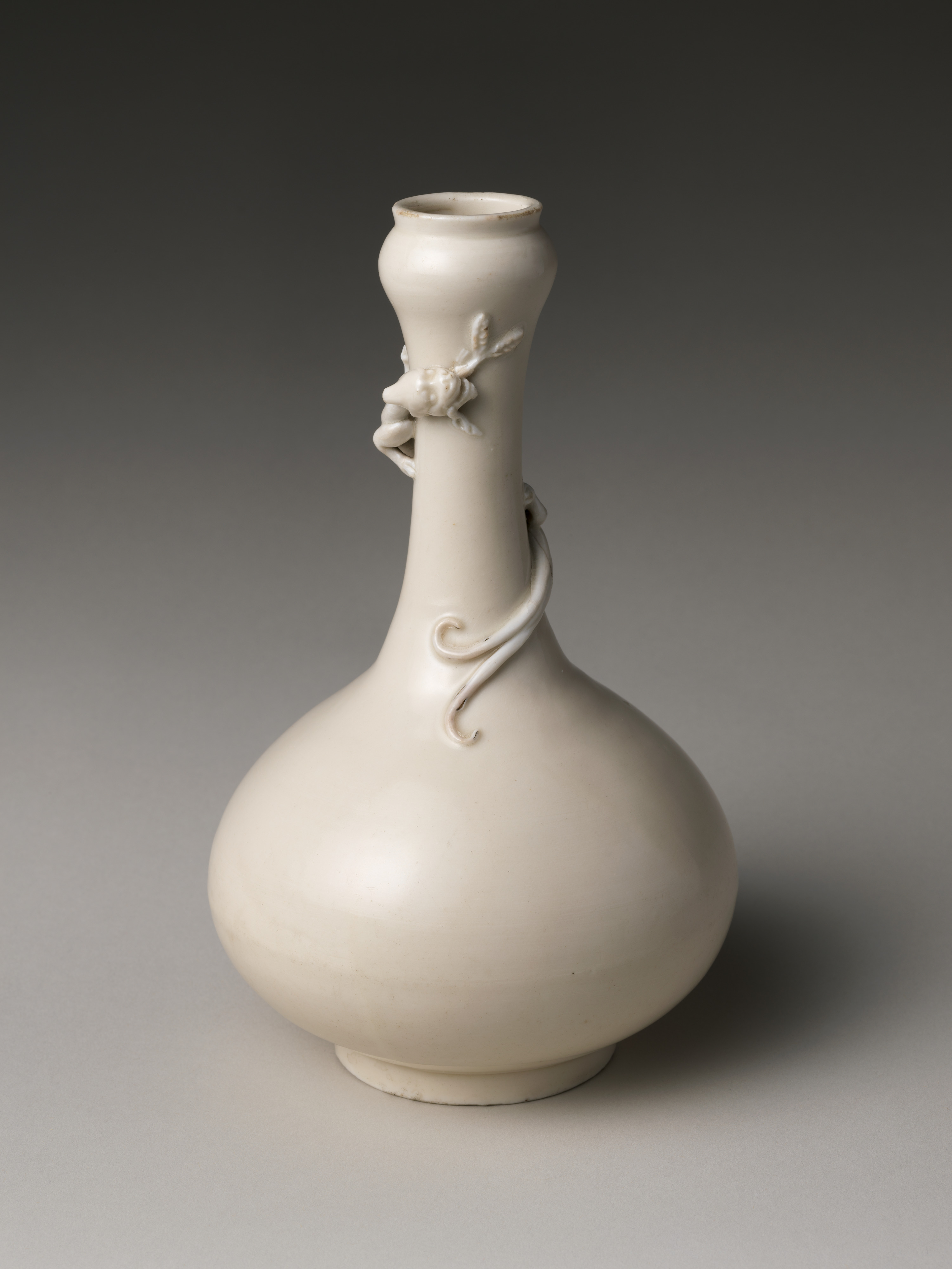
In the Dehua porcelain auction market, the premium attached to provenance is exceptionally pronounced. For a He Chaozong Guanyin of comparable quality, provenance differences alone can produce 2–5× price variation:
Provenance affects not only price but also access. Top auction houses (Christie’s, Sotheby’s) apply increasingly rigorous provenance vetting for high-estimate lots; works with broken provenance chains find it harder and harder to reach these platforms.
Market signals as of late 2025:
Upside signals —
Downside risks —
Structural assessment — the core tension in the Dehua auction market is this: the supply of top-tier works is extremely scarce (there may be no more than a few dozen genuine He Chaozong pieces worldwide), yet the authentication consensus remains fragile. Scarcity should drive prices up, but authentication uncertainty suppresses bidding confidence. The maturity of the authentication framework — particularly the uptake of materials-science testing methods — is the key variable determining whether this scarcity can be fully reflected in prices.
Keywords
Blanc de Chine auction · Dehua porcelain prices · He Chaozong · seven-tier pricing · provenance premium · Marchant · Christie’s · Sotheby’s · Hindman · Donnelly · Hickley · Burghley House · auction records · libation cup · market intelligence · price discovery · brand premium · authentication barrier
View Full Data — Auction Records
Cross-Dimension References
One Blanc de Chine, five civilizations, five readings
| Report No. | WH-GR-2026-001-DIM07 |
| Part of | WH-GR-2026-001 |
| Version | 1.0 (Initial Public Release) |
| Published | April 2026 |
| Data Cutoff | April 2026 |
| Lead Researcher | Jack Lin |
| Publisher | World Headlines Inc., Manhattan, New York |
| Review Status | Internal research review; not externally peer-reviewed |
| License | CC BY-NC 4.0 International |
| Persistent ID | 10.5281/zenodo.19519691 |
A single Dehua white porcelain Guanyin: in China it is a Buddhist image; in Europe it is “Sancta Maria”; in Japan it is the secret Madonna of hidden Christians; in the Islamic world it is a symbol of cleanliness and the sacred. The same object, unaltered, accepted simultaneously by four civilizations — each assigning it an entirely different meaning.
In known cases of cross-cultural material transmission, the vast majority of objects require modification in shape, decoration or function before they can be accepted by another culture. Dehua white porcelain required almost none. Its plain white, undecorated surface carries no culture-specific symbols, allowing each civilization to project its own system of meaning directly onto it.
This dimension enters the interior of five civilizational systems one by one, tracing the position of “white” within each semantic field, then analyses the common structural features of the five reception mechanisms.
Xu Shen’s Shuowen Jiezi: “White is the colour of the West.”
The position of white in the Chinese colour system is determined by the Five Elements: white → metal → west → autumn. The Five Elements, Five Colours, Five Directions and Five Seasons are all mapped onto one another; white is not an isolated colour term but a node in a comprehensive cosmological coding system.
The Five Virtues correspond precisely to the physical properties of Dehua white porcelain:
| Virtue | Meaning | Physical Correspondence in Porcelain |
|---|---|---|
| Ren 仁 | Warmth | The warm tone of ivory white; tactile feel of congealed fat |
| Yi 义 | Rectitude | Dense, hard body; rings clear when struck |
| Zhi 智 | Lucidity | Translucency from the high-potassium glass phase |
| Yong 勇 | Fortitude | Fired at 1,280–1,350 ℃; indelible |
| Jie 洁 | Purity | Fe₂O₃ < 0.5%; virtually no chromatic impurity |
The Five Virtues are themselves the Chinese cultural framework for evaluating “good material” — the virtues of jade are the Five Virtues. Dehua white porcelain satisfies all five criteria at the physical level, granting it an aesthetic status in Chinese culture nearly equivalent to jade.
The Huainanzi: “White stands, and the five colours are complete.” In this philosophical framework, white is not one of the five colours but their precondition — without white, no other colour can appear. The plain white of Dehua porcelain is therefore not regarded in traditional aesthetics as the absence of decoration, but as the foundation upon which all decorative possibilities rest.
Chinese connoisseurs developed an extraordinarily fine colour vocabulary for Dehua white porcelain:
Ivory white (xiangya bai) — the standard colour of the Ming peak, a faintly yellow warm tone, like aged ivory.
Lard white (zhuyou bai) — extremely high translucency, milky white, with the full lustre of solidified lard.
Scallion white (congren bai) — the cooler, slightly bluish white of the Qing dynasty, like the moist white of a scallion root.
Baby red (haier hong) — the rarest, most elusive tone. A chance fluctuation in the kiln micro-environment causes trace iron to produce a faint pink. “Few were made; fewer survived.” The colour cannot be controlled through the formula and depends entirely on accidental kiln conditions.
All four names are drawn from everyday tactile and visual experience — ivory, lard, scallion root, infant skin. This naming system classifies by sensory experience rather than spectral data, reflecting an appreciation tradition that demands the naked eye and fingertips to discern subtle gradations of whiteness.
In the Christian visual tradition, white is the colour of purity, holiness and revelation. Angels’ robes are white. At the Transfiguration, Christ’s garments “became shining, exceeding white” (Mark 9:3). The Pope’s white cassock. The white garment of baptism. The white of Easter.
When Dehua white porcelain Guanyin figures arrived in seventeenth-century Europe, their whiteness needed no translation within the Christian context — white = holy, a natural equivalence.
The British East India Company’s trade records labelled Dehua Guanyin figures as “Sancta Marias” — the Virgin Mary.
From a Buddhist iconographic perspective, the Bodhisattva Guanyin and the Virgin Mary are entirely distinct beings in two separate religious systems. From a commercial perspective, however, the relabelling was instantly effective: it converted an unfamiliar Eastern religious sculpture into a devotional object familiar to European buyers, dissolving the cultural barrier at the level of naming.
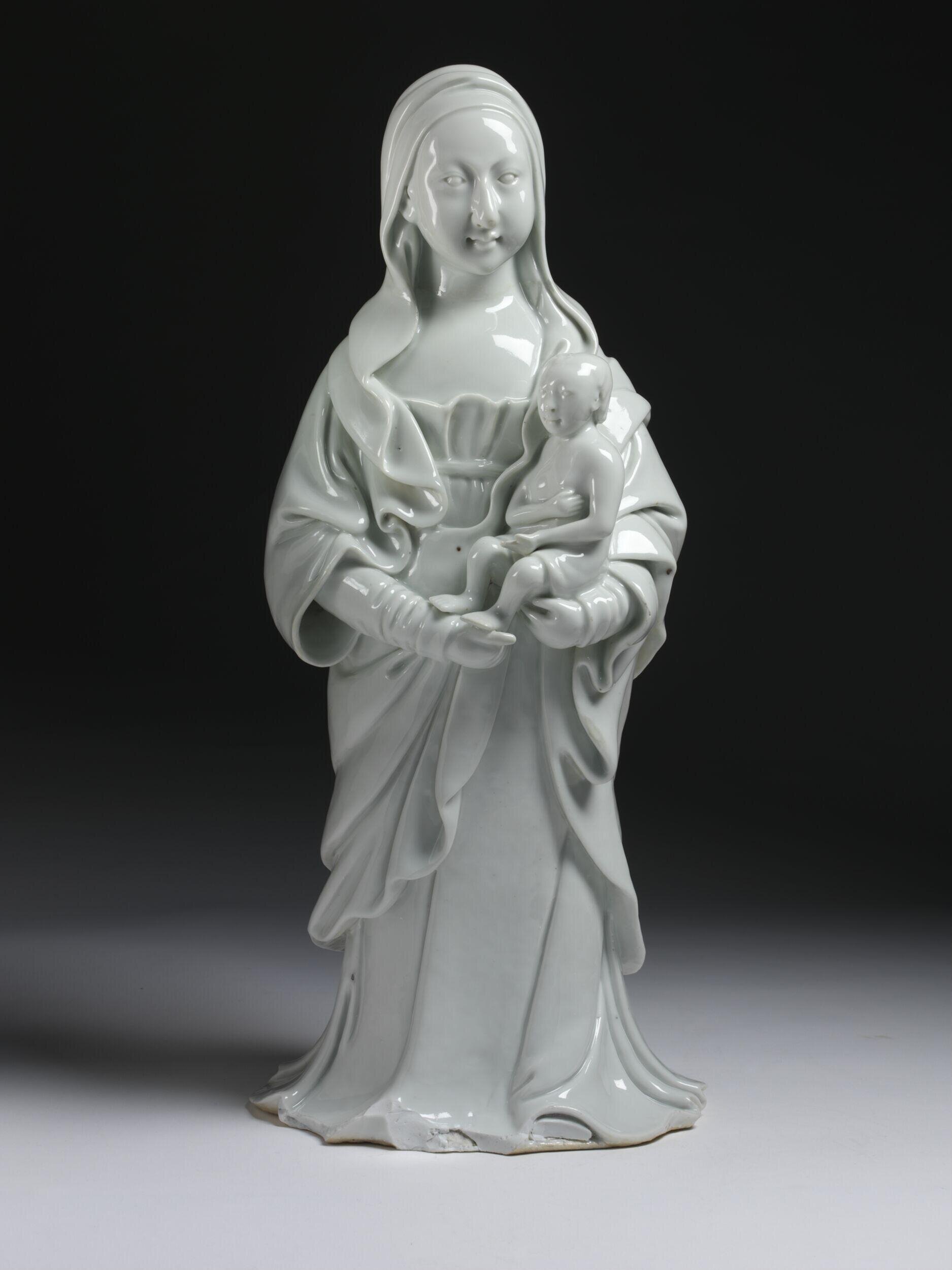
Mary II (wife of William III, reigned 1689–1694) displayed six Dehua porcelain figures at Hampton Court Palace. In the European court context, these figures were “Chinese Madonnas” — not “Buddhist bodhisattvas.”
Augustus the Strong’s 1721 porcelain inventory described Dehua figures as “dolls with children on their arms” (Puppen mit Kindern auf dem Arm). “Dolls” — a Saxon Elector’s classification for Buddhist sculpture. What he saw was not religion but decoration.
The Metropolitan Museum of Art’s 2023 exhibition “Compassion, Mercy, and Love” directly presented this cross-cultural projection in its title: Compassion (Buddhist), Mercy (Christian), Love (universal) — three words covering three semantic layers, deliberately juxtaposed without resolution.
The European imitation evidence chain detailed the physical operations of ormolu mounting. From a semantic perspective, the mounts completed a second identity rewrite for Dehua porcelain in Europe:
First rewrite: Guanyin → Madonna (religious identity)
Second rewrite: Eastern curiosity → French interior element (cultural identity)
Neither rewrite required altering the porcelain itself. One was achieved through naming, the other through a bronze mount. The object stays the same; the meaning changes entirely.
Japan’s reception of Dehua white porcelain is the most complex of the five civilizations.
In Japanese tea-ceremony terminology, Dehua white porcelain is sometimes classified under hakugorai — literally “white Goryeo (Korean) ware.” This classification is inaccurate in ceramic terms (Dehua and Korean wares are entirely separate in origin and tradition), but within the aesthetic context of tea practice, it reflects a generalised Japanese perception of “East Asian continental white porcelain.”
Dehua white porcelain Guanyin figures were widely used in Japanese home altars (butsudan). The butsudan is a miniature shrine in the Japanese home for venerating ancestors and Buddhist images — the core material carrier of daily religious life. The use of Dehua Guanyin in the butsudan brought it into the most intimate devotional space of the Japanese household.
In 1587 Toyotomi Hideyoshi issued the Bateren expulsion edict; in 1614 the Tokugawa shogunate imposed a comprehensive ban on Christianity; the ban was not lifted until 1873 under the Meiji government. During this nearly 300-year period, Japan’s hidden Christians (kakure kirishitan) used Dehua white porcelain Guanyin figures as secret substitutes for the Virgin Mary in their worship.
The same white porcelain figure: before Buddhist believers, it was Guanyin; before hidden Christians, it was the Virgin Mary. Two faiths shared the same material carrier, each reading it in its own way, without interference. Persecutors saw a legitimate Buddhist statue; the persecuted saw a secret object of Christian worship. The “silence” of Dehua porcelain — plain white, no text, no explicit doctrinal markings — was precisely what made this dual identity possible. Had the Guanyin borne Buddhist scripture, the hidden Christians could not have adopted it as the Virgin; had it borne a cross, persecutors would have identified it at once.
During the prohibition, this material characteristic carried life-or-death consequences.
In Japanese culture, white has a strong association with death and funerals. Mourning clothes are white. Bone-ash urns are white. This association creates a subtle psychological barrier for Dehua white porcelain in everyday contemporary Japanese consumption: “the funerary association causes a modern-day distancing.” The purity of white porcelain is a virtue in tea-ceremony and butsudan settings, but at the everyday dining table it may trigger uncomfortable associations.
Wabi-sabi aesthetics value imperfection, impermanence and austerity. The technical perfection of Dehua porcelain — dense, smooth, uniform — appears on its face to contradict wabi-sabi’s principle of imperfection. But Dehua’s “perfection” is itself built on an extreme act of subtraction — removing all colour and decoration to leave only white. This minimalism shares a structural affinity with wabi-sabi’s reductive spirit. Meanwhile, the subtle undulations of the Dehua body and the natural flow marks in the glaze are read within the wabi-sabi framework precisely as the life traces left by hand and kiln fire, not as flaws.
The Japanese sencha (steeped-tea) tradition’s preference for Dehua vessels (rather than figures) is a concrete expression of this aesthetic orientation.
At least thirteen Quranic passages carry positive associations with white. Those whose faces are whitened on Judgement Day receive Paradise’s favour. Rivers of Paradise flow with “white drink.” The prophetic traditions (hadith) are denser still: white garments for Friday prayer (jumu’ah); the ihram — two unsewn white cloths — for the Hajj pilgrimage.
White = cleanliness = proximity to the divine — this equation is deeply embedded in the Islamic semantic system. When Dehua white porcelain reached the Islamic world, its whiteness naturally aligned with the Islamic cultural preference for ritually clean vessels.
The kundika is a water vessel used for ritual ablution (wudu) in the Islamic world. The Dehua kilns produced large quantities of kundika-form white porcelain, explicitly customised for the Islamic market. The Muslim merchant community at Quanzhou was already substantial in the Song and Yuan periods (the Qingjing Mosque was founded in the Northern Song). Their orders fed directly back to the Dehua kilns, making the kundika a vessel form produced to external religious-functional specifications.
V&A object 1649-1876 — a Dehua white porcelain vessel fitted with an Iranian metal lid. The logic is identical to European ormolu mounts: localised adaptation without altering the porcelain itself, merely adding fittings suited to local use.
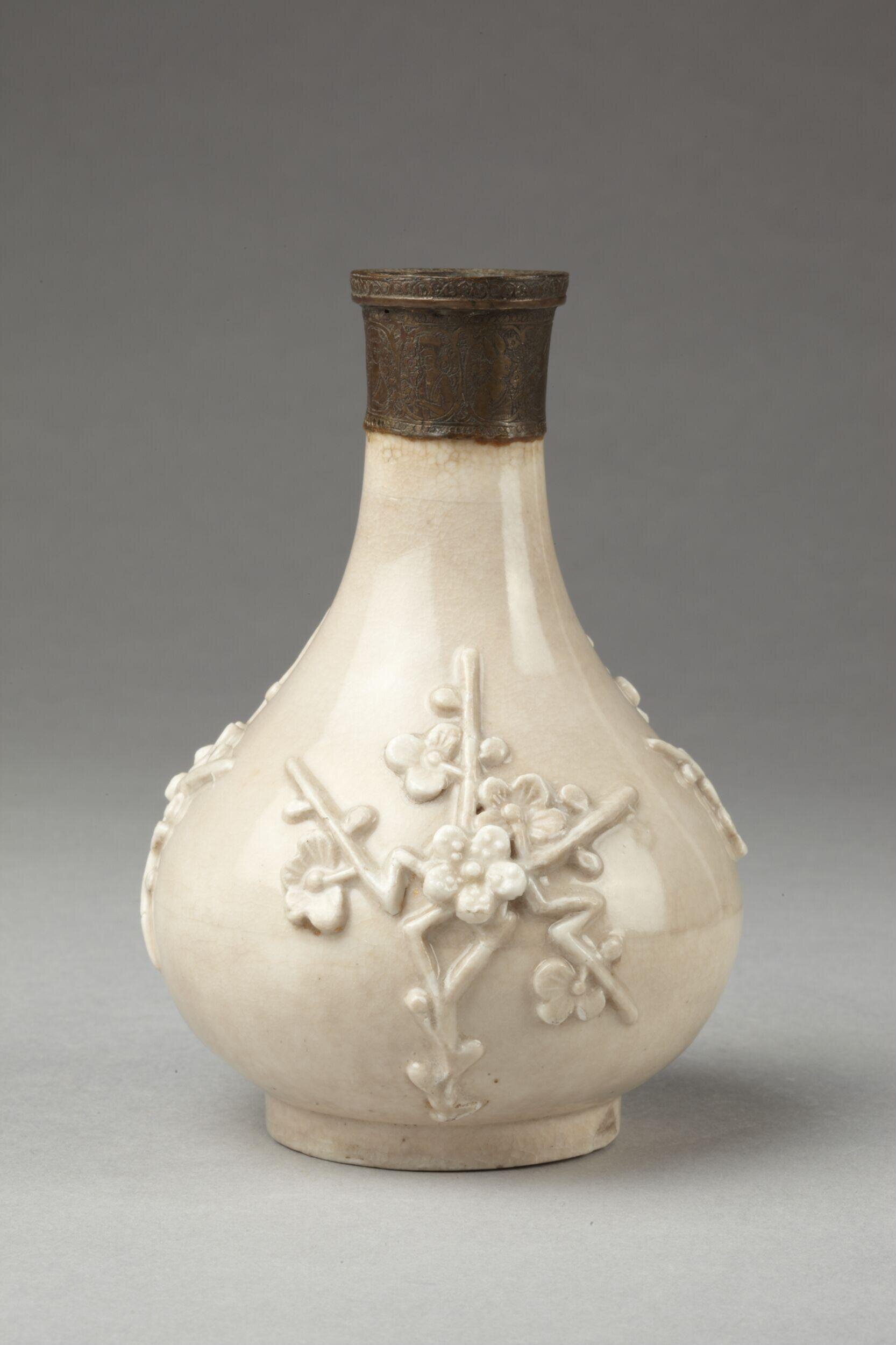
Dehua white porcelain sherds have been recovered from archaeological sites across the Islamic world:
These three sites trace an arc from the Persian Gulf to the East African coast, aligning precisely with Arab maritime trade routes.
The five civilizations received Dehua white porcelain in outwardly different ways, but the underlying logic can be distilled into five mechanisms:
(1) Material scarcity — in the seventeenth and eighteenth centuries, porcelain itself was a scarce, high-value material in Europe, Japan and the Islamic world. The material value of Dehua porcelain was accepted before its cultural meaning.
(2) Symbolic compatibility — white carries positive transcendent symbolism in Chinese (Five Virtues / purity), European (Christian holiness), Japanese (Shinto sacred / Buddhist purity) and Islamic (cleanliness / paradise) traditions. By contrast, red is celebratory in China but associated with warning in some Western contexts; blue points to paradise in Islamic tradition but occupies a secondary rank in the Chinese colour hierarchy. White is the only known colour that points toward “purity,” “holiness” and “transcendence” across all these major civilizational systems.
(3) Aesthetic universality — a plain white, undecorated surface generates no culture-specific visual information. Blue-and-white porcelain patterns can puzzle non-Chinese viewers (what does the dragon mean? why is the cloud that shape?), but white creates no such questions. Its aesthetic message is “nothing” — and “nothing” is a signal every culture can process.
(4) Religious plasticity — the Dehua Guanyin image is sufficiently “ambiguous” — a compassionate female figure holding an infant or a vase — to be claimed simultaneously by Buddhism, Christianity and even clandestine Catholicism. The plain white, text-free surface locks in no specific doctrine.
(5) Tactile biological basis — this mechanism is rarely discussed but may be the most fundamental. The ivory-white surface of Dehua porcelain is warm and fine-grained to the touch, approximating the visual-tactile associations of human skin and animal fat. The positive human response to a “warm, smooth, white surface” may have a cross-cultural biological foundation — it signals health, cleanliness and adequate nourishment. The cross-cultural consistency of this response suggests a possible evolutionary-psychological substrate rather than a purely cultural construction.
The five civilizations show a clear pattern of divergent preferences for different Dehua categories:
Figures preferred: Buddhist Asia (China, Vietnam, Thailand) + Christian Europe
Vessels preferred: Islamic world + Japanese sencha
The divergence is straightforward: the Islamic tradition’s restriction on figural imagery (especially in religious contexts) favoured vessels; the Japanese sencha ceremony’s functional requirements centre on cups, teapots and saucers. Both Buddhism and Christianity have strong traditions of figurative devotion, making the Guanyin / Madonna figure a core demand.
| Civilization | Adaptation Method | Purpose | Porcelain Altered? |
|---|---|---|---|
| Europe | Ormolu (gilt bronze) mounts | Integration into Rococo interiors | No |
| Islamic world | Metal lids / fittings | Ritual ablution and functional needs | No |
| Japan | Semantic re-encoding | Guanyin ↔ Virgin Mary dual identity | No |
All three adaptation methods share one feature: none altered the porcelain itself. European ormolu was added without grinding the porcelain; Islamic metal lids were fitted without changing the form; Japan’s semantic re-encoding occurred entirely at the cognitive level of the viewer. Every receiving civilization chose “addition” over “subtraction” — adding localised attachments or new meanings on top of the porcelain rather than modifying it. This fact indirectly reflects the completeness that Dehua white porcelain had already achieved when it left the kiln.
View Full Data — Cross-Cultural Semantics Table
Cross-Dimension References
Keywords
cross-cultural reception · semantics of white · Blanc de Chine · Dehua porcelain · Maria Kannon · kakure kirishitan · Guanyin · Madonna · Sancta Maria · Five Virtues · ivory white · lard white · scallion white · baby red · ormolu mount · wabi-sabi · hakugorai · sencha · kundika · Hampton Court · Toyotomi Hideyoshi · Tokugawa shogunate
Scale, structure and growth trajectory of the Dehua ceramics industrial cluster—the origin of Blanc de Chine
| Report No. | WH-GR-2026-001-DIM08 |
| Part of | WH-GR-2026-001 |
| Version | 1.0 (Initial Public Release) |
| Published | April 2026 |
| Data Cutoff | April 2026 |
| Lead Researcher | Jack Lin |
| Publisher | World Headlines Inc., Manhattan, New York |
| Review Status | Internal research review; not externally peer-reviewed |
| License | CC BY-NC 4.0 International |
| Persistent ID | 10.5281/zenodo.19519691 |
| Year | Output (¥100M RMB) | Growth | Note |
|---|---|---|---|
| 1978 | 0.1268 | — | Year of Reform and Opening-Up |
| 2015 | 188.2 | — | |
| 2022 | 502 | — | |
| 2023 | 577 | +14.9% | |
| 2024 | 663 | +14.9% | |
| 2025 | 760 | +15% | Source: Dehua County Government, March 2026 County Profile |
| 2027 (target) | 1,000 | — | "Thousand-Billion Target" |
The three-year CAGR from 2022 to 2025 stands at approximately 14.7%. Reaching the 2027 target of ¥100 billion requires 31.6% growth over two years, or roughly 14.7% annually—matching the recent actual pace. Feasibility and risk assessment of this growth trajectory are examined in 2027–2035 Scenario Projections.
Based on the 2025 total of ¥76 billion, the estimated product structure is as follows:
| Category | Share | Estimated Scale (¥B) | Key Feature |
|---|---|---|---|
| Export Craft Porcelain | ~60% | ~39.8 | Primarily OEM/ODM; U.S. accounts for 35.37% |
| Daily-Use Ware | ~30% | ~19.9 | Tea ware accounts for 80% of national market |
| Master Art Porcelain | ~8% | ~5.3 | National/provincial masters’ personal brands |
| High-Tech Ceramics | ~2% | — | LED ceramic substrates, far-infrared ceramics, etc. |
Online retail accounts for ¥20.3 billion, cutting across the above categories and representing roughly 27% of total output.
The export-to-domestic ratio stands at 6:4. The United States is the single largest export market at 35.37% of export value—a figure that implies significant market concentration risk against the backdrop of U.S.–China trade friction. Under tariff pressure, Dehua has begun shifting approximately 40% of export volume toward emerging markets. The urgency of export-market diversification is quantified further in 2027–2035 Scenario Projections.
The 60% share of export craft porcelain means that the bulk of Dehua’s output derives from OEM/ODM contract manufacturing. Under this model, pricing power rests with brand owners and channel operators—a structural condition that stands in direct contrast to the premium pricing achieved by Meissen, Sèvres and comparable brands examined in International Luxury Porcelain Benchmarking.
| Tier | Count | Characteristic |
|---|---|---|
| Total enterprises | 4,500+ | Including sole proprietors and micro-enterprises |
| Workforce | 100,000+ | Approximately one-third of county population |
| Above-scale enterprises | 250 | Annual output above ¥20 million |
| Self-export licensed firms | 800+ | |
| Anchor firms (>¥3B revenue) | 0 | Critical structural deficit |
Five-Year Plan “1-3-8” target: 1 firm at ¥10 billion, 3 firms at ¥3 billion, 8 firms at ¥1 billion. The current base for all three tiers is zero.
The absence of anchor enterprises manifests across three dimensions: ¥76 billion dispersed among 4,500 firms averages under ¥17 million each; no single enterprise possesses the scale to independently sustain brand-building, international channel development and R&D fixed costs; and in international markets, “Dehua” as a place of origin enjoys far greater recognition than the brand name of any individual Dehua firm.
This characteristic carries both advantages and liabilities. Place-brand dynamics are analysed in 2027–2035 Scenario Projections. The policy response framework is examined in Dehua Policy and Institutional Framework.
Shunmei Group—Licensed OEM manufacturer for Disney, Starbucks and Universal Studios. Handcrafted the Bing Dwen Dwen and Shuey Rhon Rhon mascots for the 2022 Beijing Winter Olympics. Shunmei’s client roster itself constitutes proof of capacity and quality control—Disney’s factory auditing standards rank among the most stringent in the global consumer products industry. Shunmei is also the manufacturer behind the Olympic mascots discussed in Dehua Contemporary Ceramic Art.
Xinchengmei—Annual production exceeding 20 million pieces. A pure volume player.
Tongxin—75 production lines, with integrated 5G smart manufacturing.
Lusheng—Monthly output exceeding 1 million pieces. At this rate: roughly 33,000 pieces per day, or assuming 10 production hours, 3,300 per hour, 55 per minute—approaching one piece per second.
Tangfeng—An internet-native tea-ware brand. Among Dehua’s 4,500 enterprises, Tangfeng is one of the few that faces end consumers as a brand rather than as a contract manufacturer.
Xinliang—LED ceramic substrates. This represents the high-tech ceramics category, a technology path entirely distinct from traditional white porcelain, yet one whose raw-material base remains Dehua’s native clay—the chemistry of which is detailed in Chemical Fingerprint of Dehua Blanc de Chine.
Sanfu—Far-infrared ceramics. A functional-ceramics direction.
Huide—Pet ceramics. A niche segment experiencing rapid growth.
Coverage: 95% of above-scale enterprises have completed digital upgrades. Government subsidies to date total nearly ¥100 million.
5G Cloud-Smart Factory—Tongxin provides the most representative case. The traditional production sequence—“2-hour forming → 12-hour drying → 72-hour firing”—remains unchanged (physical processes are incompressible), but 5G technology has transformed monitoring, scheduling and quality control:
| Metric | Before | After |
|---|---|---|
| Equipment efficiency | 70% | 90% |
| Energy consumption | Baseline | −16% |
| Pass rate | 80% | 95% |
3D printing compresses forming time from several hours (hand-crafted) to 30 minutes. NICID (National Industrial Ceramics Design Research Institute, established 2021) serves as the key technology platform. Related policy frameworks are addressed in Dehua Policy and Institutional Framework.
Aitaoci Platform—Connects 800+ factories with 80,000+ product SKUs. This B2B matchmaking platform aggregates the fragmented capacity of 4,500 Dehua firms into a standardised, searchable and comparable catalogue for external buyers.
E-commerce ecosystem—Over 6,000 merchants operate on Douyin, Pinduoduo, Tmall and other platforms. Dehua has been named a “Top 100 E-Commerce County” for four consecutive years. 1688 (Alibaba’s B2B platform) established its first ceramics sourcing centre in Dehua, recording ¥5 billion in transactions during 2024.
| Metric | Jingdezhen | Chaozhou | Dehua |
|---|---|---|---|
| 2024/2025 Output | ¥93.9B (incl. advanced ceramics ¥26.03B) | ¥50B+ (est.) | ¥76B (2025) |
| Core advantage | Global brand recognition #1; 60,000+ "Jingdezhen drifters" (creative talents); 13M+ tourists/year; millennium imperial-kiln IP | Sanan Group ¥58.4B market cap; 4 listed companies; #1 in sanitary ware nationally | Irreproducible white glaze (clay chemistry); 80% national tea ware; extreme cluster density |
| Exports | Only ¥790M | High (fragmented data) | ~¥39.8B (60% of output) |
| Listed companies | Few | 4 (Sanan, Songfa, etc.) | 0 |
| Talent attraction | "Jingpiao" phenomenon nationally renowned | Manufacturing talent base | Aging challenge; 3,066 new hires / 986 graduates retained |
Jingdezhen exports only ¥790 million vs Dehua’s ¥39.8 billion—Jingdezhen commands the world’s foremost porcelain brand, yet its export revenue amounts to less than 2% of Dehua’s. This reveals that Jingdezhen’s global recognition converts into tourism revenue (13 million visitors) and cultural-IP premiums rather than product exports. Dehua presents the mirror image—robust exports but brand recognition that falls far short of Jingdezhen’s. The brand dimension of this gap is analysed in International Luxury Porcelain Benchmarking.
Chaozhou’s capitalisation depth—Four listed companies, with Sanan Group alone commanding a ¥58.4 billion market capitalisation. Dehua has zero listed firms. Absence from capital markets means Dehua enterprises lack equity-financing channels, restricting growth to retained earnings and credit, and capping expansion velocity.
View Full Data — Industrial Economics Dashboard
Cross-References
Keywords
Dehua ceramics industry · industrial economy · Blanc de Chine · ¥76 billion · ¥100 billion target · CAGR · 6,000-fold growth · tea ware · export craft porcelain · daily-use ware · master art porcelain · high-tech ceramics · three porcelain capitals · Jingdezhen · Chaozhou · Sanan Group · OEM · Shunmei Group · Disney · 5G smart manufacturing · 3D printing · Aitaoci · digital transformation · enterprise pyramid · anchor enterprise · above-scale enterprise · e-commerce
Dehua—the origin of Blanc de Chine—benchmarked against five proven international luxury porcelain brand-building paths
| Report No. | WH-GR-2026-001-DIM09 |
| Part of | WH-GR-2026-001 |
| Version | 1.0 (Initial Public Release) |
| Published | April 2026 |
| Data Cutoff | April 2026 |
| Lead Researcher | Jack Lin |
| Publisher | World Headlines Inc., Manhattan, New York |
| Review Status | Internal research review; not externally peer-reviewed |
| License | CC BY-NC 4.0 International |
| Persistent ID | 10.5281/zenodo.19519691 |
Dehua’s ¥76 billion annual output demonstrates that capacity and quality are not the bottleneck; the core gap lies in international pricing power. The five brands examined below have each established stable international premium structures, and their pathways permit direct comparison.
These five brands were not selected at random. They represent five distinct brand-building paths, each directly comparable to Dehua’s present condition.
Founded: 23 January 1710. Fully funded by Augustus the Strong.
Crossed-swords mark: In use since 1722—the longest continuously used trademark in human history. Three hundred and four years.
Current ownership: Wholly owned by the Free State of Saxony since 1991. A state enterprise.
Annual revenue: Approximately €35 million.
Employees: ~600.
Historical moulds: 700,000.
Colour library: 10,000 colours.
Swords painters: Only 2 in the entire factory—the crossed swords on the base of every Meissen piece are hand-painted by these two individuals.
Price range: €59 (entry-level accessories) → €500,000 (museum-grade reproductions).
Approximately €35 million in annual revenue—under ¥300 million RMB. One two-hundred-and-fiftieth of Dehua’s ¥76 billion. Yet Meissen’s brand value, cultural standing and pricing power far exceed what output figures can measure.
Meissen’s crossover collaborations include co-branded lines with Hugo Boss and Adidas. That a three-hundred-year-old porcelain manufactory can partner with sportswear brands without diluting its brand identity is itself evidence of the liquidity and dilution-resistance of Meissen’s brand equity.
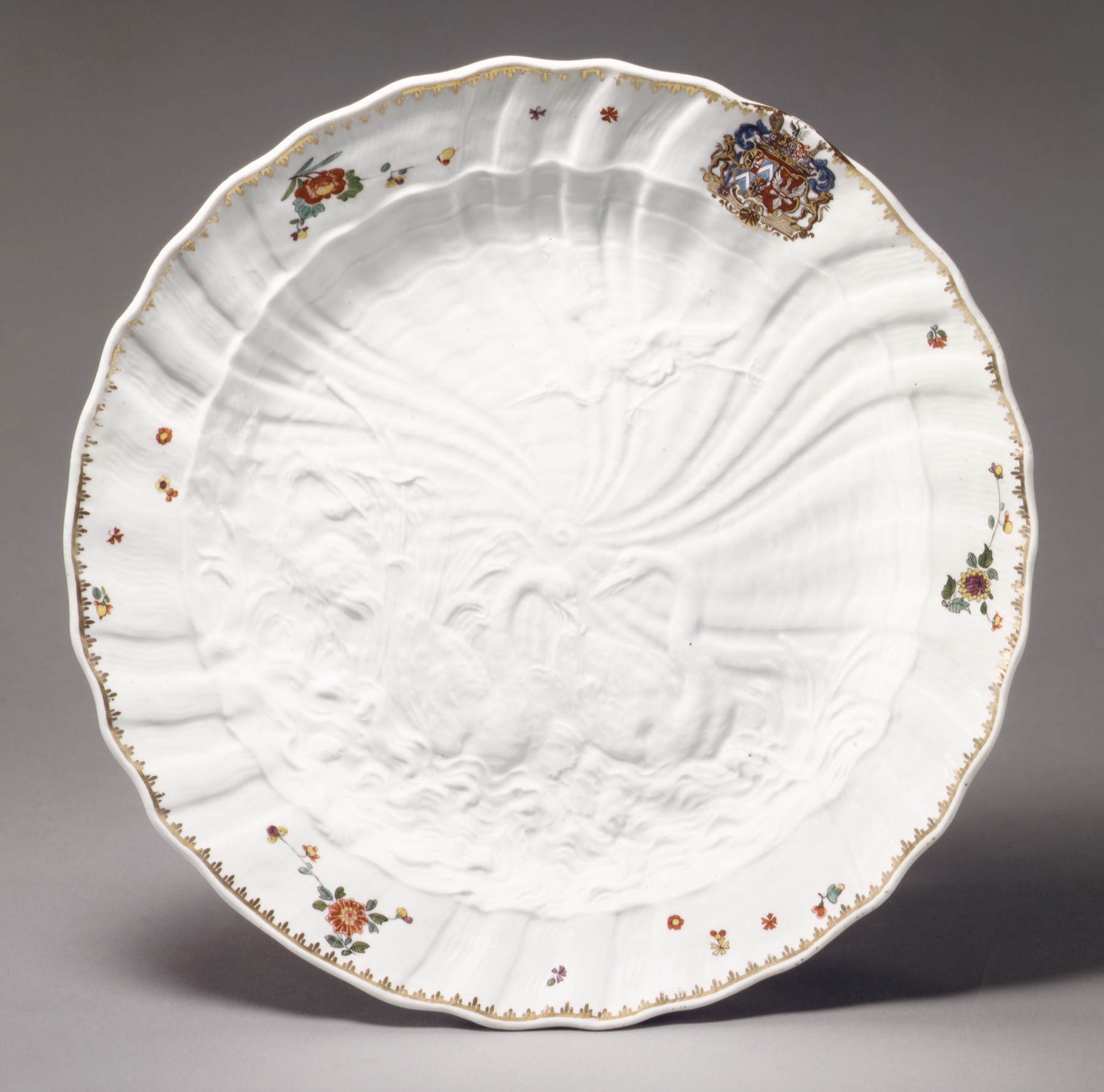
Comparison: The Meissen crossed-swords mark, in continuous use since 1722, derives its core value from uniqueness and continuity. Dehua currently lacks a unified visual symbol of comparable recognition. “Blanc de Chine” as a name has been registered with EUIPO (March 2025), but a supporting visual-symbol system has not yet been developed.
Founded: 1775.
Current ownership: Acquired by Finland’s Fiskars Group in 2013 for approximately €62 million.
Signature product: Flora Danica dinnerware—commissioned in 1790 → 1,802 pieces completed by 1802 → still in production today. Each piece requires 20+ artisans and 8–16 firings. Individual pieces retail at US$1,000–40,000+.
The Flora Danica story is a textbook case in the luxury industry: a dinner service originally crafted for the Danish Crown, still produced more than two hundred and thirty years later, with botanical motifs hand-painted from the 1761 Flora Danica compendium. The Flora Danica premium rests on three compounding factors: two hundred and thirty years of production continuity, the irreplaceability of hand-painted execution, and the original royal commission as provenance.
Christmas plates—Since 1908, a limited-edition annual plate has been released every year, for over 130 consecutive years. This series generates “generational loyalty”—plates collected by a grandmother pass to a mother and then to a daughter, binding three generations of emotional attachment to a single brand.
The acquisition price of approximately €62 million—under ¥500 million RMB. A two-hundred-and-fifty-year-old royal porcelain brand, acquired for less than the valuation of a mid-sized Dehua factory. This demonstrates that brand-value monetisation depends on management capability and market conditions; history alone does not automatically equal commercial value.
Founded: 1740. Championed by Louis XV and Madame de Pompadour.
Current status: A Manufacture nationale under the French Ministry of Culture. To this day.
Employees: ~120.
Annual output: <5,000 pieces.
One hundred and twenty people, fewer than 5,000 pieces per year, averaging roughly 42 pieces per person per year—an operating model closer to a laboratory than a factory.
Sèvres’s contemporary-art residency programme is its most instructive strategy: Louise Bourgeois, Yayoi Kusama, Pierre Soulages, Zao Wou-Ki, Lee Ufan, nendo—the world’s foremost contemporary artists and designers have created work in residence at Sèvres. Each residency collaboration produces pieces that enter two value systems simultaneously—in the art market they are “the artist’s work,” in the porcelain market they are “produced by Sèvres”—a dual-premium overlay.
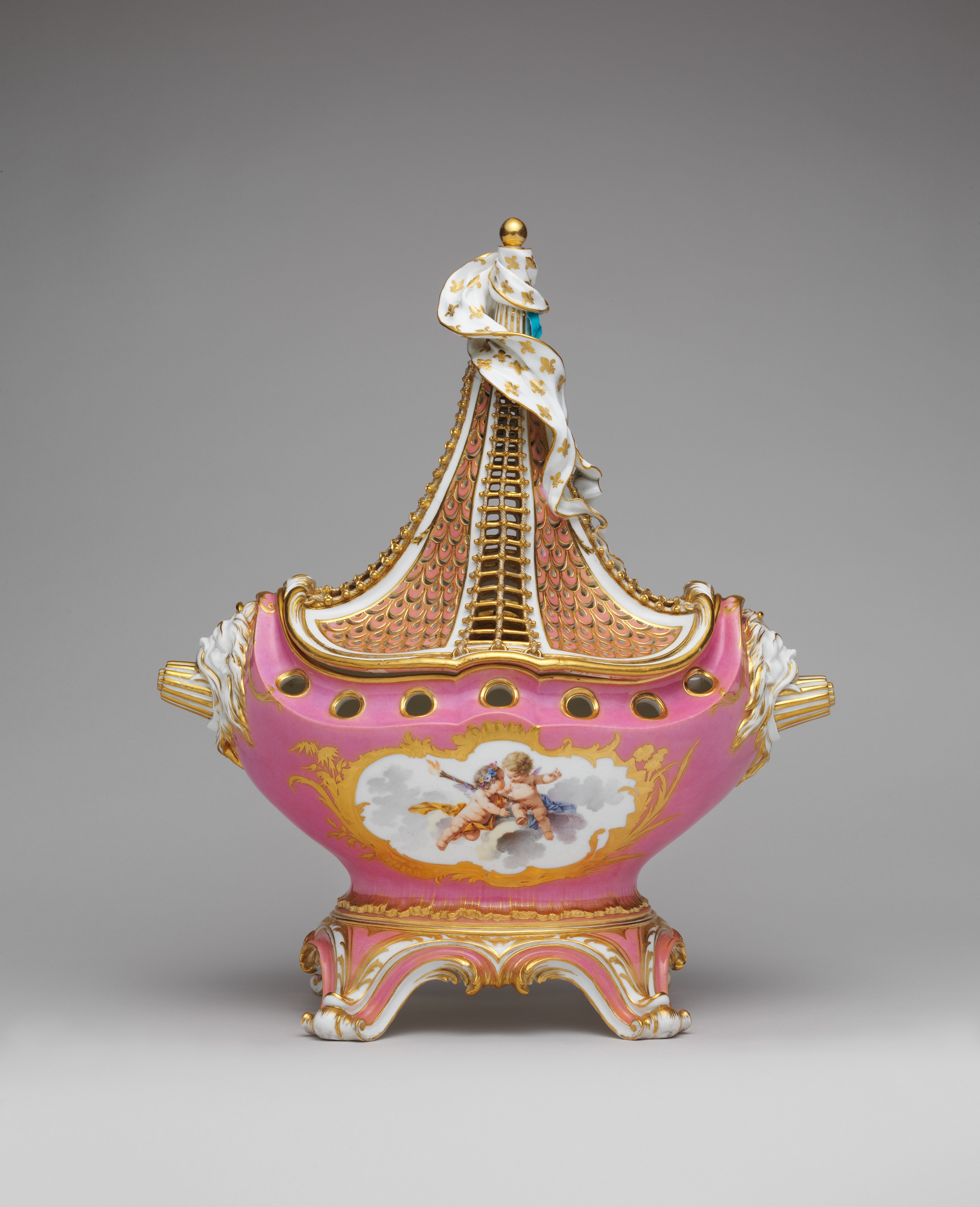
Comparison: The Sèvres model proves that “few but fine” can sustain a brand’s global standing. Dehua’s ICAA (Dehua Contemporary Ceramic Art) has launched a comparable international artist residency programme, but its current scale and continuity differ from Sèvres’s by several orders of magnitude.
Founder: Josiah Wedgwood (1730–1795), often called “the father of modern marketing.”
Signature product: Jasperware—developed through nearly 5,000 experiments. The Portland Vase reproduction alone took four years.
Josiah Wedgwood’s marketing innovations were revolutionary for the eighteenth century: showrooms (not shops), public promotion of royal warrants, mail-order catalogues, instalment payments—methods that seem self-evident two hundred and fifty years on, but were unprecedented in the 1770s.
Yet Wedgwood subsequently entered sustained decline.
January 2009: Wedgwood filed for bankruptcy. Cause: product-line overexpansion to 400+ patterns, brand positioning slipping from “British aristocratic porcelain” to mid-range consumer goods, eroding two centuries of accumulated premium capacity.
KPS Capital Partners acquired Wedgwood for approximately US$82 million.
Fiskars Group bought it from KPS in 2015 for US$437 million—a ~3.4× return for KPS.
Fiskars thus owns both Wedgwood and Royal Copenhagen—two centuries-old porcelain brands under a single Finnish consumer-goods group.
Comparison: Wedgwood’s bankruptcy proves that time depth and historical prestige cannot automatically prevent brand death. The overexpansion to 400+ patterns diluted the brand—a trajectory that structurally parallels Dehua’s current condition: 4,500 enterprises, a price spectrum spanning US$20 to US$2.5 million. When “Dehua porcelain” simultaneously covers state-gift-grade masterworks and commodity mugs at Yiwu prices, the risk of brand dilution is real.
Founded: 1616 (Genna 2), when Korean potter Yi Sam-pyeong discovered porcelain stone at Arita.
Current status: 150+ kilns (kamamoto); sales have fallen to roughly one-fifth of their peak.
Arita’s decline story differs from Wedgwood’s—it is not the management failure of a single firm, but the collective ageing of an entire production region. Over 150 kilns each operate independently, with no unified brand, no international channels, and product design stalled within traditional paradigms.
In 2013, Saga Prefecture launched “ARITA EPISODE 2”: 16 international designers collaborated with 10 Arita kilns, reinterpreting Arita traditions through international design language. The collaborative output debuted at Milan Design Week 2016, followed by an exhibition at the Rijksmuseum in Amsterdam.
The methodology is remarkably clear:
Comparison: Arita’s “EPISODE 2” and Dehua’s ICAA (Dehua Contemporary Ceramic Art) are highly comparable, but their terminal objectives differ—“EPISODE 2” output was directed toward commercially viable products, with designer pieces ultimately entering retail; ICAA output currently remains primarily at the exhibition level.
Five brands, five paths, one shared evolutionary arc:
(1) Origin in imitation, maturation through originality—Meissen imitated Dehua → Swan Service. Sèvres imitated Meissen → contemporary art residencies. Arita originated with Korean potters → Kakiemon style. All five brands began with direct study of external models, yet each ultimately built its market position on an original product language.
(2) A distinctive visual mark—Meissen crossed swords. Royal Copenhagen three-wave motif. Wedgwood blue-and-white relief. Arita’s aka-e (overglaze enamel). Each is identifiable within three seconds. Dehua currently possesses no unified visual symbol of comparable recognition.
(3) State or institutional backing—Meissen is wholly owned by the State of Saxony. Sèvres reports to the French Ministry of Culture. Royal Copenhagen carries the “Royal” prefix (by Danish Crown warrant). Arita’s revival was led by Saga Prefecture government. None of these cases resulted from purely market-driven forces.
(4) Contemporary-art collaboration—Sèvres’s residency programme. Meissen’s Hugo Boss/Adidas co-brands. Royal Copenhagen’s collaborations with contemporary designers. Arita’s “EPISODE 2.” All four surviving brands deploy collaboration with contemporary creators as a core means of maintaining cultural relevance.
(5) Heritage narrative—Every brand possesses a story that can be told in thirty seconds. Meissen: “Augustus traded soldiers for porcelain, then built his own factory.” Royal Copenhagen: “Dinnerware made for a queen two hundred and thirty years ago is still in production.” Wedgwood: “Five thousand experiments to get that blue.” Dehua currently lacks an equally distilled thirty-second narrative. The raw material—3,700 years of ceramic history, the world’s only low-iron clay—is sufficient to construct such a narrative, but it has not yet been integrated into a unified external expression.
Synthesising the premium logic across all five brands, international luxury porcelain pricing power rests on six factors:
| Factor | Description | Dehua Status | Strength |
|---|---|---|---|
| Time Depth | Historical length of the brand or production region | 3,700 years—longest globally, undisputed | Very Strong |
| Craft Irreplaceability | Manual skills that machines cannot replicate | He Chaozong tradition + master system + ICAA residency | Strong |
| Scarcity | Production or material constraints | Fe₂O₃<0.5% clay—only source worldwide | Very Strong |
| Institutional Endorsement | Museum collections and scholarly publication | V&A / Rijksmuseum / British Museum / Met, etc. | Strong |
| National Link | Brand–state identity alignment | World Heritage status + state-gift porcelain | Medium-Strong |
| Visual Identity | Instantly recognisable visual mark | Extremely weak—the critical gap | Very Weak |
Five of the six factors register as strong or very strong. The sole very-weak score—visual identity uniqueness—constitutes a structural deficit.
The remaining five assets (3,700 years of history, irreproducible clay, world-class museum collections, etc.) are difficult for international consumers to quickly identify, remember and propagate in the absence of a unified visual symbol.
View Full Data — Brand Benchmarking Matrix
Cross-References
Keywords
Blanc de Chine · Dehua porcelain · brand benchmarking · luxury porcelain · Meissen · crossed swords · Royal Copenhagen · Flora Danica · Sèvres · Manufacture nationale · Wedgwood · Jasperware · Arita ware · ARITA EPISODE 2 · premium factors · visual identity · international pricing power · brand dilution · heritage narrative · generational loyalty · state-gift porcelain · He Chaozong
Three pathways in contemporary art for Dehua, the origin of Blanc de Chine: the ICAA international competition, individual artist breakthroughs, and the state-gift system
| Report No. | WH-GR-2026-001-DIM10 |
| Part of | WH-GR-2026-001 |
| Version | 1.0 (Initial Public Release) |
| Published | April 2026 |
| Data Cutoff | April 2026 |
| Lead Researcher | Jack Lin |
| Publisher | World Headlines Inc., Manhattan, New York |
| Review Status | Internal research review; not externally peer-reviewed |
| License | CC BY-NC 4.0 International |
| Persistent ID | 10.5281/zenodo.19519691 |
Founded in 2016. Full name: “Blanc de Chine” International Ceramic Art Award (ICAA).
The ICAA must be understood within the coordinate system of global ceramic art competitions. The three internationally recognised major ceramic art events are: the Faenza International Ceramic Art Competition (Italy), the Mino International Ceramics Exhibition (Japan), and the ICAA. A three-way balance. Faenza dates from 1938, Mino from 1986, ICAA from 2016—the youngest, yet the fastest-expanding.
| Edition | Venue | Notes |
|---|---|---|
| 1st (2017) | Musée des Confluences, Lyon, France | Inaugural edition held at a major European museum |
| 2nd (2019) | Musée Masséna + Opéra de Nice, France | Dual venues, extending into performing-arts space |
| 3rd (2023) | Yinlan Centre, Hangzhou, China | First edition held in China |
| 4th (2024–2025) | Xiamen, China | 50 countries / 845 artists / 994 works / 11 prizewinners |
Editions 1–3 combined: nearly 60 countries, approximately 2,000 entrants, 2,243 works. The 4th edition (Xiamen) alone reached 50 countries, 845 artists, and 994 works, marking a step-change in scale.
The composition of the jury directly determines the academic credibility of any art competition:
| Juror | Position |
|---|---|
| Catherine Chevillot | Former Director, Musée Rodin, Paris |
| Claudia Casali | Director, MIC Faenza (International Museum of Ceramics) |
| Romain Sarfati | Director, Manufacture de Sèvres |
| Jay Xu (许杰) | Director, Asian Art Museum of San Francisco |
Musée Rodin, MIC Faenza, Manufacture de Sèvres, Asian Art Museum of San Francisco—each juror represents the highest scholarly authority in a distinct field, and their participation directly establishes the ICAA’s credibility within the international ceramics community.
50% white-porcelain material requirement—entries must use white porcelain as the primary material (at least 50%). This rule is critical: it ensures the ICAA does not devolve into a generic ceramics exhibition but remains anchored to “white porcelain,” Dehua’s core material advantage.
Fourteen countries, 39 artists, five-week creative residencies. The programme brings international artists to Dehua to work with local clay in local kilns and workshops. The core output is a relational network: upon returning to their 14 home countries, the 39 artists each become a contact point for Dehua white porcelain within their national academic and creative circles.
Su Xianzhong, born 1968. Fourth-generation inheritor of the Qiyu Porcelain Studio (蕲玉瓷庄).
Su Xuejin (1869–1919)—great-grandfather. Gold medal at the 1915 Panama-Pacific International Exposition for the work Plum Blossom. V&A object C.49-1953—a piece accessioned in 1953, which Su Xianzhong personally identified as his great-grandfather’s work during a visit to the V&A in 2019. Sixty-six years later, the great-grandson recognised his great-grandfather’s hand in a London museum.
Su Xianzhong’s transformation—from traditional Buddhist sculptural ceramics to a contemporary art language, centred on the Paper series begun in 2016.
The Paper series renders the forms of paper in white porcelain—creases, folds, tears, curls. Hard-paste porcelain fired at 1,300 ℃ displays every visual attribute of paper; the tension between physical properties and visual appearance constitutes the work’s central force.
V&A FE.52-2018—a Paper series work, accessioned by the Victoria and Albert Museum in 2018. This made Su Xianzhong the first Dehua contemporary artist to enter the V&A collection.
Works by Su Xianzhong are also held by the National Museum of China and the Metropolitan Museum of Art.
Su Xianzhong’s display practice includes a signature detail: he uses salvaged bricks from dismantled Dehua kilns as plinths for his work. Contemporary white porcelain resting on century-old kiln brick—physically, a superimposition of two temporal layers; semantically, an explicit dialogue between tradition and the contemporary. This display method materialises the dimension of time directly into spatial relationship.
Peter Ting, Malaysian-British ceramic artist and curator. First visited Dehua in 2004.
Peter Ting constructed a narrative about Dehua white porcelain aimed at Western audiences: “Dehua white porcelain was among the first Chinese ceramics to reach Europe and directly inspired the birth of Meissen.”
The power of this narrative lies in its concision and verifiability—the European imitation evidence chain provides the complete material record. Peter Ting’s contribution was to synthesise evidence scattered across museum archives and academic papers into a story that can be told in thirty seconds.
FE.52:1,2-2012—Buddha Hands, accessioned by the V&A in 2012. The work was hand-shaped by Dehua craftsman Chen Wei—Peter Ting supplied the design concept, and Chen Wei executed it using traditional Dehua techniques. This “international design + local craftsmanship” collaboration model is a precursor to the Arita “EPISODE 2” approach examined in international luxury porcelain benchmarking.
In 2017, Peter Ting held a solo exhibition at Ting-Ying Gallery in London.
2019 V&A exhibition “A Continuous Conversation”—curated by V&A curator Xiaoxin Li. The exhibition title captures Peter Ting’s methodology: a continuous conversation with tradition, neither return nor abandonment.
Why could Peter Ting—neither a Dehua native nor a mainland Chinese artist—play such an important role in the contemporary narrative of Dehua white porcelain?
Because outsiders perceive what locals cannot. Dehua artisans are so deeply familiar with their clay and techniques that the impact these elements have on an external observer is invisible to them. The outsider’s first encounter—an instinctive response to the material’s texture and the density of craft—carries unique persuasive force in an international communication context, precisely because it requires no cultural translation.
Since 1996, over 50 pieces of Dehua white porcelain have been selected as state gifts.
2017 BRICS Leaders’ Xiamen Summit—15 of 16 state-gift porcelain pieces came from Dehua. Chen Mingliang’s Sunlight (日光) was the representative work among them. 15/16—a near-total sweep. This ratio demonstrates that in quality vetting at the state-gift level, Dehua white porcelain’s competitiveness overwhelmingly surpasses that of other production regions.
Bing Dwen Dwen and Shuey Rhon Rhon—the handcrafted versions of the 2022 Beijing Winter Olympics mascots were produced by Shunmei Group in Dehua. The “impossible to find” frenzy surrounding Bing Dwen Dwen during the Games pushed Dehua into mainstream consumer discourse—even though most buyers had no idea that the mascot they were scrambling for came from a county in the mountains of Fujian.
State-gift porcelain generates no direct revenue, but its brand value lies in this: quality vetting at the highest political level constitutes an official endorsement of Dehua white porcelain’s craft standards, and this endorsement radiates across the entire production region’s commercial output.
The Dehua county government’s March 2026 briefing confirms that Dehua has become an official partner of the Michelin Guide.
The Michelin Guide’s brand equity rests on “the authority of quality discrimination”—the Michelin star is the globally recognised apex of the restaurant rating hierarchy. The Dehua–Michelin partnership links “Dehua porcelain” with “the world’s finest dining experience.”
The specific scope and form of the collaboration have not yet been fully disclosed. But the partnership itself already sends a signal: Dehua is extending from a “manufacturing brand” toward a “lifestyle brand.”
Research reveals a phenomenon rarely covered in Chinese media but persistently present in Western interior design: Dehua white porcelain—especially Blanc de Chine Guanyin figures and Foo Dogs—is a fixture in high-end interiors.
Charlotte Moss, Mary McDonald, Ruthie Sommers—these leading interior designers active in New York and Los Angeles frequently employ Dehua white porcelain in their projects. Usage is highly concentrated on one scenario: a mantelpiece with Foo Dogs paired at each end, a Guanyin figure or meiping vase at centre, flanked by a gilt mirror frame and candlesticks—the classic mantelpiece arrangement.
In this context, Dehua white porcelain is not “Chinese craft” but rather a “classic interior element”—much like Zuber wallpaper or Fortuny fabric, it has been absorbed into the Western design tradition as part of its own vocabulary.
Another use case: converting large Dehua white porcelain vessels into lamp bases. A Guanyin figure or meiping vase receives lamp hardware and a shade, becoming a table lamp. This conversion has stable demand in the New York and London antique-lamp markets, with individual converted pieces priced between $2,000 and $15,000.
Cross-References
Keywords
Blanc de Chine · Dehua porcelain · Dehua white porcelain · contemporary art · contemporary ceramics · ICAA · International Ceramic Art Award · Su Xianzhong · Paper Series · Peter Ting · Ting-Ying Gallery · state gift porcelain · BRICS · Michelin Guide · V&A · Victoria and Albert Museum · artist residency · interior design · Blanc de Chine lamp · Bing Dwen Dwen · Beijing Olympics · Faenza · Mino
The three-tier policy framework and resource constraints facing Dehua, the origin of Blanc de Chine
| Report No. | WH-GR-2026-001-DIM11 |
| Part of | WH-GR-2026-001 |
| Version | 1.0 (Initial Public Release) |
| Published | April 2026 |
| Data Cutoff | April 2026 |
| Lead Researcher | Jack Lin |
| Publisher | World Headlines Inc., Manhattan, New York |
| Review Status | Internal research review; not externally peer-reviewed |
| License | CC BY-NC 4.0 International |
| Persistent ID | 10.5281/zenodo.19519691 |
Tourism data following the successful inscription of Quanzhou on 25 July 2021:
| Metric | Pre-inscription | Post-inscription | Change |
|---|---|---|---|
| Annual visitors | 5.80 million | 10.30 million | +77.5% |
| Annual tourism revenue | ¥6.315 billion | ¥10.109 billion | +60.1% |
During the October 2022 national holiday, visitor numbers surged +178.6% year-on-year—nearly triple. This peak reflects the short-term compounding of the UNESCO effect with the holiday effect, but even stripped of seasonal fluctuation, the annual growth is substantial.
1 January 2024—the Quanzhou Municipal Regulations on the Protection and Management of “Quanzhou: Emporium of the World in Song-Yuan China” Cultural Heritage took effect. This is a dedicated local statute providing a legal framework for the protection of the 22 heritage sites, including the Dehua kiln sites. Annual conservation funding: ¥1 million.
For the protection needs of 22 heritage sites, this figure is modest. But the significance of the regulations lies in establishing the legal framework and an institutional appropriation mechanism; the funding level can be incrementally raised from this base.
The density of Dehua’s institutional infrastructure for intellectual property protection is exceptionally rare at the county level nationwide:
| Category | Count |
|---|---|
| Registered trademarks | 42,500 |
| Well-known marks | 6 |
| Madrid Protocol international registrations | 151 |
| Geographical indications | 7 |
| Patents | 13,560 |
| PCT international patents | 10 |
Copyright protection—China’s Copyright Law has covered ceramic sculpture since 1994. Original works of Dehua white porcelain (especially master craftsmen’s sculptures) enjoy copyright protection. WIPO (World Intellectual Property Organization) headquarters has exhibited Dehua white porcelain—visibility on the highest international platform in the IP domain.
Geographical indication protection—“Dehua White Porcelain” received national geographical indication product protection in 2006. It was subsequently included in the inaugural China–EU mutual-recognition GI list and the inaugural China–Thailand mutual-recognition list—in both EU and Thai markets, “Dehua White Porcelain” as a designation of origin is legally protected.
EUIPO registration—in March 2025, “BLANC DE CHINE” was registered as a trademark at the European Union Intellectual Property Office (EUIPO). This is a milestone: in the EU market, the French term “Blanc de Chine,” in use for 163 years, now has legal protection—selling non-Dehua white porcelain under the “Blanc de Chine” name entails the legal risk of trademark infringement.
OEPM registration—completed at Spain’s Patent and Trademark Office in late 2024.
IP fast-track centre—approved in November 2024 and now operational. The centre’s function is to accelerate the resolution of IP disputes—in the e-commerce era, infringing copies spread in hours while traditional IP litigation operates on a timeline measured in months or years. This speed mismatch is the core bottleneck in IP protection, and the fast-track centre targets precisely this gap.
Fujian MIIT Regulation [2022] No. 14—ten support measures for the Dehua ceramics industry, jointly issued by seven departments of the Fujian Provincial Department of Industry and Information Technology. A joint directive from seven provincial-level departments—this administrative tier and inter-departmental coordination strength is uncommon among county-level industrial policies nationwide.
In December 2022, Quanzhou Municipality issued seven support measures. Among them, the overseas-warehouse subsidy policy directly addresses the logistics cost pressure on Dehua’s export enterprises—overseas warehouses can shorten cross-border e-commerce delivery from 15–30 days to 3–7 days, but the upfront investment and operating costs are high. The government subsidy reduces enterprises’ cost of experimentation.
Issued in 2025. Key highlights:
¥5 billion credit support—a dedicated credit facility addressing the longstanding financing difficulties of small and medium enterprises.
Master Craftsman Loans and Talent Loans—two innovative financial products worth noting. “Master Craftsman Loans” extend credit based on the personal brand and inventory of national- or provincial-level master craftsmen; “Talent Loans” target recruited high-level talent. This represents an attempt to incorporate human capital and intangible assets into the credit evaluation system—under traditional bank assessment frameworks, a ceramic master’s personal brand value is difficult to quantify as loanable collateral, and the “Master Craftsman Loan” product circumvents this obstacle by design.
The core framework of Dehua’s ceramics industry five-year action plan can be summarised as “3-2-1”:
3 segments—design & R&D, manufacturing, marketing & distribution. Covering the entire value chain.
2 tracks—traditional industry upgrading + high-tech ceramics cultivation. A dual-track approach.
1 target—one hundred billion (yuan). By 2027.
The 3-2-1 logic is clear and pragmatic: from a base of ¥76 billion, achieve an additional 31.6% growth through systematic optimisation across three segments, extending the existing industrial trajectory.
“Premium Goods Going Global” (优品出海) is Dehua’s most systematic international-expansion initiative in recent years:
Organisational structure—25 departments, 6 working groups. This coordination strength is exceptionally rare at the county level—25 departments acting in concert means that internationalisation has expanded from a single commercial bureau function to a collective whole-of-county institutional effort.
Overseas showrooms—65, covering major export markets.
Overseas warehouses—8.
Touring exhibitions—launched in August 2023, with stops in Frankfurt, Delft, Copenhagen, Kyoto, New York, Chicago, Puebla (Mexico), and Semarang (Indonesia). Five-year target: 26 countries.
The choice of exhibition cities reflects strategic considerations:
| City | Strategic rationale |
|---|---|
| Delft | The Dutch node of Blanc de Chine imitation history (European imitation evidence chain) — exhibiting originals in the city of the imitators |
| Copenhagen | Home ground of Royal Copenhagen (brand benchmarking) — demonstrating traditional depth in a competitor's capital |
| Kyoto | The spiritual centre of Japanese traditional craft, interfacing with the tea-ceremony and Buddhist-altar markets (cross-cultural semantics) |
| Puebla | Extension of the Manila Galleon route endpoint — four centuries ago, Dehua white porcelain entered Mexico via Acapulco |
Established in May 2025. The institution is positioned to upgrade Dehua from a “production base” to a “supply-chain hub”—not merely producing porcelain, but managing the entire chain from raw materials to finished goods to logistics to after-sales.
Customs clearance times reduced by over 40%. For an industry where exports account for 60% of output, every day shaved off clearance means tens of thousands of containers boarding ships one day earlier. A 40%+ compression in processing time has a direct impact on enterprises’ cash-flow turnover efficiency.
| Category | Count |
|---|---|
| National-level master craftsmen | 13 |
| Provincial-level master craftsmen | 279 |
| Skilled workers (all levels) | 6,000+ |
| Ceramics academy graduates (cumulative) | 40,000+ |
| Major S&T platforms (incl. NICID) | 4 |
| New recruits (2025) | 3,066 |
| University graduates retained (2025) | 986 |
3,066 recruited, 986 retained.
986—an entire county retained just 986 university graduates in a single year. An industrial cluster with over 100,000 workers, receiving fewer than 1,000 new entrants with higher education annually.
Of all statistical indicators covered in this report, this one carries the most significant structural risk.
Dehua sits in the mountainous interior of central Fujian, approximately 100 km from the nearest prefecture-level city Quanzhou and 200 km from Xiamen. Competing for young talent against first-tier and strong second-tier cities, its geographic location and urban amenities are inherent disadvantages. The average age of the 13 national-level master craftsmen is rising—if young people do not come, the craft transmission chain will fracture within a single generation.
The ageing pressure is already visible in current recruitment data, not a distant projection.
View Full Data — Policy Framework Comparison
Cross-References
Keywords
Blanc de Chine · Dehua porcelain · ceramics industry policy · three-tier policy framework · UNESCO Quanzhou · World Heritage · intellectual property · geographical indication · EUIPO · trademark registration · Madrid Protocol · overseas expansion · overseas showroom · talent bottleneck · ceramics talent · industrial cluster · Dehua County · five-year action plan · hundred-billion target · IP fast-track centre · master craftsman loan
Three possible futures for the Blanc de Chine homeland, Dehua, from 2027 to 2035
| Report No. | WH-GR-2026-001-DIM12 |
| Part of | WH-GR-2026-001 |
| Version | 1.0 (Initial Public Release) |
| Published | April 2026 |
| Data Cutoff | April 2026 |
| Lead Researcher | Jack Lin |
| Publisher | World Headlines Inc., Manhattan, New York |
| Review Status | Internal research review; not externally peer-reviewed |
| License | CC BY-NC 4.0 International |
| Persistent ID | 10.5281/zenodo.19519691 |
Scenario planning differs from forecasting. Forecasting attempts to answer “what will happen”; scenario planning attempts to answer “what could happen.” The three scenarios constitute a probability-weighted possibility space, not a set of mutually exclusive options. The actual trajectory will likely be some hybrid of the three.
The projection rests on the following assumptions:
| Scenario | Probability | 2027 Output | 2035 Output | Brand Progress |
|---|---|---|---|---|
| Scenario A: Transformation | 35–40% | ≥¥100B | ¥150–200B | 2–3 international brands |
| Scenario B: Steady Growth | 55% | ¥80–90B | ~¥100B | Professional-circle recognition |
| Scenario C: Constraints | 20% | ¥80–85B | Stagnation | Limited progress |
Core characteristics: The hundred-billion target is met on schedule (2027), with output surging to ¥150–200 billion during 2030–2035. Two to three internationally recognized brands are established. “Blanc de Chine” attains a level of origin recognition in international markets comparable to “Swiss Made”—meaning consumers encountering “Blanc de Chine” immediately associate it with quality and premium expectations, analogous in terms of origin recognition rather than price equivalence.
Required conditions (all must be met simultaneously):
Key judgment: Scenario A is assessed at 35–40% probability, not above 50%, because two of the five conditions—US–China relations (condition 1) and comprehensive smart manufacturing (condition 5)—involve external variables that Dehua cannot fully control.
Core characteristics: Growth rate drops from the recent three-year average of approximately 14.7% to 8–10%. Output reaches ¥80–90 billion by 2027, falling short of the hundred-billion target on schedule. The milestone is delayed to 2028–2029. Brand building makes limited progress—“Blanc de Chine” gains recognition in professional circles (museums, the design community, collectors) but fails to break through the recognition barrier in mass consumer markets. OEM/ODM remains the primary revenue source for the vast majority of firms.
Why this is the highest-probability scenario (55%):
Because it most closely follows the inertial trend—no breakthrough policy changes or market turning points are required; the natural continuation of existing trends is sufficient. The growth from ¥76 billion to ¥80–90 billion can be driven by:
The risk in Scenario B lies not in output failing to grow, but in value failing to grow—output volume increases without a corresponding rise in per-unit premium capability.
Core characteristics: Growth rate drops below 5%. Output stagnates in the ¥80–85 billion range. Multiple external constraints tighten simultaneously.
Trigger conditions (any single one can trigger; multiple conditions compound the deterioration):
Why Scenario C probability is 20% rather than lower: because each of the five trigger conditions is not hypothetical in the April 2026 environment—they already exist to varying degrees or are actively developing. The 20% reflects the joint probability of multiple trigger conditions deteriorating simultaneously.
Regardless of which scenario materialises, the following five variables will determine the trajectory of the Dehua ceramics industry from 2027 to 2035:
The race between brand building and porcelain clay consumption is the most consequential of the five variables.
Dehua faces a race: to transform the industry from “selling resources” to “selling brand” before porcelain clay reserves are exhausted (timeline unknown—a data gap). A resource-selling industry ends with resource depletion—the Jingdezhen porcelain clay crisis of 2009 is an established precedent. A brand-selling industry can produce fewer but more expensive products using less clay (the chemical uniqueness of the clay is detailed in Chemical Fingerprint of Dehua Porcelain), thereby extending resource life.
Meissen: 600 employees, annual revenue of €35 million, 700,000 historic moulds—its annual clay consumption is negligible, yet brand value far exceeds its material input (the premium mechanism is analysed in International Luxury Porcelain Benchmarking). Sèvres: 120 employees, producing fewer than 5,000 pieces per year—an even more extreme “less but dearer” model.
Not all 4,500 firms in Dehua need to follow the Meissen or Sèvres model. But a reference proportion: if 50 of them achieve brand-premium capability, consuming 10% of clay while generating 30% of output, the resource consumption pressure would decrease markedly.
Exports to the US account for 35.37% of the total. This level of market concentration constitutes a significant external risk exposure.
Diversification has already begun—the “Premium Export” touring exhibitions have covered Frankfurt, Delft, Copenhagen, Kyoto, New York, Chicago, Puebla, and Semarang. But touring exhibitions are “knocking on the door,” not “moving in.” From exhibitions to establishing stable distribution channels and consumer recognition, the distance remains considerable.
The Middle East market warrants particular attention. Cross-Cultural Semantics of White Porcelain has analysed the natural affinity of the Islamic world for white porcelain—the equation white = purity = the sacred is deeply rooted in Arab culture. High-net-worth consumers in the Middle East rank among the world’s leading luxury purchasers, while Dehua’s white porcelain presence in the Middle East market is currently near zero.
Dehua’s current internationalization pathway is primarily “product export”—shipping ceramics abroad. Brand building depends on “cultural export”—telling stories abroad.
Existing cultural-export initiatives include the ICAA residency programme, Peter Ting’s V&A exhibition (Contemporary Ceramic Art in Dehua), the “Premium Export” touring exhibitions and Michelin Guide collaboration documented in Policy and Institutional Framework—directionally correct, but insufficient in scale and frequency to alter the international market’s perception landscape.
For comparison: Jingdezhen attracts over 13 million visitors annually. Even without generating direct consumption, an annual footfall of 13 million constitutes brand-communication infrastructure in itself. Dehua currently lacks a cultural-tourism engine of comparable scale. Its World Heritage status provides a narrative framework, but visitor numbers growing from 5.8 million to 10.29 million remain well below Jingdezhen’s magnitude.
Annual retention of university graduates stands at just 986. If this figure does not change, all other variables lose their relevance. Youth retention determines the continuity of skill transmission; skill transmission supports the master-craftsman system; the master-craftsman system provides the irreplaceable handcraft foundation on which brand premium depends. If any link in this chain breaks, the industry reverts to “selling resources”—and resources are finite, as the Jingdezhen 2009 porcelain clay crisis has already demonstrated.
The fracture point of this cycle lies in young people’s expectations for Dehua’s future. Institutional tools already exist: master-craftsman loans, talent loans, the Ceramics Smart-Manufacturing Industrial College. What has not yet formed is a complementary narrative—the penetration rate of the perception that “Dehua is a place worth devoting a lifetime to” among the target demographic remains unknown.
Current R&D intensity is below 1%.
By comparison: Meissen, while not disclosing its R&D expenditure ratio, maintains a library of 10,000 colours and 700,000 moulds—the upkeep of which is itself the product of continuous R&D. Sèvres, as a national manufactory, conducts R&D without regard to commercial return. Jingdezhen’s advanced ceramics segment (¥26.03 billion) operates at an R&D intensity far above that of traditional ceramics.
The output span from ¥76 billion to the hundred-billion target corresponds to an R&D intensity benchmark of approximately 2–3%, or ¥20–30 billion in annual R&D investment—2.5 to 3.8 times the current level. In an industrial structure lacking any single firm above ¥3 billion in revenue, observable funding channels include government-guided funds, shared contributions by SMEs, and public R&D services from four science-and-innovation platforms including NICID.
All dimensions converge on a single judgment:
Data across twelve dimensions point to the same structural fact: the bottleneck in the Dehua ceramics industry’s transition from volume growth to value growth is concentrated in the absence of international pricing power.
Origin branding—as “Bordeaux” is to wine, “Swiss Made” is to watches, “Murano” is to glass—is one proven model for resolving this type of bottleneck. “Blanc de Chine” within this framework already possesses five foundational conditions: a legal foundation (EUIPO registration in March 2025, Policy and Institutional Framework), an academic foundation (ICAA, Contemporary Ceramic Art in Dehua), an institutional-endorsement foundation (V&A / British Museum / Metropolitan Museum holdings, He Chaozong and the Global Corpus), a narrative foundation (3,700 years of history, Historical Evolution of Dehua Porcelain), and a material foundation (Fe₂O₃ < 0.5% unreplicable porcelain clay, Chemical Fingerprint of Dehua Porcelain). As of April 2026, all five foundations exist, but no systematic mechanism for integrating them into a unified brand system has been observed.
Cross-References
Keywords
Blanc de Chine · Dehua porcelain · scenario planning · industry outlook · three scenarios · five variables · transformation · steady growth · resource constraints · hundred-billion target · brand building · market diversification · cultural export · talent competition · R&D intensity · porcelain clay resource · 2027–2035 · output trajectory · international pricing power · Meissen · Sèvres · Jingdezhen
On 28 November 1709, Augustus the Strong, Elector of Saxony, dispatched seven or eight Dehua Blanc de Chine Guanyin figures to the Meissen porcelain factory. These pieces would prove to be among the earliest direct imitation models for the European porcelain industry.
As of 2026, multiple developments surrounding the historical connection between Dehua white porcelain and the European ceramic industry are converging.
ICAA has brought ceramic artists from nearly sixty countries under the Dehua name. Peter Ting stands in the V&A telling the story of the porcelain that “first reached Europe and inspired Meissen.” Su Xianzhong places his contemporary white porcelain on kiln bricks from his great-grandfather’s workshop, folding four generations into a single exhibit. Output grew from ¥66.3 billion to ¥76 billion—the resilience of manufacturing has not broken. The EUIPO registration number locks the legal boundary of “Blanc de Chine” in the European Union market.
From “making for the world” to “making the world recognise”—the essence of this shift is a question of identity.
For 3,700 years, Dehua has been making porcelain. The historical impact of its manufacturing capabilities has been confirmed through multiple evidence chains: at least six European porcelain centres used Dehua Blanc de Chine as direct models to launch imitation (European Imitation Evidence Chain); Meissen agent Hoym-Lemaire ground off the Meissen mark to pass pieces as Chinese originals; Dutch Delft used tin-glazed earthenware to imitate the appearance of white porcelain; French marchands-merciers added gilt-bronze mounts and resold at ten times the price.
Yet a significant gap exists between manufacturing capability and international brand recognition.
Jingdezhen is known worldwide—the word “China” itself means porcelain. Meissen’s crossed swords have remained unchanged for 304 years. Royal Copenhagen’s Christmas plates have allowed three generations to accumulate emotional attachment to a single brand. Sèvres invited Yayoi Kusama to fire polka-dot porcelain in their own kilns. Arita invited sixteen foreign designers to relaunch in Milan.
Dehua’s corresponding assets include: 3,700 years of ceramic history, porcelain clay with Fe₂O₃ below 0.5% that no other region can replicate, holdings in over a dozen premier museums including the V&A, British Museum, and Metropolitan Museum, a manufacturing scale of ¥76 billion, and legal protection completed through the 2025 EUIPO registration.
The missing link between these assets and international brand building is: re-establishing definitional authority through professional research and academic discourse.
Who defines what “Blanc de Chine” means? For 163 years, the answer has been Jacquemart and Donnelly and Blumenfield and Kerr and Wood—French, British, American, British, British. They defined the terminology, established the classification framework, wrote the reference literature, and curated the exhibitions. They produced excellent academic work, and this report’s twelve dimensions draw extensively on their scholarship.
The ownership of this definitional authority is changing.
The ICAA jury—former director of the Musée Rodin, director of the Faenza museum, director of Sèvres, director of the Asian Art Museum of San Francisco—represents the deployment of the highest tier of international professional authority to rebuild Dehua’s position in global ceramic discourse. Su Xianzhong entering the collections of the V&A, the National Museum of China, and the Metropolitan Museum—this proves through contemporary creation that the tradition has not died. Peter Ting’s “continuing dialogue”—this uses an outsider’s eyes to help Dehua see its own value. The EUIPO registration—this uses legal instruments to secure a name that has belonged to Dehua for 163 years but was never legally protected.
Global ceramic supply chain management centre. Michelin Guide partnership. Premium export exhibitions from Frankfurt to Delft to Kyoto to Puebla.
The temporal and directional convergence of these events points to a single systemic trend: Dehua is transforming from a passive object of study into an active participant in defining its own identity.
This transformation is characterised not by retrospective claims against historical imitation, but by the re-establishment of origin-place authority in global ceramic discourse through independent academic research, brand legal protection, and international curatorial participation.
Porcelain clay with Fe₂O₃ below 0.5%, industrial clustering within a single valley, and 3,700 years of unbroken ceramic tradition—these constitute the entire material and historical foundation for the transformation of “Blanc de Chine” from an academic term into an origin brand.
25 core references cited in this report, arranged alphabetically by author surname within two language groups
WORLD HEADLINES®
Global Research · Manhattan, New York
Report No. WH-GR-2026-001
Principal Investigator Jack Lin
Contact [email protected]
Address 500 8th Avenue FRNT 3-1632, Manhattan, NY 10018, United States
Website blancdechine.org
© 2026 World Headlines Inc. All Rights Reserved.
blancdechine.org
Scan to access the online edition